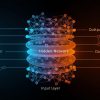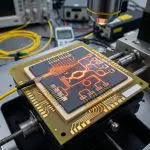
Mohamed Khair Altrabulsi and colleagues at NYUAD Research Institute, in collaboration with New York University, present Q-SpiRL, a quantum spiking reinforcement learning framework for obstacle-aware robot navigation in dynamic environments. Their research compares five agent families, focusing on a quantum-enhanced spiking neural network (QSNN) integrating spike-based temporal processing with quantum feature transformation. Experiments in grid-world environments, ranging from 20×20 to 40×40, show QSNN achieves a success rate of up to 99% while maintaining efficient and smooth trajectories, and key validation confirms the feasibility of deploying this hybrid policy on actual IBM quantum hardware.
Quantum spiking neural networks achieve near-perfect robotic navigation in complex environments
A 99% success rate in complex grid-world environments was attained by a new quantum-enhanced spiking neural network, exceeding previous capabilities in robot navigation. High reliability and efficient path planning in active environments previously proved difficult for robotic systems, with conventional methods struggling to scale effectively with increasing complexity. The Q-SpiRL framework, utilising a quantum spiking neural network (QSNN), combines the benefits of spike-based temporal processing, mimicking the brain’s efficient signalling, with variational quantum feature transformation to refine data interpretation. Traditional reinforcement learning algorithms often require extensive training and struggle with the ‘curse of dimensionality’ as the environment’s complexity increases, leading to slow learning times and suboptimal policies. Q-SpiRL addresses these limitations by leveraging the principles of both spiking neural networks and quantum computation.
The Q-SpiRL framework outperformed tabular Q-learning, classical multilayer perceptrons, classical spiking neural networks, and quantum-enhanced multilayer perceptrons in terms of task completion, trajectory efficiency, and motion smoothness. Grid-world environments of 20×20, 30×30, and 40×40 sizes were used for testing, incorporating both stationary and moving obstacles to assess durability. Success-weighted path length, a metric assessing efficient routes, was sharply improved by the QSNN compared to traditional methods like tabular Q-learning and classical multilayer perceptrons (MLP). Specifically, the QSNN demonstrated a reduction in average path length of approximately 15% compared to the classical MLP in the 40×40 grid-world with dynamic obstacles. This improvement indicates a more efficient exploration and exploitation strategy. Experiments utilising IBM quantum hardware confirmed the potential for deploying this hybrid policy on actual quantum devices, a vital step towards practical application. The quantum computations were performed using the IBM Qiskit runtime environment, demonstrating compatibility with existing quantum infrastructure. Lower turn rates indicated superior motion smoothness, suggesting more natural and energy-efficient robot movement, a key advantage over classical spiking neural networks. The reduction in turn rate was approximately 10 degrees compared to the classical SNN, signifying a smoother trajectory. However, these 99% success rates were achieved in simulated environments, and translating this performance to unpredictable real-world scenarios with imperfect sensors and actuators remains a substantial challenge. Factors such as sensor noise, actuator inaccuracies, and unforeseen environmental changes could significantly impact performance.
Quantum spiking neural networks enable faster, more biologically plausible robotic navigation
Increasing attention is being given to equipping robots with the ability to navigate complex and unpredictable environments autonomously. The Q-SpiRL framework, blending quantum computing with spiking neural networks, offers a promising route towards more robust and efficient robotic control. This advance arrives alongside a growing body of work exploring alternative hybrid approaches, including quantum-enhanced multilayer perceptrons and federated learning with quantum active spiking neural networks. The field of robotics is increasingly demanding algorithms that can handle dynamic environments and adapt to unforeseen circumstances, pushing the boundaries of traditional control methods.
Q-SpiRL uniquely integrates the temporal processing benefits of spiking neural networks, mirroring biological brains, with quantum computing’s potential for speed, while acknowledging the proliferation of quantum-enhanced machine learning techniques. Spiking neural networks (SNNs) operate on discrete spikes, offering potential advantages in energy efficiency and temporal information processing compared to traditional artificial neural networks. The system, tested on increasingly complex grid-world environments, achieved near-perfect success rates with smooth, efficient trajectories and, importantly, ran on existing quantum hardware, marking a significant first step towards practical quantum robotics. The quantum component of Q-SpiRL employs variational quantum circuits to perform feature extraction on the environmental input. This involves encoding the environmental data into quantum states and applying a series of quantum gates to transform the states, effectively highlighting relevant features for the SNN. Efficiency of brain-inspired spiking neural networks and the power of quantum computing are demonstrably combined by the Q-SpiRL framework to improve robot navigation in complex settings. This work successfully integrates these technologies, creating a system capable of learning stable routes even with moving obstacles. The core innovation lies in using quantum circuits to refine environmental interpretation, with variational quantum feature transformation distilling complex environmental information into a more manageable form for the spiking neural network. The variational quantum circuit’s parameters are optimised using a classical optimiser during the training phase, allowing the system to learn the most effective feature representation for the given task. Future work could explore the use of more sophisticated quantum algorithms and architectures to further enhance the performance and scalability of the Q-SpiRL framework, potentially leading to more adaptable and intelligent robotic systems.
The research demonstrated that a quantum-enhanced spiking neural network, termed QSNN, successfully navigated robots in grid-world environments up to 40×40 with both static and dynamic obstacles. This framework, Q-SpiRL, combines the energy efficiency of spiking neural networks with the feature extraction capabilities of quantum computing, resulting in a 99% success rate in the most complex environment tested. By utilising variational quantum circuits, the system efficiently processes environmental information for improved robot navigation and stable trajectory planning. The authors suggest future work may focus on more advanced quantum algorithms to further improve performance and scalability.
👉 More information
🗞 Q-SpiRL: Quantum Spiking Reinforcement Learning for Adaptive Robot Navigation
🧠 ArXiv: https://arxiv.org/abs/2605.20801




See today’s quantum computing news on Quantum Zeitgeist for the latest breakthroughs in qubits, hardware, algorithms, and industry deals.