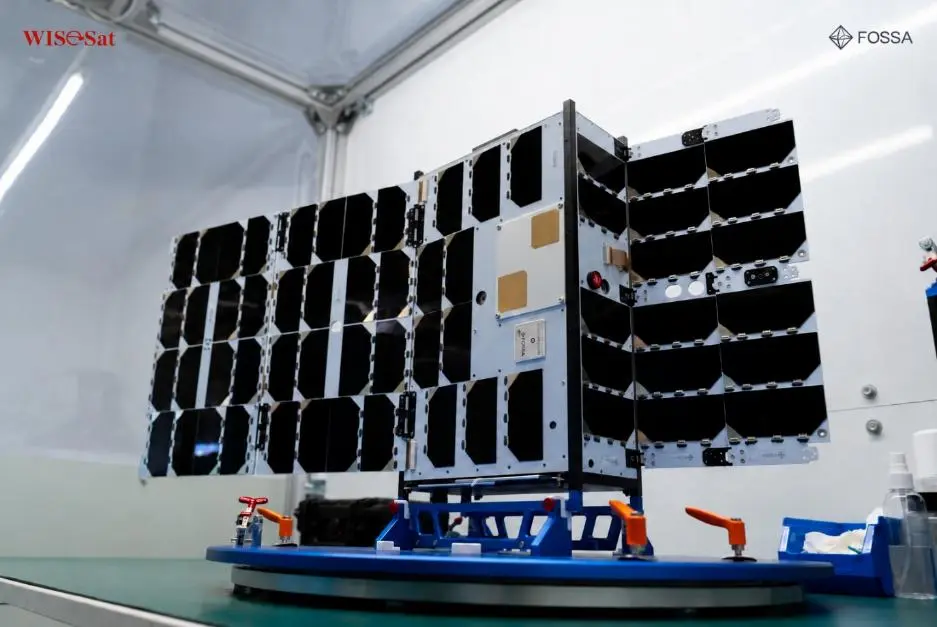
A 6U satellite, FOSSASAT-2E27, is now in orbit following launch aboard a SpaceX Falcon 9 Bandwagon-5 mission, expanding opportunities for in-orbit testing of cybersecurity technologies. WISeSat. Space WISeSat.Space Holdings Corp. announced the deployment of the satellite, developed with partner FOSSA Systems, which integrates VaultIC secure-element technology Corp. (Nasdaq: LAES) to strengthen resilience against cyber and quantum threats. “Building quantum-resilient space infrastructure requires a clear path from technology development to demonstrated performance in orbit,” said Carlos Moreira, CEO of WISeSat.
Space. WISeSat and FOSSA intend to pursue more systematic and demanding in-orbit testing protocols for security technologies under an extended technical collaboration covering up to six selected FOSSA satellite missions.
FOSSASAT-2E27 Launch Validates SEALSQ Security Technologies In Orbit
FOSSASAT-2E27 provides a further opportunity to advance WISeSat’s technology-validation roadmap, building on years of cooperation to integrate hardware-based cybersecurity into satellite systems. The mission illustrates the value of a strategic industrial relationship established in 2021 through WISeQey Corp’s original investment in FOSSA and reinforced by WISeSat’s participation in FOSSA’s latest financing round in June 2026.
WISeSat and FOSSA intend to pursue more systematic and demanding in-orbit testing protocols for security technologies, including repeatable functional testing, performance monitoring and analysis under actual space operating conditions. The collaboration is expected to support the progressive validation of VaultIC secure elements and, subject to technical readiness and integration, the QS7001 secure element.
The launch of FOSSASAT-2E27 builds upon a strategic partnership established in 2021, initially through WISeQey Corp’s investment in FOSSA and further solidified by WISeSat’s participation in FOSSA’s June 2026 financing round. This sustained investment emphasises a commitment to systematic in-orbit validation, moving beyond isolated tests to a more rigorous and repeatable process.
The collaboration is not limited to VaultIC; plans are underway to integrate and validate the QS7001 secure element, anticipating the growing demand for quantum-resistant technologies. “We have worked together for several years to bring advanced semiconductor security technologies into space, and our new 6U platform creates further opportunities to expand that work.
With the next phase of our collaboration, we intend to move toward more systematic in-orbit testing and validation, building the technical experience required for increasingly sophisticated secure satellite applications.” The timing of this expanded testing program coincides with a broader shift toward cybersecurity, particularly in response to U.S. Executive Order 14412 issued on June 22, 2026. That order establishes an accelerated framework for federal migration to cryptography, with implementation requirements scheduled to begin in 2030.
WISeSat anticipates that demonstrable performance in orbit will become a critical differentiator as governments and critical infrastructure operators seek to secure their communications against future quantum threats, the company says. Carlos Moreira, CEO of WISeSat.Space, commented: “This planned mission represents the next step in that process by providing another platform to evaluate security technologies under real operating conditions.” Gwenaël Rouy-Poirier, Group CFO of WISeSat.Space, highlighted the strategic rationale behind the partnership, noting that the launch exemplifies the company’s approach to accelerating technology validation while maintaining capital discipline.
The FOSSASAT-2E27 mission also incorporates software-defined radio capabilities, onboard AI processing and an electric-propulsion demonstration, showing the evolving capabilities of FOSSA’s satellite platforms. This comprehensive testing program supports WISeSat’s broader roadmap to develop orbital infrastructure intended to support planned Quantum Spatial Orbital Cloud and other secure communications applications, positioning the companies to capitalize on the emerging market for quantum-resistant space-based security solutions.
We have worked together for several years to bring advanced semiconductor security technologies into space, and our new 6U platform creates further opportunities to expand that work.
Julián Fernández, CEO and Co-founder of FOSSA Systems




See today’s quantum computing news on Quantum Zeitgeist for the latest breakthroughs in qubits, hardware, algorithms, and industry deals.