

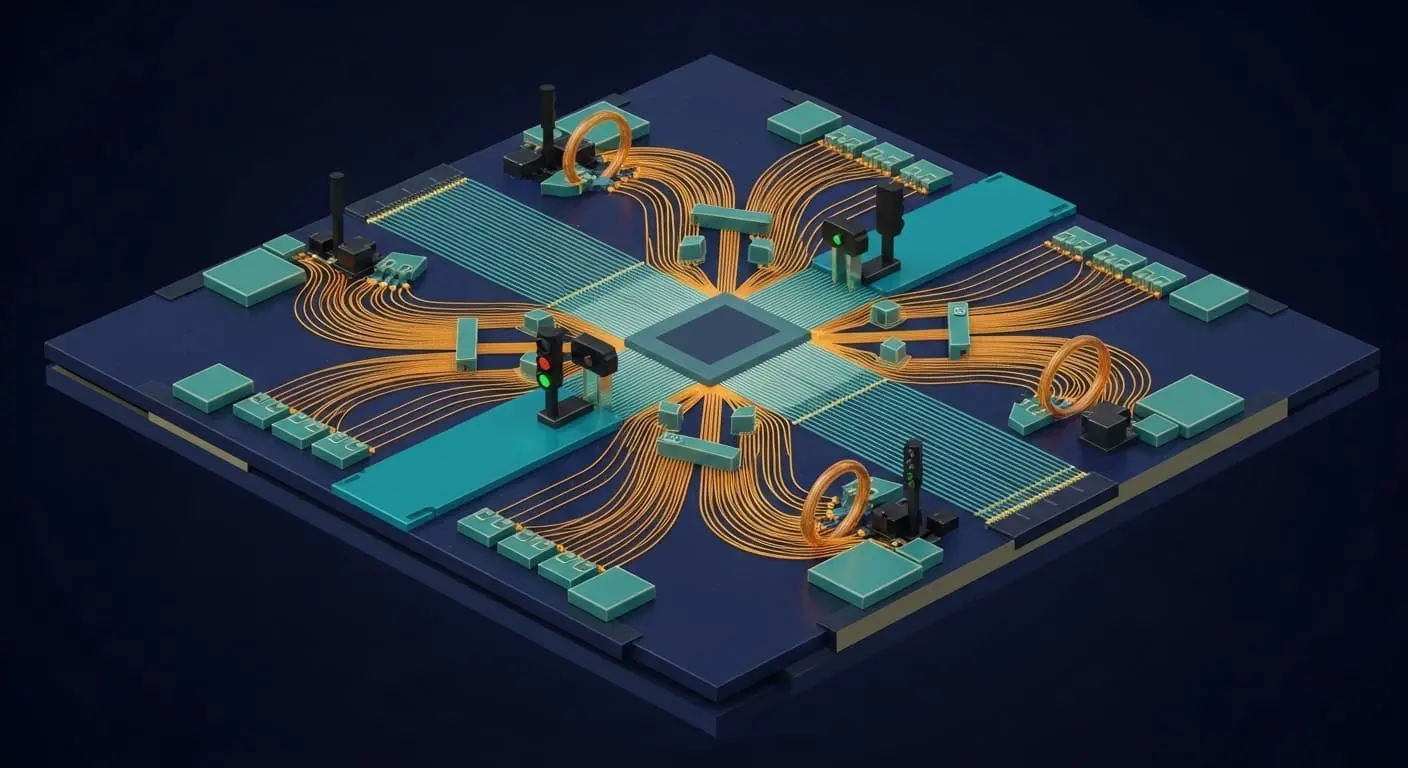
Volkan Gurses and colleagues at the California Institute of Technology have created a new integrated photonic-electronic quantum-limited coherent receiver delivering key performance metrics including 14.0 dB shot noise clearance and a 90.2 dB common-mode rejection ratio. The device sharply advances quantum transceiver development, demonstrating a 32-channel array and achieving squeezing below the shot noise limit. It enables communication schemes that may exceed the Shannon limit and ultimately approach the fundamental Holevo limit for channel capacity.
Squeezed light receiver achieves record noise clearance and signal fidelity
A quantum-limited coherent receiver attained 14.0 dB shot noise clearance, a substantial improvement over previous designs and a key threshold for sensitive signal detection. This metric represents the extent to which the receiver’s noise floor is reduced below the level of classical shot noise, which is inherent in all optical measurements. Classical shot noise arises from the discrete nature of photons and fundamentally limits the sensitivity of conventional receivers. The principle behind this advancement lies in the utilisation of squeezed light, a non-classical state of light where the quantum fluctuations in one quadrature (amplitude or phase) are reduced at the expense of increased fluctuations in the other. This manipulation allows for enhanced signal clarity in specific applications, effectively circumventing the limitations imposed by standard quantum noise. The integrated photonic-electronic nature of the device is crucial, as it allows for compact and stable implementation of these quantum techniques, overcoming challenges associated with free-space optical systems.
The 32-channel array scaled this performance to a median 26.6 dB shot noise clearance, demonstrating the potential for parallel signal processing and increased data throughput. Each channel operates independently, allowing for simultaneous reception of multiple signals. This scalability is vital for building high-capacity communication links. Automatic common-mode rejection ratio correction yielded a median 76.8 dB common-mode rejection ratio, enabling more robust signal processing. Common-mode noise refers to unwanted signals that are present in all channels simultaneously, often originating from environmental factors or imperfections in the system. A high CMRR indicates the receiver’s ability to effectively suppress these interfering signals, improving the signal-to-noise ratio and enhancing the reliability of data transmission. The automatic correction algorithm dynamically adjusts the receiver’s parameters to minimise common-mode noise, further optimising performance.
With a 2.57 gigahertz 3-dB bandwidth, the device can accurately process signals within a defined range of frequencies. This bandwidth determines the rate at which information can be transmitted and received. A wider bandwidth allows for faster data transfer, but also increases the susceptibility to noise. The device’s performance is, in effect, restricted by fundamental quantum noise, as confirmed by a 3.50 gigahertz shot-noise-limited bandwidth. This signifies that the receiver’s sensitivity is ultimately limited by the inherent quantum fluctuations of light, rather than by classical noise sources. Characterisation of the receiver’s sensitivity revealed a 520 microwatt knee power, indicating the threshold for detecting weak signals. The ‘knee power’ represents the minimum signal strength required to achieve a specific bit error rate, a crucial parameter for evaluating the performance of a communication system. A lower knee power indicates higher sensitivity. A high 90.2 dB common-mode rejection ratio (CMRR) was also achieved, signifying the receiver’s ability to filter out unwanted, interfering signals, and this was further improved to a median 76.8 dB CMRR with automatic correction in the 32-channel array. This robust noise rejection is essential for maintaining signal integrity in noisy environments. Measurements confirmed 0.15±0.01 dB of squeezing, a reduction in noise below the standard quantum limit, although this performance is currently constrained by losses in components outside the integrated receiver itself. Squeezing is a key indicator of the quantum nature of the receiver and its ability to surpass classical limitations.
Integrated quantum receiver advances demonstrate potential for exceeding data transmission limits
The relentless drive for faster data transmission has long focused on squeezing more information from existing channels. Traditional approaches have largely relied on increasing signal power or improving modulation schemes, but these methods are often limited by physical constraints and regulatory restrictions. This new receiver represents a step towards that goal by enhancing signal clarity through quantum techniques, offering a viable path towards integrated quantum receivers. The Shannon limit, a fundamental theorem in information theory, defines the maximum rate at which information can be reliably transmitted over a noisy channel. Achieving 14.0 dB shot noise clearance and scaling to a 32-channel array establishes a foundation for communication systems potentially exceeding the Shannon limit, a long-standing benchmark in information theory. By reducing the noise floor, the receiver effectively increases the signal-to-noise ratio, allowing for higher data rates without compromising reliability.
These advances pave the way for potentially reaching the theoretical Holevo limit for data transmission capacity. The Holevo limit, a more stringent bound than the Shannon limit, considers the quantum nature of the communication channel and the use of quantum states for encoding information. It represents the ultimate limit on the amount of information that can be transmitted through a given channel, even with optimal quantum encoding and decoding strategies. While current squeezing measurements are hampered by signal losses occurring outside the integrated receiver, specifically in the optical connections and detection circuitry, this work nonetheless establishes an important building block for future communication networks. These external losses degrade the squeezed state, reducing the overall performance gain. Further research will focus on minimising these external losses through improved component design and integration techniques, such as monolithic integration of all optical and electronic components onto a single chip. This will fully realise the potential of this approach and unlock even greater gains in signal fidelity and data throughput, potentially revolutionising long-distance communication and secure data transmission.
The researchers demonstrated an integrated photonic-electronic quantum-limited coherent receiver achieving 14.0 dB shot noise clearance and a 32-channel array with 26.6 dB median clearance. This matters because reducing noise in a receiver improves the signal, enabling potentially higher data transmission rates without errors. The system surpassed the Shannon limit, a key benchmark in information theory, and the authors suggest this work provides a pathway towards achieving the more stringent Holevo limit for communication capacity. They intend to minimise signal losses through improved integration of components to further enhance performance.
👉 More information
🗞 Quantum coherent transceivers toward Holevo-limited communications
🧠 ArXiv: https://arxiv.org/abs/2604.07087



See today’s quantum computing news on Quantum Zeitgeist for the latest breakthroughs in qubits, hardware, algorithms, and industry deals.



