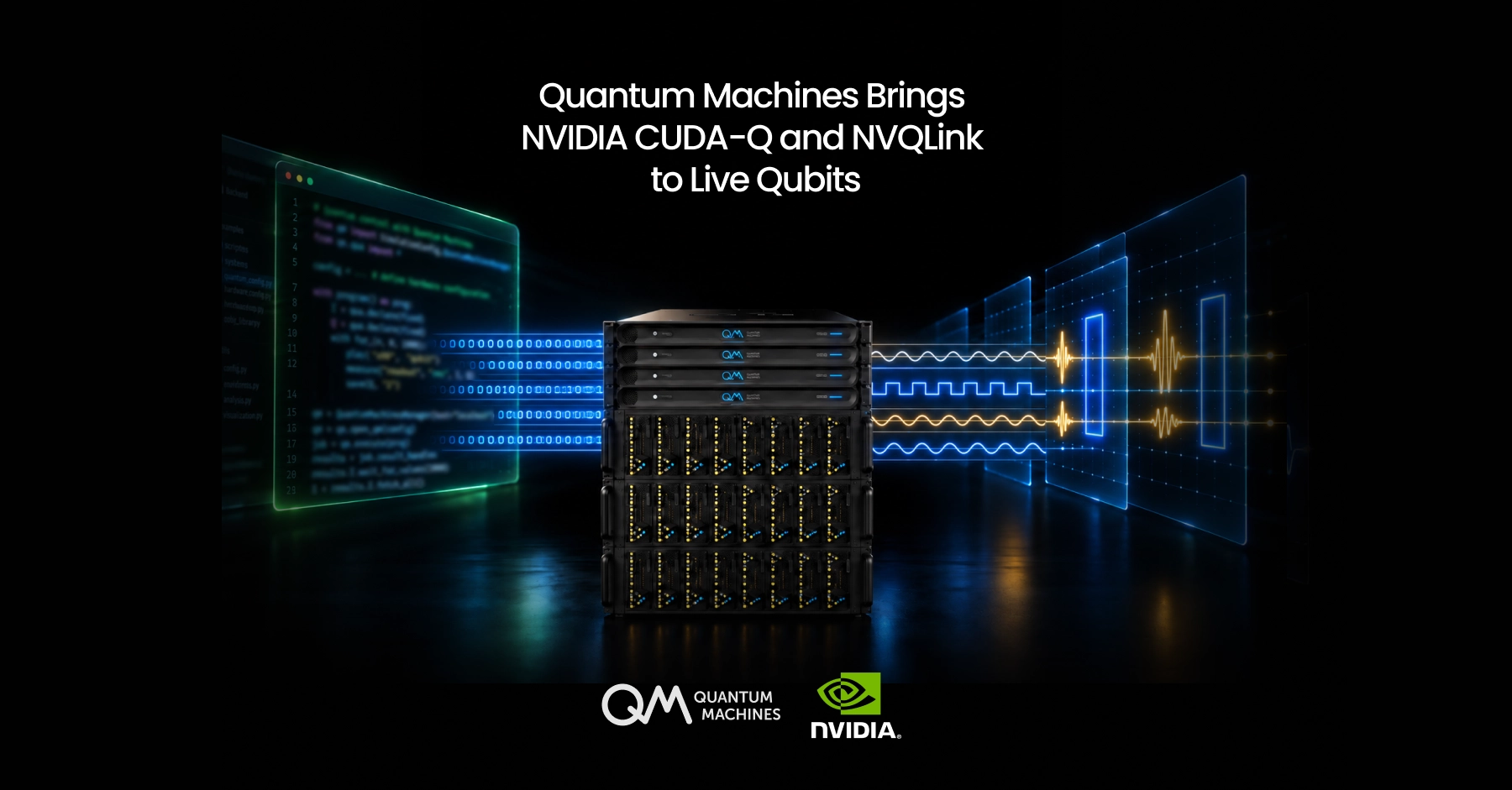
September 2026 marks the first time a control company has run an end-to-end NVIDIA CUDA-Q program across live qubits and a Quantum Machines Pulse Processing Unit classical processor with NVIDIA NVQLink. This demonstration showcases a fully integrated quantum-classical workflow, completing the full exchange in approximately one millionth of a second.
The advance simplifies quantum programming by allowing developers to utilize familiar languages like Python and C++, eliminating the need for specialized low-level hardware control. “We have been working closely with NVIDIA for a long time and are very happy to see these technologies and tools come together to enable quantum developers and allow them to move faster towards realizing large-scale quantum computers,” says Yonatan Cohen, CTO of Quantum Machines.
CUDA-Q Simplifies Quantum Program Execution Across QPUs, GPUs, and CPUs
The ability to execute a single program across quantum and classical processors has moved closer to reality with the integration of Quantum Machines’ control stack and NVIDIA’s CUDA-Q platform, facilitated by NVQLink’s microsecond-speed connection. Previously, developers faced the challenge of hand-coding low-level control sequences, a task demanding specialist quantum-hardware expertise; now, CUDA-Q abstracts much of this complexity, allowing code to be written once and deployed across heterogeneous hardware. The system routes each task seamlessly to the appropriate processor, quantum processing unit, GPU, or CPU, reducing time-to-value for both research and commercial applications.
This integration builds on a trend of increasingly unified computing architectures, mirroring the evolution of GPUs from specialized accelerators to integral components alongside CPUs, NVIDIA says. Sam Stanwyck, Director of Quantum Product at NVIDIA, highlighted the potential for future supercomputers operating with this integrated approach, stating, “Quantum processors become transformative when working tightly alongside GPUs and CPUs as a single unified quantum supercomputing system.” Quantum Machines has embedded NVIDIA NVQLink within its Orchestration Platform, establishing a low-latency link between the hardware controlling qubits and NVIDIA’s accelerated computing infrastructure. This speed is critical, enabling measurement data to reach classical processors and decisions to return to the quantum control system in microseconds, a timeframe essential for demanding workloads like real-time quantum error correction.
The architecture allows developers to write quantum applications in languages like Python, C++, or QUA, with Quantum Machines’ control system translating those operations into the precisely timed signals needed to manipulate and measure qubits. This conversion happens dynamically, allowing CPUs and GPUs to be invoked in real time during quantum operations. NVIDIA and Quantum Machines have collaborated on low-latency QPU-GPU integrations for some time, and this NVQLink implementation represents the latest step toward scalable, application-driven quantum deployments.
We have been working closely with NVIDIA for a long time and are very happy to see these technologies and tools come together to enable quantum developers and allow them to move faster towards realizing large-scale quantum computers.
Yonatan Cohen, CTO of Quantum Machines
NVQLink Enables Microsecond-Speed Quantum-Classical Data Exchange
NVQLink establishes a connection capable of transferring data between a quantum controller and GPUs in less than one millionth of a second, a speed critical for complex hybrid applications. The integration significantly reduces the specialist expertise needed to program quantum processors by automating tasks that previously required deep knowledge of quantum hardware and eliminating the need for hand-coding low-level control sequences. The company’s CUDA Quantum platform and DGX Quantum systems provide the infrastructure for these hybrid workflows, supported by partnerships with companies like Quantinuum, QuEra Computing, and IonQ.
NVIDIA’s investment in QuEra, announced in 2025, and the subsequent support for QuEra hardware within CUDA-Q, exemplifies this commitment to integrating diverse quantum architectures. NVIDIA reported in July 2026 a quantum calibration model functioning across six qubit modalities, highlighting ongoing efforts to improve system-wide performance and compatibility. This collaborative ecosystem, combined with the speed of NVQLink, positions quantum computing closer to practical, scalable applications.
Quantum Machines’ Platform Integrates NVQLink for Low-Latency Control
The company’s approach mirrors the evolution of GPUs themselves, integrating quantum processing units as another resource applications can access when needed, moving beyond isolated experimentation. When developers utilize CUDA-Q, Quantum Machines’ system dynamically translates operations into precisely timed signals that control and measure qubits, eliminating the traditionally arduous task of hand-coding these sequences and lowering the barrier to entry for quantum programming and accelerating algorithm development. NVIDIA’s partnerships with companies like QuEra Computing, Rigetti, and IonQ, alongside its investment in QuEra, demonstrate a commitment to building a collaborative ecosystem around CUDA-Q and NVQLink.
Quantum processors become transformative when working tightly alongside GPUs and CPUs as a single unified quantum supercomputing system.
Sam Stanwyck, Director of Quantum Product at NVIDIA


See today’s quantum computing news on Quantum Zeitgeist for the latest breakthroughs in qubits, hardware, algorithms, and industry deals.