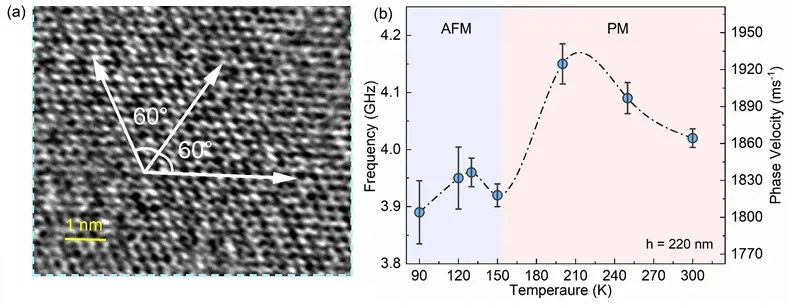
Researchers at UCLA and Auburn University report the measurement of a connection between atomic vibrations and quantum spin in the semiconductor nickel phosphorous trisulfide. The team found that acoustic phonons, vibrations carrying heat and sound, slowed down around -180 degrees Fahrenheit, coinciding with a shift in the material’s electron spin organization. This correlation, observed using a custom-built technique at the California NanoSystems Institute, indicates that magnetic order affects vibrational travel and may lead to more energy-efficient AI chips resistant to overheating.
Nickel Phosphorous Trisulfide Links Spin Order to Acoustic Phonons
The semiconductor nickel phosphorous trisulfide exhibited a distinct change in electron spin organization at approximately -180 degrees Fahrenheit, transitioning from a random arrangement to a zigzag pattern where adjacent electron poles oppose each other. Researchers observed that these acoustic phonons slowed down on the material’s surface at the same time as the shift in electron spin, a direct link previously unmeasured. This connection was revealed through custom-built instrumentation developed by Alexander Balandin, UCLA Samueli’s Fang Lu Endowed Chair in Engineering and a distinguished professor of materials science and engineering, and his team.
The team’s work extends beyond observation. Computer simulations corroborated the observed mechanisms, validating the interplay between quantum spins and acoustic phonons at temperatures below -180 Fahrenheit. The use of nickel phosphorous trisulfide, a semiconductor only a few atoms thick, was deliberate, offering a platform to explore the interaction of electrons, spins and phonons for potential gains in computing efficiency.
Linking acoustic phonons to quantum spin states opens new technological avenues, particularly for the development of more efficient artificial intelligence chips. Traditional microelectronics face limitations in managing heat generated during processing; exploiting the relationship between spin and phonons could offer a pathway to reduce energy consumption and prevent overheating. The research team suggests that new advanced measurement techniques could influence the future of AI and quantum computing.
Beyond AI, the findings may also benefit the advancement of quantum computers, promising enhanced cybersecurity and more accurate modeling of natural phenomena. The researchers’ work demonstrates a new capability for measurement using Brillouin-Mandelstam spectroscopy, potentially unlocking fundamental physics discoveries and unforeseen technologies.
BMS Spectroscopy Visualizes Quantum-Vibration Correlation for Future AI Chips
This specific temperature is notable because it represents a measurable point of change in quantum behavior at a relatively accessible, though still cryogenic, level. Researchers observed this shift in electron spin organization while investigating the interplay between these spins and acoustic phonons, vibrations propagating through the material. This correlation was visualized using Brillouin-Mandelstam spectroscopy, a technique now demonstrating a new capability for measurement by accessing information about acoustic phonons and their relationship with quantum properties.
The study revealed that below -180 degrees Fahrenheit, the connection between these quantum spins and the acoustic phonons became demonstrably stronger, suggesting a potential pathway for controlling energy flow within future computing architectures. Zahra Ebrahim Nataj, a doctoral candidate and the study’s first author, along with colleague Maedeh Taheri, a research engineer, led the investigation into this phenomenon.




See today’s quantum computing news on Quantum Zeitgeist for the latest breakthroughs in qubits, hardware, algorithms, and industry deals.