

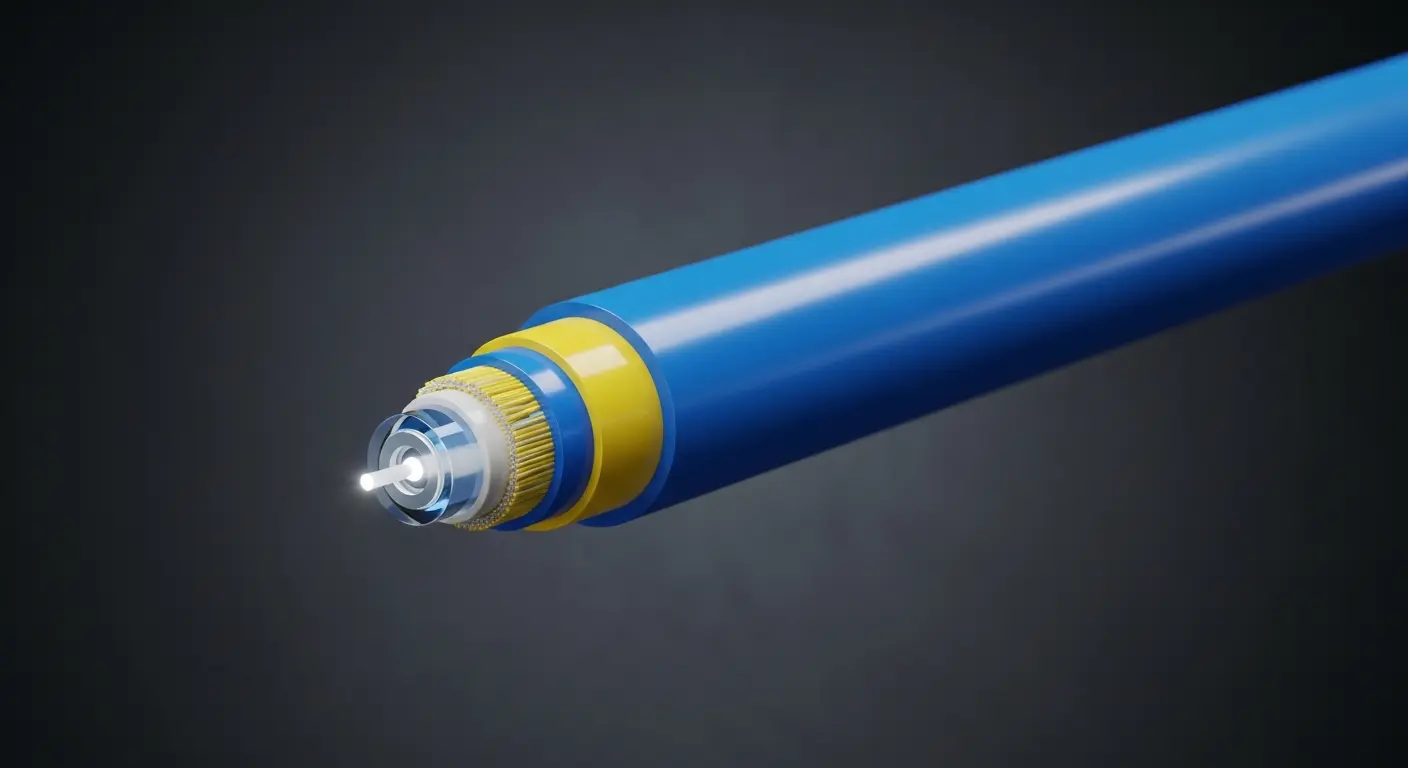
Scientists, led by A. I. Lvovsky and colleagues from University of Oxford, RTX BBN Technologies, University of Maryland, National University of Singapore, and 1 other institutions, have developed a theoretical framework that overcomes the diffraction limit in passive optical imaging. The framework treats imaging as a quantum measurement problem and identifies optimal detection strategies capable of recovering spatial information previously considered inaccessible due to quantum noise. These methods surpass conventional imaging in classifying, localising, and imaging incoherent sources below the Rayleigh limit, offering potential advancements in fields such as microscopy, astronomy, and optical sensing.
Recovering inaccessible spatial information via quantum-inspired optical measurement
Spatial-mode demultiplexing, analogous to a prism separating white light into its constituent colours, is central to this novel optical imaging technique. The process dissects incoming light into its individual spatial modes, essentially, the different paths light can take, enabling separate analysis of each component. This is crucial because each spatial mode carries information about the object being imaged. Careful measurement of these components, rather than simply capturing an image, extracts more information about the observed object. The technique treats imaging as a quantum measurement and estimation problem, akin to a detective using clues and statistical methods to deduce hidden details. Unlike traditional imaging which focuses on directly reconstructing an image, this approach focuses on optimally estimating the object’s properties from the received light.
This passive method circumvents the need for direct probe access or nonlinear optical effects, expanding its use to remote sensing and astronomy. Traditional super-resolution techniques often require actively illuminating the sample, which can damage delicate specimens or be impossible for distant astronomical objects. Quantum principles are now applied to optical imaging, exceeding classical limitations imposed by diffraction. Reformulating imaging as a quantum measurement and estimation problem allows recovery of previously inaccessible spatial information, enabling optimal detection strategies and potentially surpassing conventional imaging resolution. This opens possibilities for super-resolution imaging without active illumination or complex hardware, offering benefits where direct access is limited, such as in biological imaging or long-distance observation. The ability to passively gather information is particularly valuable in scenarios where disturbing the observed system is undesirable or impractical.
Quantum measurement techniques circumvent classical diffraction limitations
The diffraction limit has dictated resolution in passive optical imaging for one and a half centuries, stemming from the wave nature of light and the inevitable spreading of light waves as they propagate. This limit, approximately 0.61λ/NA (where λ is the wavelength of light and NA is the numerical aperture of the imaging system), defines the smallest feature that can be reliably distinguished. Now, a means of achieving resolution improvements exceeding a factor of two over conventional methods has been demonstrated theoretically. This breakthrough surpasses the longstanding barrier imposed by quantum noise, specifically shot noise arising from the discrete nature of photons, previously limiting the precision of any optical system. Reframing imaging as a quantum measurement problem unlocks the potential to recover spatial information once considered fundamentally inaccessible, paving the way for super-resolution imaging without active illumination or complex hardware.
This new approach optimises light detection and analysis using quantum principles, enabling sharper images and more precise measurements. The theoretical framework utilises quantum Cramér-Rao bounds and Chernoff bounds to construct receivers, employing spatial-mode demultiplexing to separate light based on its spatial characteristics. Consequently, superior classification, localization, and imaging of incoherent light sources below the traditional resolution threshold are now possible. The quantum Cramér-Rao bound provides a fundamental benchmark for parameter-estimation imprecision, particularly in single-molecule microscopy, representing the absolute limit on how accurately a parameter can be estimated given the available data and noise. However, current experimental demonstrations have not yet fully closed the gap between theoretical quantum limits and practical imaging performance, indicating substantial engineering challenges remain before widespread application is feasible. These challenges include maintaining coherence of the spatial modes and developing detectors with sufficient sensitivity and bandwidth.
Advancing resolution through quantum-inspired data reconstruction
Optical imaging has been constrained by the diffraction limit for over a century, a fundamental barrier to resolution that has driven decades of research into overcoming its limitations. Rather than increasingly sophisticated hardware, a new approach prioritises intelligent data processing, extracting maximum information from available light. Achieving consistently quantum-limited resolution, the theoretical best possible, remains elusive, as experimental demonstrations still fall short of these ideals. This discrepancy arises from imperfections in optical components, detector noise, and the difficulty of accurately modelling the quantum state of the light. Despite not yet consistently reaching this theoretical peak, these quantum-inspired techniques represent a significant advance.
Conventional image processing extracts detail from existing light; this new approach fundamentally alters how information is captured, potentially revealing features previously obscured by noise. The key lies in treating the imaging process not as a simple recording of light intensity, but as a quantum measurement that inherently disturbs the system being observed. Even approaching these limits offers benefits in fields like microscopy, astronomy and optical sensing, enabling finer detail and improved analysis of samples and distant objects, while full quantum advantage remains a goal. A new model for optical imaging has been established, moving beyond the limitations imposed by the diffraction limit. By reframing image formation as a quantum measurement problem, strategies to recover spatial information previously obscured by inherent quantum noise in light have been identified. This approach opens avenues for improved classification, localisation, and imaging of very small, incoherent light sources, potentially revolutionising fields reliant on high-resolution imaging capabilities. The development of practical implementations will require significant advancements in quantum-enhanced detectors and signal processing algorithms.
The research demonstrated that imaging can be improved by treating it as a quantum measurement problem, allowing recovery of spatial information previously limited by the diffraction limit. This is significant because it offers a pathway to surpass conventional resolution limits by intelligently processing available light and minimising the effects of quantum noise. Researchers achieved this through theoretical frameworks like quantum Cramér-Rao and Chernoff bounds, alongside techniques such as spatial-mode demultiplexing. The authors suggest further work is needed to develop improved quantum-enhanced detectors and signal processing algorithms to fully realise these benefits in areas including microscopy, astronomy, and optical sensing.
👉 More information
🗞 Passive optical superresolution at the quantum limit
🧠 ArXiv: https://arxiv.org/abs/2605.10767


See today’s quantum computing news on Quantum Zeitgeist for the latest breakthroughs in qubits, hardware, algorithms, and industry deals.



