
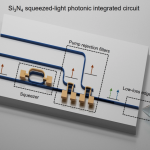
Scientists at University of Toronto, M. Sloan and J. E. Sipe, have developed a new non-perturbative description of squeezed light generation in coupled microring resonators, enabling near complete suppression of unwanted thermal noise and sharply enhancing signal generation. Their work focuses on two-ring photonic molecules, where the interference of optical fields within the coupled rings modifies the resonance spectrum, leading to improved performance. Hybridization effects between these resonators achieve near unit fidelities, representing a significant advancement and paving the way for more efficient quantum technologies. The research presents a key set of tools for improving squeezed light generation in complex, lossy structures, moving beyond previous perturbative approaches.
High fidelity squeezed light enabled by suppression of parasitic four-wave mixing
Near unit fidelities, exceeding 0.991, are now achievable in squeezed light generation, a substantial leap from previous limitations that typically resulted in fidelities below 0.8. This breakthrough surpasses a critical threshold for reliable quantum information processing, where even small errors accumulate rapidly, degrading the quantum state. Previously, unwanted noise, particularly stemming from parasitic four-wave mixing (FWM), corrupted the delicate quantum state, making such high-fidelity squeezed light unattainable. The generation of squeezed light relies on reducing quantum noise below the standard quantum limit, and FWM represents a significant source of such noise in these systems. Coupled microring resonators, manipulating light interference to enhance signal generation through hybridization effects, enabled this result. These resonators, typically fabricated from silicon nitride or silicon on insulator, support the confinement and circulation of light, enhancing light-matter interaction. An auxiliary resonator was strategically tuned to split unwanted resonances, effectively suppressing parasitic four-wave mixing, a non-linear optical process creating unwanted thermal noise, and achieving a fidelity exceeding 0.991. This tuning creates a destructive interference condition for the FWM process, minimising its contribution to the overall noise. Hybridization, achieved by carefully shifting a pump resonance, enhanced signal generation. The primary ring reporting an intrinsic quality factor of 3.4x 10⁶ and a loaded quality factor of 7.83x 10⁵. The intrinsic quality factor represents the rate of energy loss within the resonator itself, while the loaded quality factor accounts for external coupling losses. These high-Q values indicate minimal energy dissipation, crucial for maintaining coherence in the generated squeezed light. Careful control of parasitic four-wave mixing, utilising a dual-pump degenerate squeezing scheme with five resonances within the coupled microring resonators, strengthened fidelity levels. Degenerate squeezing involves generating correlations in the same frequency band, and the dual-pump configuration provides additional control over the squeezing process. This new approach promises to unlock more efficient and robust quantum technologies reliant on this refined light source, paving the way for advancements in sensing, metrology, and computation. The ability to generate high-fidelity squeezed states is particularly important for applications such as gravitational wave detection and quantum key distribution.
Five-resonance limitations impacting scalability of squeezed light generation
Methods for generating squeezed light, a delicate quantum state vital for technologies like enhanced sensors and quantum computers, are steadily improving. Achieving truly reliable squeezed light remains challenging, as this work highlights a reliance on approximating complex systems with just five resonances. This simplification, while enabling a tractable analytical description, may not hold true in more elaborate designs, raising questions about scalability and potentially introducing unforeseen complications to photonic circuits with numerous interconnected rings. The five-resonance approximation captures the dominant modes of interaction within the coupled system, but higher-order modes and interactions may become significant as the number of resonators increases. A more complete description would require considering a significantly larger number of resonances, leading to increased computational complexity. Furthermore, the impact of fabrication imperfections and disorder on the resonance spectrum is not fully accounted for within this simplified model. These imperfections can lead to mode mismatch and reduced squeezing efficiency.
This research establishes a general method for describing squeezed light generation within complex, interconnected photonic circuits. The resulting control over light’s properties now prompts investigation into scaling these designs to more intricate photonic structures and exploring the limits of strong coupling between individual resonators. Strong coupling occurs when the interaction between resonators is stronger than the rate of energy loss, leading to significant modifications in the resonance spectrum and enhanced light-matter interaction. The demonstrated near-complete suppression of unwanted noise and high fidelity output states establishes a key benchmark for future development. Further research will focus on developing more sophisticated numerical models and experimental techniques to address the limitations of the five-resonance approximation and explore the scalability of these devices. Understanding these limitations now accelerates progress towards practical quantum technologies, providing a solid foundation for building more sophisticated squeezed light sources even if scaling presents further hurdles. Investigating alternative designs, such as three-dimensional photonic structures, may also offer a pathway towards overcoming these limitations and achieving even higher levels of performance.
This research demonstrated near complete suppression of unwanted noise in squeezed light generation using coupled microring resonators. Controlling these properties is important because squeezed light is a vital resource for quantum technologies. By employing a dual-pump scheme and hybridization effects between resonators, researchers achieved near unit fidelities with the desired output state. The authors intend to develop more sophisticated models and experimental techniques to address the limitations of their current five-resonance approximation and explore the scalability of these devices.
👉 More information
🗞 Squeezing Enhancement Through Resonant Interference in Multi-ring Resonators
🧠 ArXiv: https://arxiv.org/abs/2605.10731



See today’s quantum computing news on Quantum Zeitgeist for the latest breakthroughs in qubits, hardware, algorithms, and industry deals.