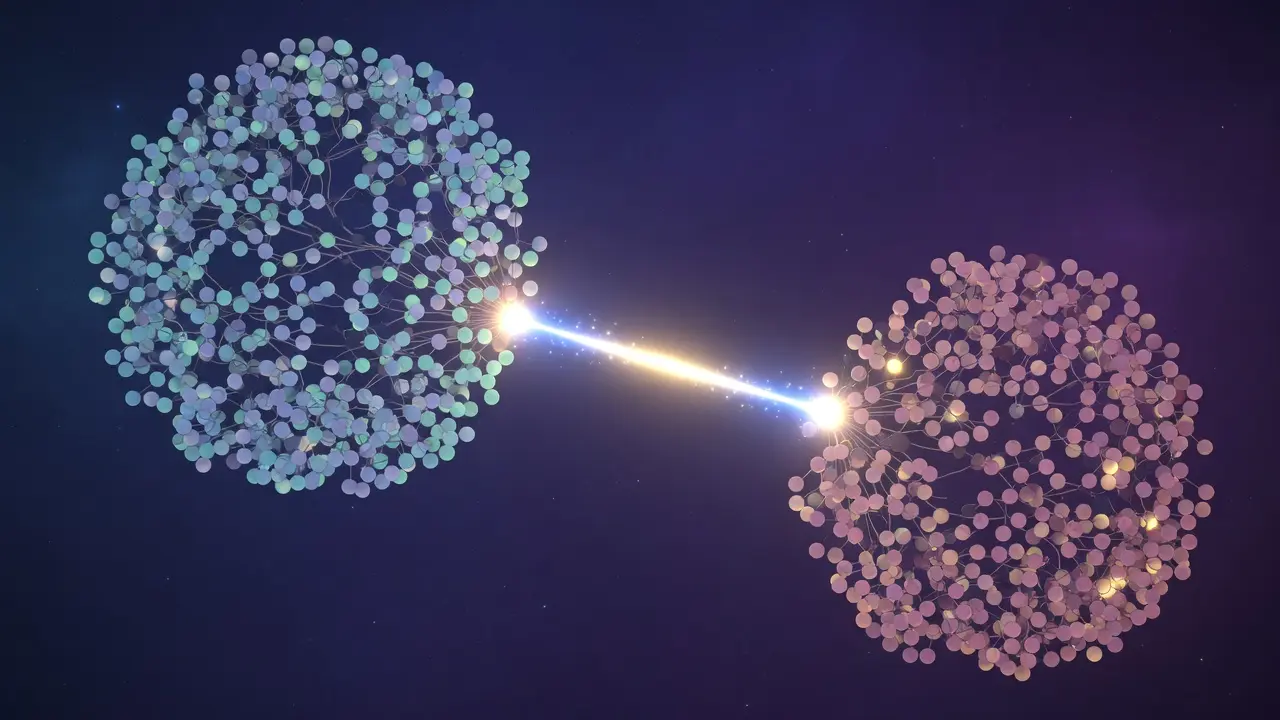
Diversity amplification factors of up to 11923 were achieved using a new hybrid approach combining quantum computing and classical algorithms. The team, from JIJ Inc., Amazon, and AWS Quantum Technologies, demonstrated that this method significantly expands the range of solutions for complex maximum independent set problems. Classical processing then recovers a median of 21% of all possible optimal arrangements within these problem sets; in six instances it recovered everything.
The team has pioneered a method combining quantum computing with conventional algorithms to greatly increase the number of diverse solutions found for complex problems; specifically, finding maximum independent sets within networks. By taking initial results generated by quantum hardware and expanding upon them using established computer processing techniques, they achieved diversity amplification, increasing the range of potential answers, by up to eleven thousand times in some cases.
The team has pioneered a hybrid method combining quantum computing with conventional algorithms to greatly increase the number of diverse solutions found for complex problems; specifically, finding maximum independent sets within networks, imagine trying to identify the largest group of people at a party where nobody knows each other.
Quantum computers can generate good initial answers but struggle to explore all possibilities due to sampling limitations, particularly when many equally valid solutions exist. To overcome this, researchers applied an algorithm akin to systematically tweaking an initial solution and exploring nearby options, known as Houdayer cluster updates, expanding upon results from QuEra’s Aquila device using established computer processing techniques. This boosted diversity by up to eleven thousand times across 43 problem instances, recovering a median of 21% of *all* possible optimal arrangements; in six cases they found every single one.
Quantum hybridization unlocks unprecedented diversity in maximum independent set solutions
Diversity amplification factors soared to 11923 with a new hybrid approach combining quantum computing and classical algorithms, an order of magnitude improvement over previous results for maximum independent set problems. Finding diverse optimal solutions had remained elusive due to fundamental sampling limitations in current quantum devices. Amazon and AWS Quantum Technologies validated the method on data from QuEra’s Aquila device across forty-three problem instances, recovering a median of 21% of all potential ground state arrangements; complete recovery was achieved for six individual cases where prior methods failed to map the entire solution space.
Analysis revealed that some unit disk graph instances possess between 10³ and 10⁶ distinct maximum independent sets, one containing almost two million optimal configurations, numbers which stress the scale of explored solution spaces. In six specific cases, classical post-processing uncovered complete ground state arrangements missed by earlier methods. Initial results from their Aquila processor combined with an algorithm called Houdayer cluster update allowed systematic exploration of potential solutions through classical processing techniques, achieving gains beyond those possible using quantum hardware alone.
Ground state knowledge limits broad applicability despite hybrid optimisation gains
This hybrid approach demonstrably expands solution sets for complex optimisation problems, finding larger groups where no two members know each other serves as a useful analogy, but it isn’t a universal fix. The method relies on prior knowledge of ground state degeneracies which won’t always be available in real-world scenarios; this dependence creates tension with ambitions to apply these techniques more broadly.
Estimating key properties beforehand can itself prove computationally expensive and negate any speedup gained from quantum processing, though acknowledging that pre-calculating those important ground state properties is demanding introduces a trade-off between classical processing time and potential quantum speedup for some problems. Nevertheless, the technique provides a valuable way to wring more performance from existing quantum devices, particularly given current hardware limitations where generating diverse solutions remains challenging.
This research demonstrated a hybrid approach combining quantum computing with a classical algorithm, the Houdayer cluster update, to improve solution diversity in maximum independent set problems. By using an Aquila processor alongside this post-processing step on forty-three problem instances, researchers amplified the number of distinct solutions by up to 11923x compared to relying solely on quantum measurements.
The method recovered a median of 21% of all possible ground state arrangements and completely mapped six previously incomplete solution spaces; these results suggest that classical processing can expand upon initial findings from quantum hardware. This work highlights how existing devices may be used more effectively when paired with established algorithms, despite limitations in generating varied solutions.
👉 More information
🗞 Efficient Ground-State Manifold Amplification for Rydberg Atom Arrays via Houdayer Cluster Updates
✍️ Andrew J. Ochoa (Affiliation: JIJ); Martin J. A. Schuetz (Affiliation: Amazon Advanced Solutions Lab); Helmut G. Katzgraber
🧠 ArXiv: https://arxiv.org/abs/2610.28528




See today’s quantum computing news on Quantum Zeitgeist for the latest breakthroughs in qubits, hardware, algorithms, and industry deals.