


This analysis encompasses five advanced QEC codes across three leading quantum processing unit hardware platforms. Bryan Pan and Yufeng Xin at the University of North Carolina have created a method for evaluating the performance of quantum error correction codes on different types of quantum computers.
The analytical framework quickly identifies the primary causes of errors within complex quantum systems, focusing on the structure of the code itself and the overhead from two-qubit operations. By pinpointing these key factors, the team’s work supports the development of more efficient designs for quantum computers. The team at Chapel Hill have developed an analytical framework for evaluating quantum error correction codes across various quantum computing systems.
This framework provides a rapid way to estimate logical error rates, pinpointing code structure and the burden of two-qubit operations as primary error sources; quantum error correction introduces redundancy to protect information from corruption. The team’s work extends beyond expensive simulations, offering insights into how to optimise designs for both single and distributed quantum computers, enabling multiple smaller machines to function as a more powerful one.
Framework accelerates quantum error correction analysis via circuit parameter abstraction
The team’s framework reduces the computational cost of assessing quantum error correction, achieving a five-fold improvement in estimating logical error rates compared to prior simulation methods. This breakthrough crosses a vital threshold, enabling rapid prototyping of quantum error correction schemes previously limited by extensive computational demands. Until now, detailed analysis required days or weeks of simulation time, hindering iterative design and optimisation.
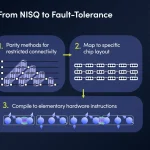
By abstracting complex quantum systems into key circuit-level parameters, the framework identifies code structure and two-qubit gate overhead as the dominant contributors to logical error, offering a pathway to targeted improvements. This analytical approach enables the exploration of design regions for distributed quantum error correction, which is important for linking multiple quantum processors into a more powerful, unified system. The approach accurately reproduced qualitative trends previously observed in larger-scale quantum simulations, confirming its reliability in predicting error behaviour.
Further analysis revealed that the framework can pinpoint the ‘sweet spot’ design region by optimising the balance between connectivity and noise across inter-processor links, a key step towards linking multiple quantum processors. Five families of advanced quantum error correction codes were evaluated: topological, subsystem stabilizer, concatenated, quantum low-density parity-check, and Floquet. These codes were categorised according to their structure and suitability for different hardware.
An analytical framework estimates logical error rates across hardware platforms and distributed quantum computing systems, considering code structure and two-qubit gate overhead. The framework offers a fast estimation of logical error rates and identifies key factors such as circuit volume or routing overhead. Despite decades of theoretical development, building practical, scalable quantum systems remains challenging. Engineers can now explore a wider range of possibilities before committing to complex, resource-intensive simulations, offering a sharply faster method for evaluating quantum error correction codes and bypassing the need for extensive computer time.
Such speed is important for rapidly prototyping and refining designs. This analytical framework represents a new approach to evaluating quantum error correction, moving beyond computationally intensive simulations to rapidly assess code performance across diverse hardware. By pinpointing code structure and the operational burden of two-qubit gates as key influences on error rates, the team’s work provides a means to optimise designs for both single and distributed quantum systems; distributed quantum computing links multiple smaller machines to function as a more powerful one. Validating the framework against existing simulation data confirms its reliability and opens questions regarding the interaction between circuit complexity and error propagation.
The research successfully estimates logical error rates for five families of advanced quantum error correction codes across various quantum computing systems. This analytical framework offers a faster method for evaluating these codes by considering code structure and the impact of two-qubit gates, bypassing the need for extensive simulations. The framework identifies key factors influencing error rates, such as circuit volume and routing overhead, and can optimise designs for both single and distributed quantum systems. Authors demonstrated the framework’s ability to find the optimal balance between connectivity and noise in distributed quantum computing, which is critical for linking multiple quantum processors.
👉 More information
🗞 A Cross-Platform Analysis of High-Performance Quantum Error Correction Codes
✍️ Bryan Pan and Yufeng Xin
🧠 ArXiv: https://arxiv.org/abs/2607.04082


See today’s quantum computing news on Quantum Zeitgeist for the latest breakthroughs in qubits, hardware, algorithms, and industry deals.



