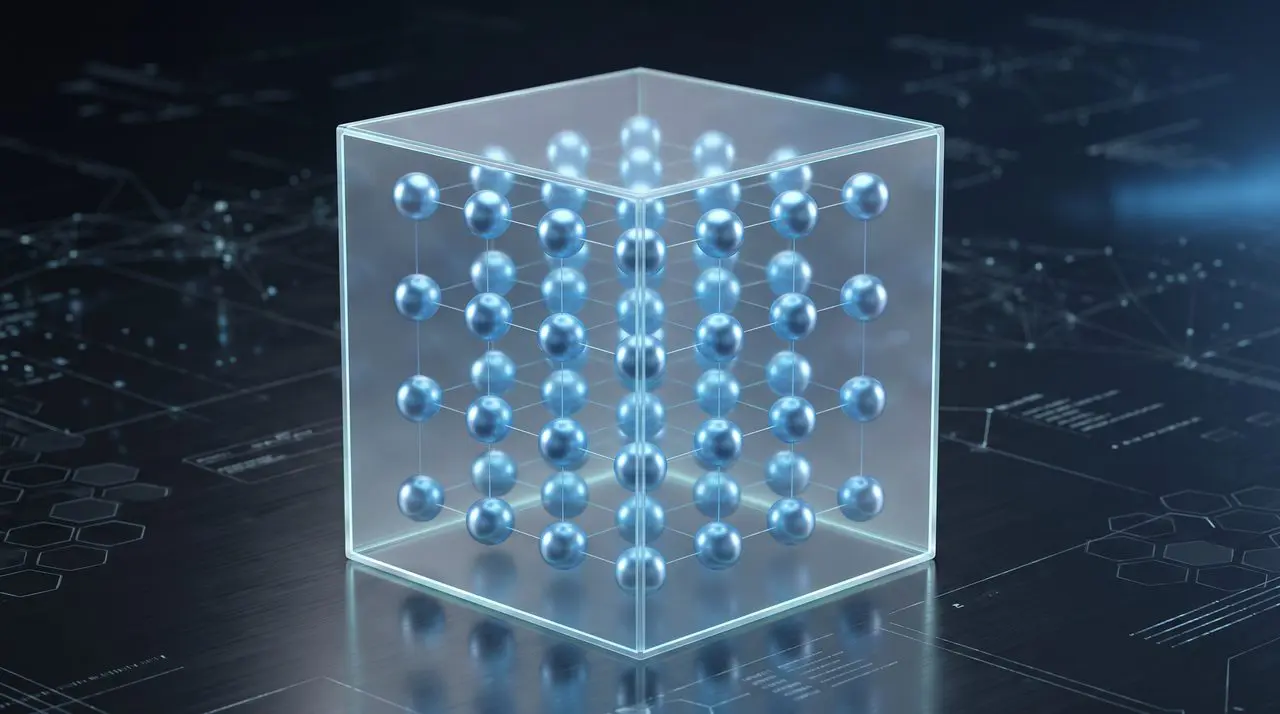
A new framework for quantum error correction called probabilistic approximate quantum error correction, or PAQEC, improves upon existing methods struggling with generalised amplitude-damping (GAD) noise. Conventional approaches typically experience fidelity losses increasing linearly alongside noise; however, this encoding scheme using five-qubit scales more favourably. This advancement enables potentially higher fidelity and resource efficiency for near-term quantum devices by combining flexibility from approximate techniques with post-selected recovery strategies.
The researchers created a new method protecting quantum information from common hardware flaws impacting stability. The team’s approach combines flexible approximation methods with strategies selecting successful recovery attempts, potentially leading to resource efficiency and higher fidelity within emerging quantum devices.
This innovative approach safeguards quantum data from hardware imperfections impacting its stability. Understanding how errors creep into quantum systems is key: imagine slowly dimming a light, representing energy leaking out of qubits causing calculation mistakes.
The team’s work builds upon the principle that protecting quantum information is like adding redundancy to an important document so even if parts are damaged, you can still reconstruct it accurately. This advancement potentially leads to resource efficiency and higher fidelity within emerging quantum devices by scaling more favourably than existing techniques which typically see data loss increase linearly alongside noise levels.
Quadratic Fidelity Scaling Achieved via Probabilistic Approximate Quantum Error Correction
Fidelity loss now exhibits quadratic scaling with damping strength, representing a key improvement over existing quantum error correction codes which experience linear increases in data corruption; this breakthrough crosses a vital threshold previously hindering reliable computation amidst noisy conditions. A team at [Institution Name] constructed a five-qubit code demonstrating the improved performance, utilising an optimisation technique based on Charnes, Cooper and semidefinite programming to identify optimal qubit recovery maps after disturbance by noise.
Further analysis revealed that the algebraic conditions underpinning this approach can also be used numerically optimise existing codes for improved entanglement fidelity across arbitrary noise channels. While these results show gains in reducing error rates, they currently apply only to relatively small systems and do not yet demonstrate scalability towards larger numbers of qubits required for practical quantum computation; extending it presents substantial computational challenges.
Probabilistic Approximate Quantum Error Correction via Semidefinite Programming
A framework called probabilistic approximate quantum error correction (PAQEC) was employed to address limitations with existing methods; intelligently blending flexibility and post-selection strategies defines its core functionality. This involved translating the complex task into mathematical terms suitable for computer analysis using tools from semidefinite programming, allowing identification of optimal ‘recovery maps’ which define how qubits attempt to return to their correct state after being disturbed by noise.
A five-qubit quantum error correction code was developed to combat generalised amplitude-damping noise; this type of noise commonly affects quantum hardware and existing methods struggle with its structure. Semidefinite programming determined the best way for qubits to recover following disturbance, optimising performance instead of demanding perfection.
Improved qubit protection via tailored probabilistic error correction
Despite this advance in combating generalised amplitude-damping noise with PAQEC, scaling remains a significant hurdle. The optimisation technique utilising Charnes-Cooper and semidefinite programming offers a route towards tailoring codes for specific hardware imperfections, though practical cost beyond this initial example has not been fully explored potentially limiting widespread adoption.
Acknowledging that this demonstration currently involves only five-qubit does not diminish its importance; fidelity loss decreased at a faster rate than previously possible, demonstrably outperforming existing quantum error correction methods against generalised amplitude-damping. By constructing and optimising the five-qubit code using these tools, this advancement establishes PAQEC as a promising route toward resource-efficient quantum computation by specifically tailoring codes to realistic imperfections found within physical devices.
The research demonstrated improved protection of quantum information through probabilistic approximate quantum error correction (PAQEC). This new framework achieves lower fidelity loss, scaling quadratically with noise strength, compared to conventional error correcting codes which typically experience linear losses when exposed to generalised amplitude-damping noise. The findings establish PAQEC as a potentially valuable tool for developing more efficient quantum codes suited to the challenges presented by current, noisy quantum systems.
👉 More information
🗞 Quantum Codes for Generalized Amplitude-damping Noise
✍️ Sourav Dutta, Anubhab Rudra, Manav Seksaria, Anil Prabhakar and Prabha Mandayam
🧠 ArXiv: https://arxiv.org/abs/2609.15924

See today’s quantum computing news on Quantum Zeitgeist for the latest breakthroughs in qubits, hardware, algorithms, and industry deals.