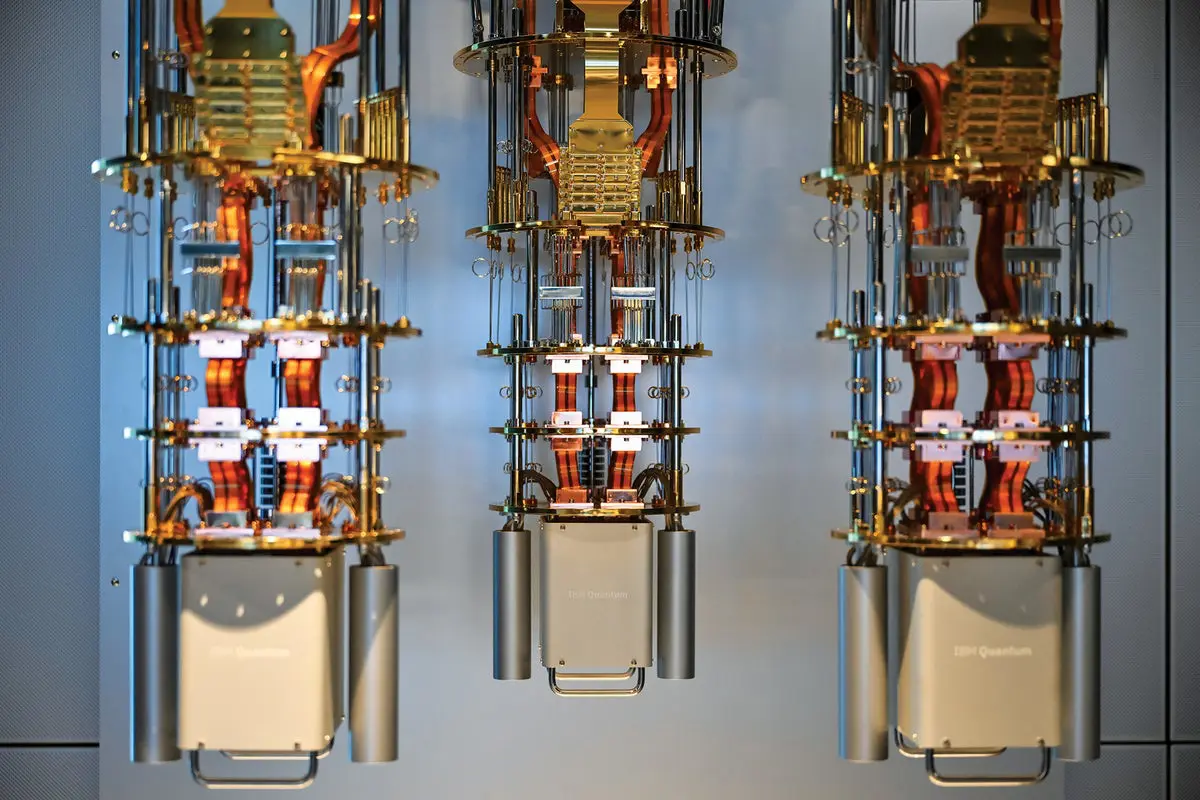
A surge of $1.2 billion in venture capital funding is fueling a critical juncture for quantum computing, as companies race to translate theoretical potential into tangible breakthroughs. Inside Rigetti Computing’s fabrication plant in California, superconducting chips are held by intricate structures and cooled with both liquid helium and liquid nitrogen, reflecting the complex engineering required to build these machines. Rigetti’s CEO, Subodh Kulkarni, envisions a future where quantum computers achieve speeds “a million or a billion times faster with a very small fractional energy consumption” than classical computers, potentially solving currently unsolvable problems. While promises of revolutionizing fields like artificial intelligence remain unconfirmed, researchers worldwide are striving to scale up these systems and demonstrate a definitive advantage over existing technology.
Rigetti Computing and the Quantum Computing Investment Landscape
A substantial $1.2 billion in venture capital funding is driving the development of quantum computing, signaling a significant financial commitment to a field with potential for disruption, yet still facing considerable hurdles. This influx of funding is particularly evident in companies like Rigetti Computing, whose California fabrication plant embodies the complex engineering required to realize the promise of quantum computation. The plant’s tanks, cleanroom, and reserves of liquid nitrogen are all used to support the goal of building quantum computers. Rigetti’s approach highlights the resource-intensive nature of quantum hardware development, a challenge shared by other major players like IBM and Google. This projected speed increase, coupled with enhanced energy efficiency, is driving much of the investment, despite the fact that such performance gains are currently limited to specific computational tasks.
Kulkarni further asserts, “That’s the beauty of quantum computing. We can potentially solve problems that are unsolvable today,” a claim that underscores the high-stakes ambition of the field. However, the path to realizing this potential is far from certain. While venture capitalists and proponents tout applications ranging from artificial intelligence to drug discovery and financial modeling, experts remain cautious about these near-term promises. Governments are particularly interested in the potential for quantum computers to break existing encryption algorithms, driving further investment in the technology. The current moment is critical; scientists are striving to scale up quantum systems to a size capable of delivering genuine breakthroughs and surpassing the capabilities of classical machines. If successful, quantum computers could fundamentally reshape numerous industries, but significant obstacles remain, and the true capabilities of these machines will only become clear as they overcome these challenges.
Superconducting Qubits and Quantum Computation Fundamentals
The pursuit of functional quantum computers has converged on several physical platforms, but superconducting qubits currently represent a leading approach in terms of scalability and control. This dual-coolant system is not merely aesthetic; it represents a critical component in the facility supporting the goal of building quantum computers. Maintaining this environment is paramount, as even minute disturbances can disrupt the delicate quantum states necessary for computation. Qubits, unlike classical bits limited to 0 or 1, leverage the principle of superposition, existing as a combination of both states simultaneously. This is analogous to Schrödinger’s cat, existing in a superposition of dead and alive until observed. Crucially, quantum computers don’t just use quantum physics; they exploit the ability to finely tune these superpositions.
Researchers can manipulate qubits into any desired superposition, allowing for complex calculations beyond the reach of classical computers. When qubits are entangled, their fates are intertwined, even when physically separated, a phenomenon essential for performing calculations. However, this entanglement is fragile, susceptible to decoherence from even the slightest environmental interaction. “Preventing unwanted interactions among a quantum computer’s components is one of the prime hurdles standing between today’s relatively modest quantum computers and the larger, more powerful ones scientists and engineers are hoping to develop.” The potential payoff for overcoming these hurdles is substantial. While widespread claims of quantum computers revolutionizing artificial intelligence remain unconvincing to some experts, the promise of accelerating specific computations is significant. Subodh Kulkarni, Rigetti’s CEO, envisions a future where these machines can tackle previously intractable problems.
This speed boost stems from algorithms like Shor’s algorithm, which could theoretically factor large numbers, the foundation of modern encryption, in days, a task that would take classical supercomputers millions of years. Beyond cryptography, quantum computers offer the potential to model molecular interactions with unprecedented accuracy, promising breakthroughs in drug discovery and materials science. However, realizing this potential hinges on scaling up current systems and maintaining the delicate quantum states within them, a challenge that continues to drive innovation in superconducting qubit technology.
The idea that quantum computers can do anything faster than classical computers, that is just simply not true,”
William Oliver, a professor of electrical engineering, computer science and physics at M.I.T. and co-founder of a quantum computing start-up recently acquired by Google
Schrödinger’s Cat and the Principle of Tunable Superposition
Understanding the principles behind these qubits requires a journey into the counterintuitive world of quantum mechanics, specifically the thought experiment proposed by Erwin Schrödinger involving a cat sealed in a box. The enduring image of Schrödinger’s cat, simultaneously dead and alive until observed, illustrates the concept of superposition, a state where a quantum system exists in multiple possibilities at once. Unlike classical bits representing either zero or one, qubits leverage superposition, allowing them to represent zero, one, or any combination thereof. As the article explains, by manipulating the timing of observation, one could theoretically place the cat into “any superposition you like with any share of aliveness and deadness.” This is precisely what distinguishes a quantum computer from its classical counterpart, enabling potentially exponential increases in computational power.
However, maintaining this superposition is extraordinarily difficult, as any interaction with the environment causes the qubit to collapse into a definite state and destroy the quantum advantage. This fragility underscores the challenge of building practical quantum computers. While conventional computers rely on transistors governed by quantum physics, quantum computers actively exploit quantum phenomena like entanglement, where qubits become linked, sharing the same fate, but require precise control over these interactions. “Faster” is an understatement; theoretically, using Shor’s algorithm, a quantum computer could factor in several days a number that would take a nonquantum supercomputer millions of years. This speed, if realized, could have profound implications for cryptography, potentially breaking the encryption that secures much of the internet, a capability that has understandably attracted the attention of governments worldwide. Rigetti’s CEO, Subodh Kulkarni, envisions a broader impact, but acknowledges the significant hurdles that remain before these theoretical capabilities translate into practical applications.
The reason that quantum computers were initially proposed is the idea that you can use them to simulate quantum systems.
Ewin Tang, a quantum computer scientist at the University of California, Berkeley
Shor’s Algorithm Enables Potential Cryptographic Breakthroughs
The potential for quantum computers to disrupt modern cryptography is no longer theoretical; it’s a rapidly approaching practical concern, driven by advances in hardware and algorithms like Shor’s algorithm. Developed by Massachusetts Institute of Technology theoretical computer scientist Peter Shor, this algorithm presents a fundamental challenge to the security protocols that underpin much of modern digital life. While quantum computers are still in their nascent stages, the speed with which they could potentially break current encryption standards is prompting significant investment and research into quantum-resistant cryptography. Shor’s algorithm specifically targets the difficulty conventional computers have with factoring large numbers, a mathematical problem at the heart of widely used encryption methods like RSA. This isn’t merely an academic exercise; the security of online transactions, secure communications, and sensitive data storage all rely on the computational intractability of factoring large numbers for classical computers.
A functioning, sufficiently powerful quantum computer employing Shor’s algorithm would therefore render these systems vulnerable. Rigetti Computing, alongside other companies and research institutions, recognizes this threat and is actively developing hardware capable of executing such complex algorithms. The scale of investment, $1.2 billion in venture capital funding, underscores the seriousness with which the industry views the cryptographic implications.
The implications extend beyond simply breaking existing codes. Governments worldwide are prioritizing the development of quantum computers, recognizing their potential to compromise national security. “That’s the beauty of quantum computing.” However, the race isn’t solely about offense; it’s also driving research into post-quantum cryptography, developing new encryption methods resistant to attacks from both classical and quantum computers, to safeguard data in a future where quantum computers are a reality. The development of these new cryptographic standards is crucial to mitigating the risks posed by algorithms like Shor’s and ensuring continued digital security.
There are only certain problems, which have a certain internal structure to them, as we understand it today, that allow a quantum computer to take advantage of its quantumness.
William Oliver, a professor of electrical engineering, computer science and physics at M.I.T. and co-founder of a quantum computing start-up recently acquired by Google
Quantum Computing’s Promise for Applications in Multiple Industries
Quantum computing’s potential extends far beyond theoretical physics, promising to reshape industries from finance to pharmaceuticals, though realizing these benefits remains a significant challenge. While venture capital investment currently totals $1.2 billion, the true impact hinges on overcoming substantial engineering hurdles and demonstrating practical advantages over existing technologies. The promise of speed is central to the excitement surrounding quantum computers. Specific applications include revolutionizing drug discovery by accurately modeling molecular interactions, improving weather forecasting through complex simulations, and optimizing strategies within the financial industry. However, the most immediate and perhaps pressing application lies in cryptography. These simulations, impossible for classical computers to perform due to their inability to replicate quantum phenomena, could accelerate the development of new materials and pharmaceuticals, offering solutions to some of the world’s most pressing challenges.
There are a lot of ways to do it, and everyone thinks that they have the best way.
Alaina Green, a physicist at the University of Maryland’s Joint Quantum Institute
Source: https://www.scientificamerican.com/article/quantum-computing-is-reaching-its-make-or-break-moment/


See today’s quantum computing news on Quantum Zeitgeist for the latest breakthroughs in qubits, hardware, algorithms, and industry deals.