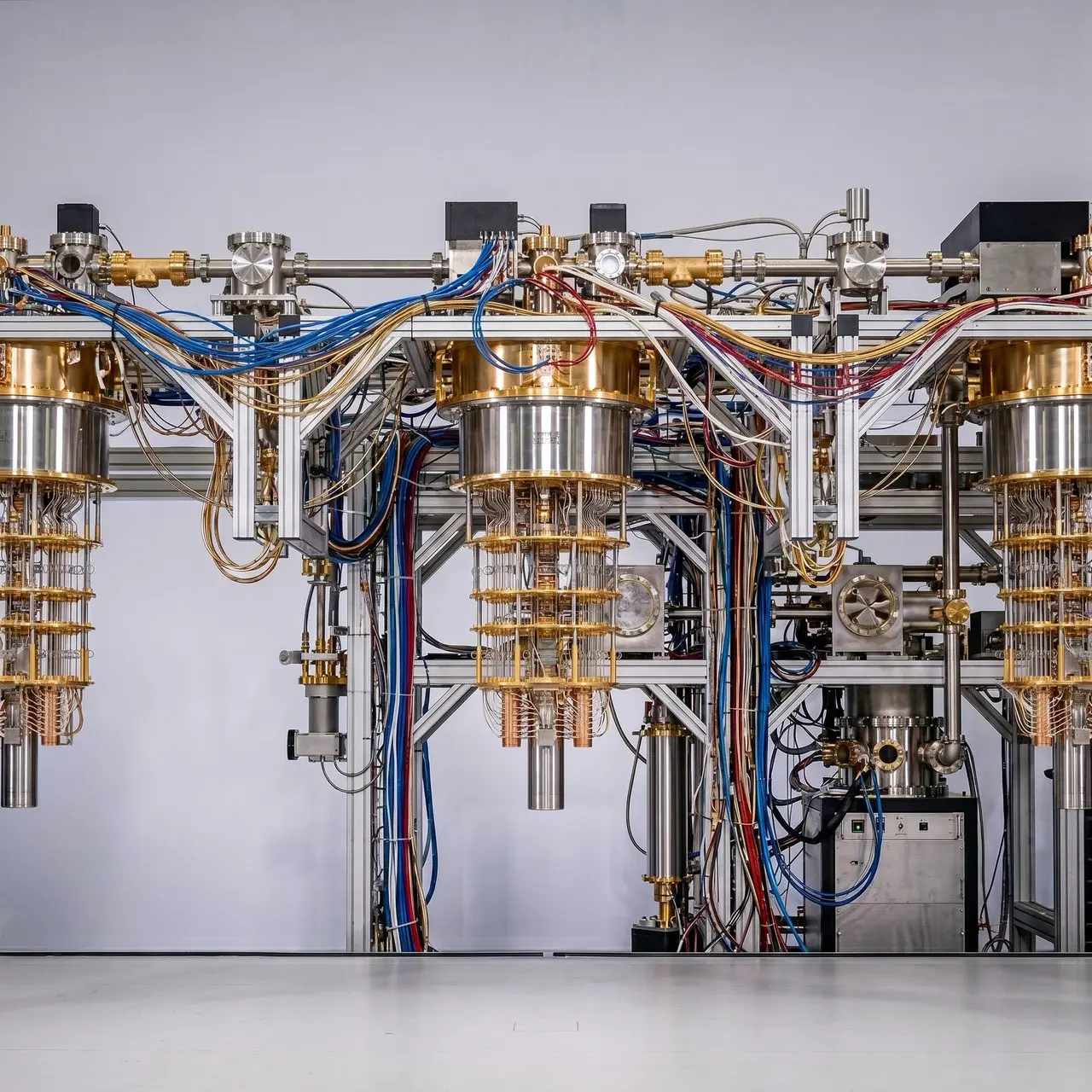
Mid-circuit measurements provide direct access to trajectory-level observables, revealing dynamical structures in many-body systems previously hidden within ensemble-averaged quantities. This capability was used to realise and study an instance of the Floquet-East model on a superconducting quantum processor. The interplay between mid-circuit measurements, kinetically constrained unitary operations and hardware noise generates complex many-body phenomena.
Analysis of trajectories derived from temporally and spatially resolved mid-circuit measurements enabled identification of dynamical heterogeneity, a key characteristic of glassy dynamics. Researchers at Universität Tübingen and The University of Nottingham contributed to this work alongside Sapienza Università di Roma, Piazzale Aldo Moro 5, Rome, Italy.
Quantum computation resolves dynamical heterogeneity in glassy systems
The researchers Sapienza Università di Roma, and The University of Nottingham achieved trajectory resolution of dynamical heterogeneity, a key feature of glassy materials, with approximately 10⁵ quantum trajectories obtained within ten minutes runtime on an ibm kingston processor. Previously, investigations relied upon ensemble-averaged quantities which obscured these individual system behaviours; the new approach unlocks detailed analysis impossible before now.
Utilising mid-circuit measurements on a superconducting quantum processor to realise the Floquet-East model allowed quantification of behaviour through inactive space-time regions revealing a crossover from area- to perimeter-dominated scaling in their probability distribution, a characteristic property associated with proximity to dynamic phase transitions.
The team obtained and analysed around 10⁵ quantum trajectories to reveal intricate many-body phenomena arising from both mid-circuit measurements and hardware noise within the Floquet-East model. Examining temporally and spatially resolved data gathered during experiments on the ibm kingston processor enabled identification of dynamical heterogeneity as cluster size increased, resulting in discovery that probability distributions transitioned between scaling dominated by area and perimeter. Current noisy intermediate-scale quantum devices can serve as viable platforms for investigating complex correlated behaviours at an unprecedented level of detail; this opens new avenues for materials science research.
Individual particle behaviours reveal hidden complexity in simulated glass formation
Detailed insights into complex systems are now being unlocked through analysis of individual behaviours rather than relying solely on averaged data, but establishing how widely applicable these findings are remains a key question. The report details observation of dynamical heterogeneity within one specific Floquet-East model instance, though it isn’t yet clear whether similar behaviour will emerge across different models or under varying conditions requiring further investigation.
While stemming from one particular instance of a complex physical model, understanding behaviour even within limited systems provides important groundwork for broader theories. Noisy quantum processors aren’t simply simulators; they represent tools capable of directly observing complex behaviours within physical systems, a shift away from reliance on averaged data towards analysing individual instances of system evolution.
Researchers observed dynamical heterogeneity, a property linked to glassy dynamics, when studying the Floquet-East model using a superconducting quantum processor. This demonstrates how current noisy intermediate-scale quantum devices can be used to investigate correlated many-body phenomena at the level of measurement trajectories. The authors suggest further investigation is needed to determine whether these findings extend beyond this specific model instance.
👉 More information
🗞 Glassy dynamics with softened kinetic constraints on a noisy quantum computer
✍️ Marcel Cech, Igor Lesanovsky and Federico Carollo
🧠 ArXiv: https://arxiv.org/abs/2608.19335

See today’s quantum computing news on Quantum Zeitgeist for the latest breakthroughs in qubits, hardware, algorithms, and industry deals.