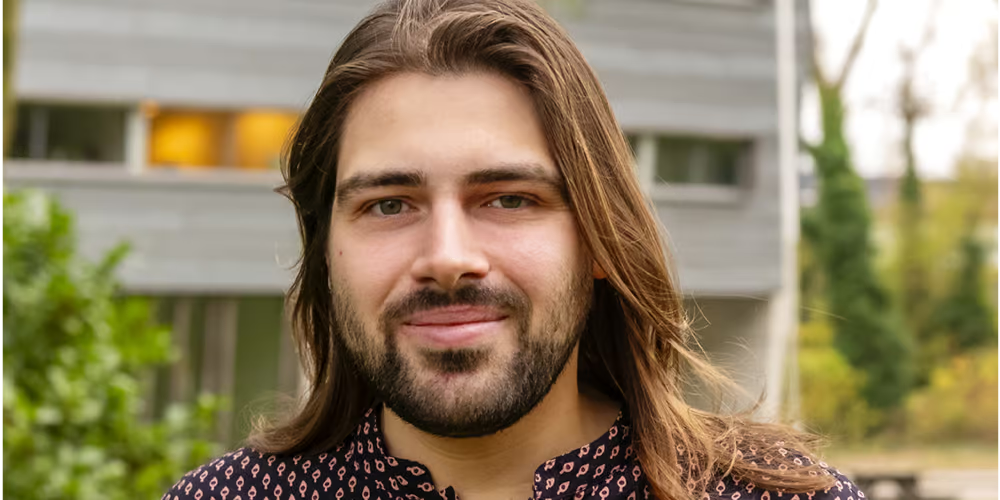
Dr. Stefano Polla officially began his appointment as Assistant Professor at QuSoft on April 1, 2026, establishing a research group focused on executing algorithms like Quantum Phase Estimation. Polla’s work bridges computational chemistry and quantum algorithms, using molecular systems to inspire solutions for complex computational problems.
“QuSoft has long been a center of expertise for quantum algorithms in the Netherlands, while remaining forward-looking,” Polla says, adding that the institute offers an ideal environment for interdisciplinary research across the University of Amsterdam and Centrum Wiskunde & Informatica. His research will specifically explore molecular embedding and quantum-classical integration.
Polla’s Appointment Advances Quantum Chemistry at QuSoft
This focus acknowledges the current limitations of quantum technology and aims to derive value from near-term devices, demanding innovative approaches to noise mitigation and circuit optimization. His group will concentrate on algorithms with provable convergence for currently under-explored areas within computational chemistry, specifically molecular embedding and quantum-classical integration. This targeted approach moves beyond standard quantum chemistry simulations, seeking to unlock new computational capabilities through a focused methodology. His prior work, including the development of echo verification, a purification-based error mitigation technique, demonstrates a strong foundation in quantum software development.
Polla’s contributions extend to adapting error mitigation protocols for early fault-tolerant QPE, results published in PRX Quantum in collaboration with Google, Covestro, and QuSoft member Alicja Dutkiewicz, the company says. He also leads a national consortium on Quantum Software for Drug Design (QSDD) within the QDNL Forward Challenge in Life Sciences and Health, collaborating with QuSoft members including Dutkiewicz, Freek Witteveen, and Kareljan Schoutens, which solidifies QuSoft’s position as a leading center for quantum chemistry research.
It offers an ideal environment for interdisciplinary and cross-departmental research, and I look forward to collaborating with colleagues across UvA and CWI.



See today’s quantum computing news on Quantum Zeitgeist for the latest breakthroughs in qubits, hardware, algorithms, and industry deals.