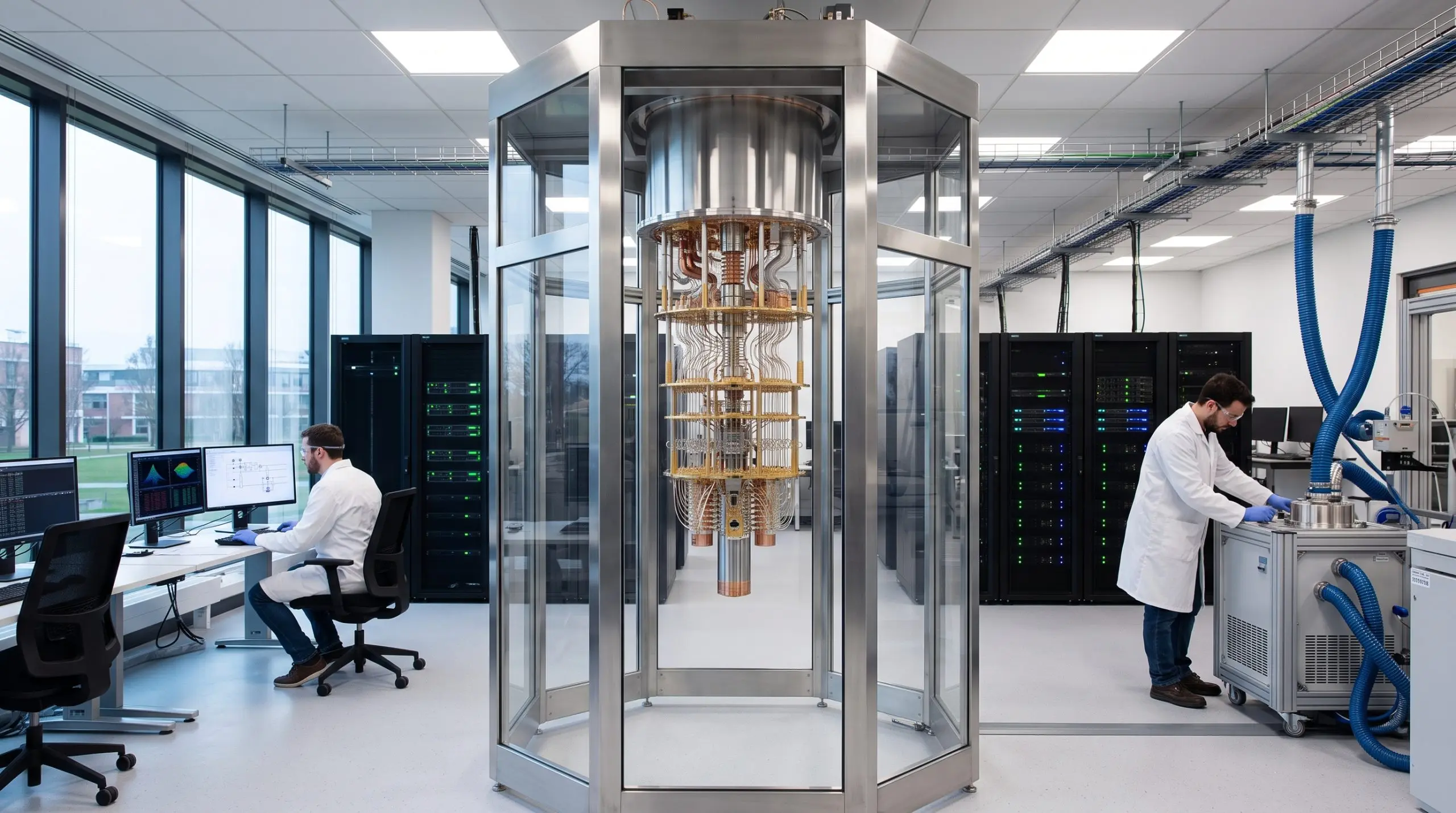
New York City’s Economic Development Corporation will invest $29.2 million in New York University to establish a Quantum Fabrication Facility, or QFab, at 770 Broadway in Manhattan. The facility aims to bridge the gap between quantum research and scalable technology development, offering specialized equipment for prototyping quantum chips and components. QFab is expected to encourage a “quantum ecosystem” within the city, with potential applications ranging from disease diagnosis to faster bus routes.
NYU QFab: Scaling Quantum Technologies in New York City
This facility is designed to allow researchers to test new device concepts without the immediate expense and rigidity of full manufacturing, a key step toward translating theoretical advances into tangible technologies. NYU plans to collaborate with the City University of New York to broaden access to QFab, intending to reach over 35,000 New Yorkers within a decade of operation and support the incubation of dozens of quantum-focused companies.
The projected impact extends to the creation of thousands of jobs and the attraction of $80 million in follow-on investment, signaling a deliberate effort to build a self-sustaining quantum ecosystem within the city. QFab’s establishment is directly linked to the broader vision of the NYU Quantum Institute, which recognizes that progress in quantum technologies requires a multidisciplinary approach.
According to Javad Shabani, director, their development “requires materials scientists, electrical engineers, computer scientists, fabrication experts and others working closely together.” This collaborative spirit aims to move beyond isolated discoveries and identify opportunities that would otherwise remain unseen. New York City’s existing infrastructure and concentration of relevant industries, including finance, healthcare and communications, provide a uniquely fertile ground for this interdisciplinary work, alongside the presence of major industry players like IBM, Google and Microsoft.
The anticipated benefits of this quantum research extend beyond fundamental science, with potential applications impacting everyday life. He specifically cited the potential for improved disease diagnosis and vaccine development, alongside more efficient traffic management systems. “It will help us predict traffic patterns and ensure that our buses can run faster,” he said.
The facility, expected to open in early 2030 is a research center and a physical manifestation of the city’s commitment to attracting talent, funding and burgeoning quantum companies. This focus on practical application and scalability distinguishes QFab from purely academic endeavors.
The facility will provide students and technicians with hands-on training on equipment essential to the emerging quantum industry, addressing a critical skills gap. By providing a middle ground between theoretical research and large-scale production, QFab aims to accelerate the translation of quantum innovations into commercially viable products and services, solidifying New York City’s position as a leader in this rapidly evolving field.
Shabani’s Materials Research for Robust Qubit Reliability
Javad Shabani’s research focuses on material interfaces grown using molecular beam epitaxy, a technique enabling precise control over layer composition and quantum behavior. This precision is critical for creating stable qubits, the fundamental building blocks of quantum computers, and addresses a core challenge in scaling quantum technology beyond laboratory demonstrations. Shabani’s lab investigates hybrid systems combining semiconductors and superconductors, aiming to exploit emergent quantum properties at their interfaces, a path toward topological quantum computing.
Unlike current quantum computers reliant on extensive error correction, topological qubits promise inherent stability, reducing the need for complex and resource-intensive correction schemes. More reliable qubits drive a “full-stack” approach to quantum research, mirroring the development of a complete technology ecosystem.
This exponential growth in qubit numbers, even without complete understanding of the underlying physics, marks an important moment in quantum research and a potential paradigm shift in computation and sensing.
Molecular Beam Epitaxy & Hybrid Quantum Systems
Molecular beam epitaxy is central to creating the highly controlled material interfaces necessary for advanced qubit designs. Researchers are using this technique to build hybrid systems, combining the properties of semiconductors and superconductors to engineer quantum behaviors not found in either material alone. This precise layering allows for the creation of materials with atomic-scale control, a critical step towards realizing topological quantum computing, a promising path for more stable quantum information processing.
The challenge extends beyond material creation to device fabrication, demanding iterative cycles between fundamental science and practical engineering. Davood Shahrjerdi’s work exemplifies this need, focusing on translating promising quantum materials into functional devices. Shabani explains, “Think of it like building a modern technology ecosystem from the ground up.” While full-scale quantum computing remains a long-term goal, certain quantum technologies are already impacting other fields.
Quantum sensing, for example, is currently used to detect microscopic magnetic fields with applications in medicine and materials science. Shabani anticipates seeing more robust networks within a few years. “AI is very good at finding shortcuts and patterns, while quantum computing is fundamentally about simulating nature at its most basic level,” he said.
Shabani emphasizes that the future of the field will not be defined by a single breakthrough, but rather by the ability to build and iterate on quantum discoveries. Shabani’s excitement stems from this progress, noting, “It’s the sense that something big is happening, even if we don’t fully understand it yet.” The ability to repeatedly move between fundamental science and practical engineering, between atomic-scale materials and large-scale systems, will ultimately determine the pace of innovation.
Shahrjerdi’s Nanofabrication for Quantum Device Creation
The ability to rapidly prototype quantum devices will be significantly enhanced by the new facilities at NYU, allowing researchers to bypass the lengthy and costly process of relying on established large-scale manufacturing for initial testing. This access is particularly important for startups seeking to explore novel designs without substantial upfront investment in infrastructure, and will also provide valuable hands-on training for students and technicians entering the quantum workforce.
The creation of QFab is explicitly intended to attract quantum companies to New York City, filling commercial space and stimulating further investment in the field. Scaling quantum computing beyond experimental stages relies heavily on fabricating components using materials and techniques compatible with existing semiconductor manufacturing processes, and this compatibility is a central focus of the new facility.
Professor Davood Shahrjerdi of NYU Tandon directs the NYU Nanofabrication Cleanroom in Brooklyn, dedicating his research to the advanced electronic materials, nanotechnology and fabrication processes necessary to translate promising materials into functional hardware. Nanofabrication, the often-unseen foundation of modern electronics, involves depositing thin films, patterning them with lithography and selectively removing material to create structures at the micro- and nanoscale, processes that become exceptionally demanding when applied to quantum devices.
The collaborative work of Javad Shabani, Shahrjerdi, and fellow researcher Almanakly exemplifies the integrated approach necessary for progress. Shabani investigates materials and quantum states for future devices, while Shahrjerdi concentrates on the fabrication methods to build hardware from these materials, and Almanakly studies how that hardware can communicate and function within a larger system. Current quantum computers lack the power to solve problems without careful pre-design, necessitating this comprehensive, “full-stack” approach.
Researchers are now routinely forced to adapt their approaches based on the limitations of existing quantum hardware, a constraint that often sparks innovation. Shabani notes that this limitation encourages a focus on specific, solvable problems, or the redesign of the machine itself to address new challenges. “A physicist might not think about algorithm design, and a computer scientist might not understand device fabrication,” he says, highlighting the need for cross-disciplinary expertise.
Low-Energy Ion Beam Etching of Superconducting Resonators
Conventional semiconductor fabrication techniques can inadvertently damage the delicate properties of promising superconducting materials due to chemical reactions during patterning. To address this, Shahrjerdi and collaborators investigated low-energy ion beam etching, a method that relies on physical bombardment rather than chemical processes to shape materials. The team successfully fabricated superconducting resonators using niobium, a widely used superconducting material demonstrating a process with potential applicability to a broader range of materials.
This fabrication approach is particularly important as quantum engineering continues its search for optimal material and device combinations. The ability to work with more materials is not merely an academic exercise. It directly impacts the potential for building more robust and powerful quantum systems.
The NYU Quantum Fabrication Facility, or QFab, supports this work across semiconductors, quantum materials, communications and biomedical technologies, providing a prototyping environment to transition ideas from research toward manufacturing. This facility is designed to bridge the gap between fundamental discovery and practical implementation, a goal central to accelerating the development of quantum technologies. The institute’s structure reflects this integrated approach, spanning multiple disciplines rather than being confined to a single academic department.
Researchers collaborate across physics, engineering and computer science, with facilities located in both Brooklyn and Manhattan. Aziza Almanakly’s work exemplifies the benefits of this cross-disciplinary collaboration, extending beyond individual processors to address challenges in quantum interconnectivity. Almanakly’s laboratory combines superconducting circuits, microwave engineering, cryogenic experimentation, theoretical modeling and quantum control to explore solutions for distributing entanglement between remote superconducting systems. Entanglement, a defining feature of quantum mechanics, allows for correlations between quantum systems even when physically separated.
If engineers can reliably distribute entanglement, they may be able to construct modular quantum computers, linking many smaller devices to function as a larger, more powerful system. Almanakly’s demonstration of a chiral quantum interconnect capable of directing microwave photons and creating entanglement represents a step toward realizing this modular architecture.
Her work also explores quantum sensing, where the sensitivity of quantum systems could be used to measure extremely weak signals. The research, involving Javad Shabani, Eric Vieira, John DiBartolo and Almanakly, highlights the complex interplay between device physics, communication and computer architecture required to build a complete quantum technology.
NYU Quantum Institute: Unifying Quantum Disciplines
The NYU Quantum Institute (NYUQI) is structured to accelerate the translation of quantum discoveries into tangible technologies, recognizing that progress demands expertise beyond a single scientific discipline. This collaborative model is central to NYUQI’s design, deliberately connecting research layers to ensure rapid iteration and knowledge transfer between them. This deliberate decentralization aims to support a dynamic exchange of ideas, allowing researchers to identify opportunities that might be missed within siloed environments.
Shabani emphasizes that when experts from diverse fields collaborate, “they can identify opportunities that neither would see alone.” This interconnectedness is further bolstered by existing infrastructure like the Nanofab, and the newly established Quantum Fabrication Facility, or QFab, which is intended to bridge the gap between prototyping and commercialization. The concentration of sectors that could benefit from quantum technologies, finance, healthcare and communications, creates a unique ecosystem for innovation and potential application.
Shabani notes that this environment is not merely coincidental. It provides a fertile ground for translating research into real-world solutions. The institute’s location within this dense urban landscape is a deliberate effort to facilitate partnerships and accelerate the development of practical quantum technologies. Beyond the potential benefits, NYUQI acknowledges the risks associated with quantum technologies, particularly in the area of cybersecurity. Shabani highlights the potential for advanced quantum computers to compromise existing encryption systems, a concern the institute is actively addressing.
As an academic institution, NYUQI is committed to open knowledge sharing, but also recognizes the need for responsible development and oversight. “That’s a critical question,” Shabani states, acknowledging the dual-use nature of these powerful technologies and the importance of navigating their ethical implications. The institute’s commitment to both innovation and responsible development positions it as a key player in shaping the future of quantum technology.



See today’s quantum computing news on Quantum Zeitgeist for the latest breakthroughs in qubits, hardware, algorithms, and industry deals.