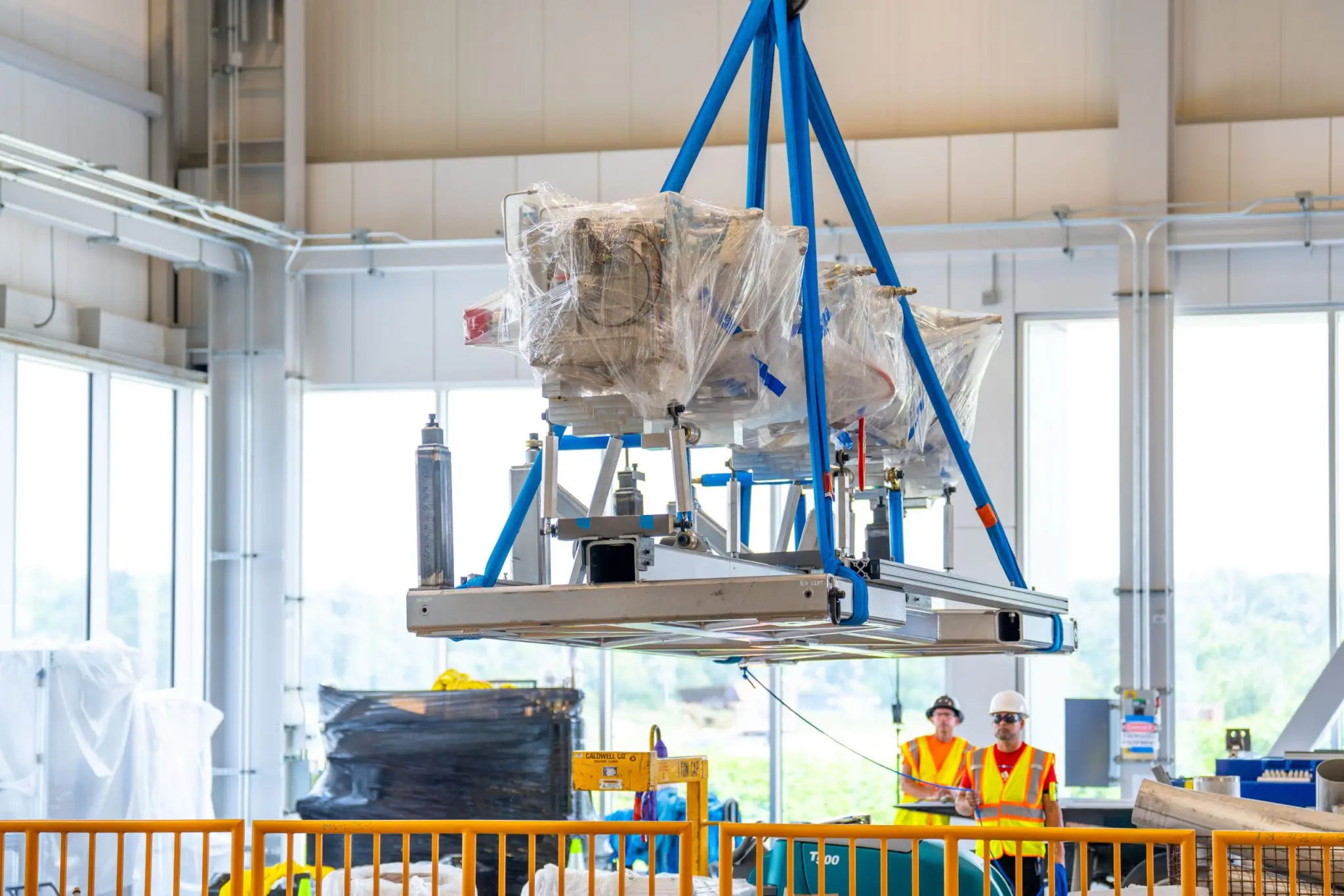
Fermilab has begun installing the first component of a new accelerator, carefully lowering a radio-frequency quadrupole, or RFQ, 30 feet into a tunnel that will eventually house the PIP-II linear accelerator. This marks a major step forward for the lab’s future neutrino research program and the Deep Underground Neutrino Experiment (DUNE), where beams of neutrinos will travel 800 miles through Earth from Batavia, Illinois, to Lead, South Dakota. During the delicate move, the RFQ was driven to its installation site at a speed of 5 miles per hour to avoid damage. “2026 marks a significant milestone for the PIP-II project,” said PIP-II Project Director Cristian Boffo. “As we accelerate cryomodule production across the United States, U.K. and France, our team is beginning installation of the warm front end in the newly completed facility.”
PIP-II Installation: Initial RFQ Component Placement
The placement of the first major component of the Proton Improvement Plan, II (PIP-II) linear accelerator signifies a pivotal moment for future neutrino research at Fermilab, with the radio-frequency quadrupole (RFQ) now installed within the accelerator tunnel. This critical piece will form the heart of the front end of PIP-II’s superconducting linac, ultimately powering a high-energy particle beam destined for the Deep Underground Neutrino Experiment (DUNE) at the Long-Baseline Neutrino Facility. The ambitious experiment relies on neutrinos traveling 800 miles through the Earth, originating in Batavia, Illinois, and concluding their journey in Lead, South Dakota, allowing scientists to study these elusive particles. During its careful relocation, the RFQ was transported at a speed of 5 miles per hour on a purpose-built fixture, demonstrating the sensitivity of the operation.
Once arriving at the newly completed High Bay Building, a crane lowered the component 30 feet to the tunnel level before it was carefully wheeled into position. Linac installation manager Curt Baffes explained that the RFQ handles one of the trickiest regimes, where the beam’s energy is low and the velocity is changing a lot. The team anticipates interfacing the RFQ with cooling, radio-frequency, and vacuum systems throughout the remainder of the year, and plans to begin powering the device and initiating beam commissioning in 2027. Steve Dixon, PIP-II conventional facilities manager, added, “The last time we built a linac was in the 1960s, and it served the lab for all of this time. What we’re building now will set Fermilab up for the next 50 to 60 years.”
2026 marks a significant milestone for the PIP-II project. As we accelerate cryomodule production across the United States, U.K. and France, our team is beginning installation of the warm front end in the newly completed facility.
The successful installation of the radio-frequency quadrupole, or RFQ, represents a pivotal step in the construction of Fermilab’s PIP-II linear accelerator; this component will form the core of the accelerator’s front end. Unlike the superconducting sections of the linac, the 4-meter-long RFQ is constructed from copper and operates at room temperature, a deliberate design choice to manage the complexities of initial beam formation. Installing the RFQ as the first beamline component allows for maximum space and flexibility as construction progresses. The PIP-II linac will ultimately comprise 23 cryomodules, accelerating H-minus ions to 800 million electron volts along its 215-meter length.
Beyond the installation of the radio-frequency quadrupole, significant progress is occurring on the PIP-II accelerator’s complex cryogenic system, essential for maintaining the superconducting state of the majority of the linac’s 23 cryomodules. Key components of this system, including the coldbox and its associated compressors, arrived at the PIP-II site in January 2025 and underwent a rigorous installation and interconnection process with both piping and electrical wiring. Recent weeks saw the team receive operational readiness clearance for the cryoplant and compressor room, representing another crucial milestone in the project’s advancement. Commissioning of the coldbox is now underway, a process anticipated to require approximately six months to complete. The international scope of PIP-II extends beyond the United States, with institutions in France, India, Italy, Poland, and the United Kingdom contributing vital technologies, instrumentation, and expertise; this collaborative effort underscores the United States’ capacity to host and lead major global scientific infrastructure projects, fostering international partnerships in fundamental research. The PIP-II linac, comprising 23 accelerating devices, is projected to support a broad physics research program for the next half-century.


See today’s quantum computing news on Quantum Zeitgeist for the latest breakthroughs in qubits, hardware, algorithms, and industry deals.