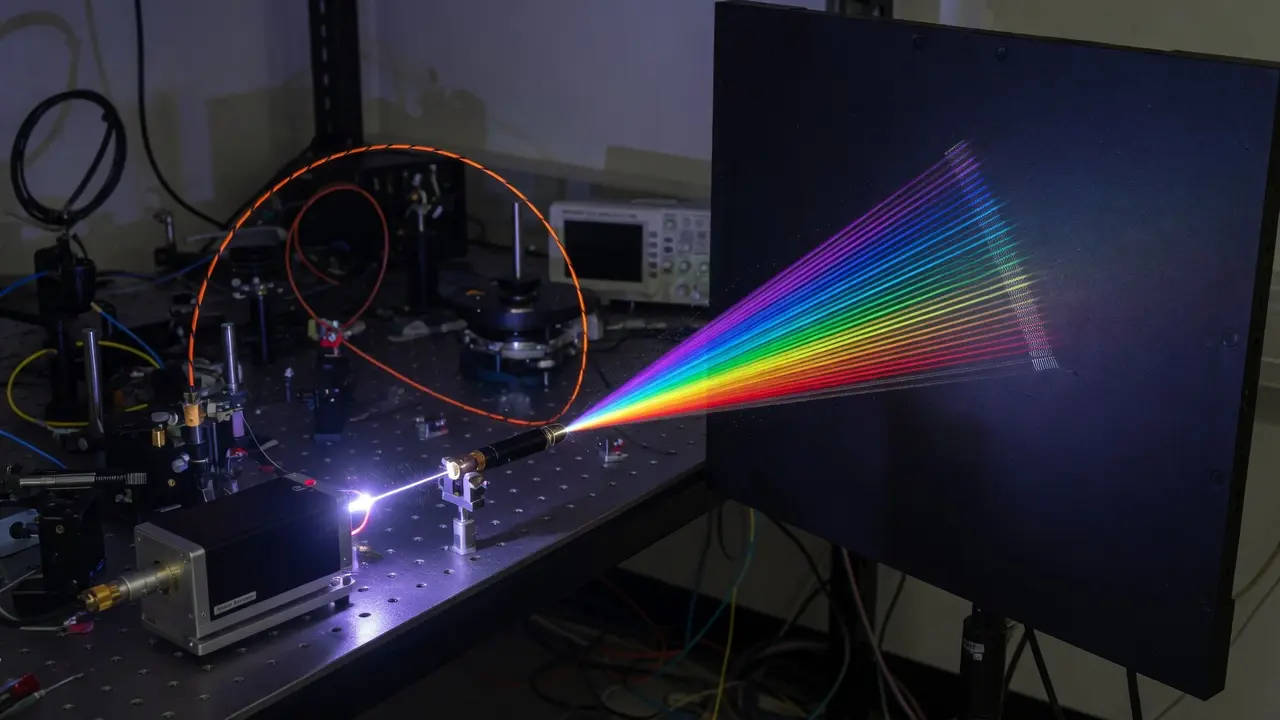
Quantum information stored in ‘qutrits’, building blocks similar to qubits but exploiting a three-state system, now lasts over ten times longer than before. This breakthrough uses single-step operations on an ultracold atomic ensemble and achieves gate fidelities around ~ 93%; sharply improving upon earlier methods reliant on complex sequences limiting scalability. The technique also creates a new multi-path atom interferometer offering potential for advanced sensing applications.
Information storage duration within qutrits, quantum systems utilising three distinct states rather than the usual two found in qubits, has increased by more than tenfold compared to previous techniques. This improvement stems from simplifying the operations needed to shield these delicate states from disruptive noise; complex sequences are no longer required for protection. Researchers at Universidade Federal do Rio de Janeiro, Université de Toulouse, Nanyang Technological University, and National University of Singapore created a new type of atomic interferometer which could lead to more precise sensors and tests of fundamental physics principles.
How long information can be stored within qutrits, quantum systems that can simultaneously represent 0, 1 or both states allowing for greater data density, has been extended over ten times. The team achieved this by implementing single-step operations rather than complex sequences previously required to simplify the protective measures needed for these delicate states.
Key to this advancement is also a novel type of atomic interferometer, an extremely precise measuring device using atoms behaving like waves splitting and recombining similarly to ripples in water around obstacles, which could lead to more accurate sensors and fundamental tests of physics principles. These advances hinge upon carefully timed manipulations of qutrit states.
High Fidelity Gates Unlock Extended Qudit Coherence and Novel Interferometry
Approximately ~ 93% gate fidelity marked a substantial improvement over earlier methods, extending coherence more than tenfold compared to previous qutrit manipulation techniques. This threshold surpasses limitations imposed by state preparation and measurement errors that previously hindered reliable quantum information storage. The unique laser beam geometry also realised a three-path Mach, Zehnder atom interferometer, impossible with prior multi-gate approaches reliant on complex SU gates, enabling potential precise vector force measurements and tests validating fundamental principles like Born’s rule.
Quantum process tomography revealed scores of ~ 93% for both Hadamard and Pauli-X gates used in superposition and echo operations respectively. A novel three-path Mach, Zehnder atom interferometer became possible thanks to the laser beam geometry, offering opportunities for precise vector force measurements as well as validation of foundational physics such as Born’s rule. While these 93% fidelities represent sharp progress, they do not yet account for errors accumulating across complex multi-qubit circuits or demonstrate long-term stability required for practical quantum computation.
Extended Qutrit Coherence Enables Scalable Quantum System Development
Demonstration of extended coherence in qutrits alongside a new three-path interferometer signifies genuine progress toward robust quantum systems; however, reported gate fidelities still face limitations inherent in preparing and measuring initial states. This reliance on ‘state preparation and measurement’ (SPAM) errors is common but remains an ongoing challenge when building scalable quantum technologies. The researchers extended the lifespan of quantum information held within qutrits, leveraging three distinct states instead of qubits’ two, by over ten times using a refined Hahn echo technique.
Researchers successfully generalized the Hahn echo method to extend coherence time in qutrits, quantum systems utilizing three levels rather than the standard two found in qubits, increasing it by more than tenfold. This was achieved through single-step SU(3) gates implemented on an ultracold atomic ensemble with fidelities reaching approximately 93%, though these scores are currently limited by state preparation and measurement errors. These results demonstrate control for dynamical decoupling of qutrits and multi-path interferometry.
👉 More information
🗞 Single-step SU(3) Hahn Echo in a Qutrit Atom Interferometer
✍️ Chirantan Mitra, Lucas Gabardos, David Wilkowski and Chang Chi Kwong (Nanyang Technological University); François Impens (Universidade Federal do Rio de Janeiro); David Guéry-Odelin (Université de Toulouse)
🧠 ArXiv: https://arxiv.org/abs/2610.32160


See today’s quantum computing news on Quantum Zeitgeist for the latest breakthroughs in qubits, hardware, algorithms, and industry deals.