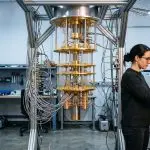
Broadcom is funding 26 Caltech researchers as the two institutions explore the future of computation, a partnership formally marked by the first symposium held in the Allen and Charlotte Ginsburg Center’s new first-floor symposium room. Caltech President Ray Jayawardhana highlighted the deep roots of quantum science, beginning with Richard Feynman’s early vision, and stated, “I’m convinced that the future of quantum is being shaped right here in Pasadena.” The five-year collaboration, begun in 2023, aims to advance quantum research and potentially unlock technologies exceeding even the disruptive potential of artificial intelligence, according to Broadcom’s Charlie Kawwas.
Broadcom & Caltech Launch Five-Year Quantum Science Partnership
Broadcom’s investment extends beyond personnel; the company is actively shaping the physical infrastructure supporting quantum research through the new Broadcom Quantum Laboratory within the Ginsburg Center. This laboratory, housed within the recently opened facility, benefits from design elements inspired by quantum principles, such as the wave-like ceiling of the first-floor symposium room where the Broadcom symposium was held. The symposium room’s design reflects the fundamental, wave-like nature of quantum particles like photons and electrons, demonstrating a commitment to integrating scientific inspiration into the research environment.
The Ginsburg Center itself is part of a larger network connecting researchers with engineers, amplifying collaborative potential. The partnership’s focus isn’t solely on advancing quantum computing in isolation, but also on its interplay with artificial intelligence.
Charlie Kawwas, president of Broadcom’s semiconductor solutions group, spoke about the tech giant’s interest in quantum technologies: “However, when we look beyond AI, and we take a look at the long-term horizon, especially for technologies that we can turn into products, we truly believe that the potential of quantum computing is even greater, deeper, and more disruptive than AI.” The symposium’s first panel discussion focused largely on the future of computation and how it will shape both Broadcom’s technologies and scientific research at.
Hirosi Ooguri, the Kent and Joyce Kresa Leadership Chair of the Division of Physics, Mathematics and Astronomy and the Fred Kavli Professor of Theoretical Physics and Mathematics at, presented a custom-made sculpture to Kawwas in recognition of Broadcom’s generous support.
The sculpture demonstrates an engraved 3D glass picture of the Ginsburg building resting on a base that includes a portion of a 1920s wall from the time of founding along with wood from a 400-year-old Engelmann oak that predated the campus. Ooguri said, “The Ginsburg Center image is engraved in it, representing that we are manipulating light to look into the inner workings of objects.” Kawwas replied that the piece was “very special because my father was a carpenter.”
Quantum science has deep roots here at Caltech, starting with Richard Feynman’s early vision of quantum computing and continuing through pioneering experiments in quantum entanglement and teleportation.
Ginsburg Center for Quantum Precision Measurement Design & Funding
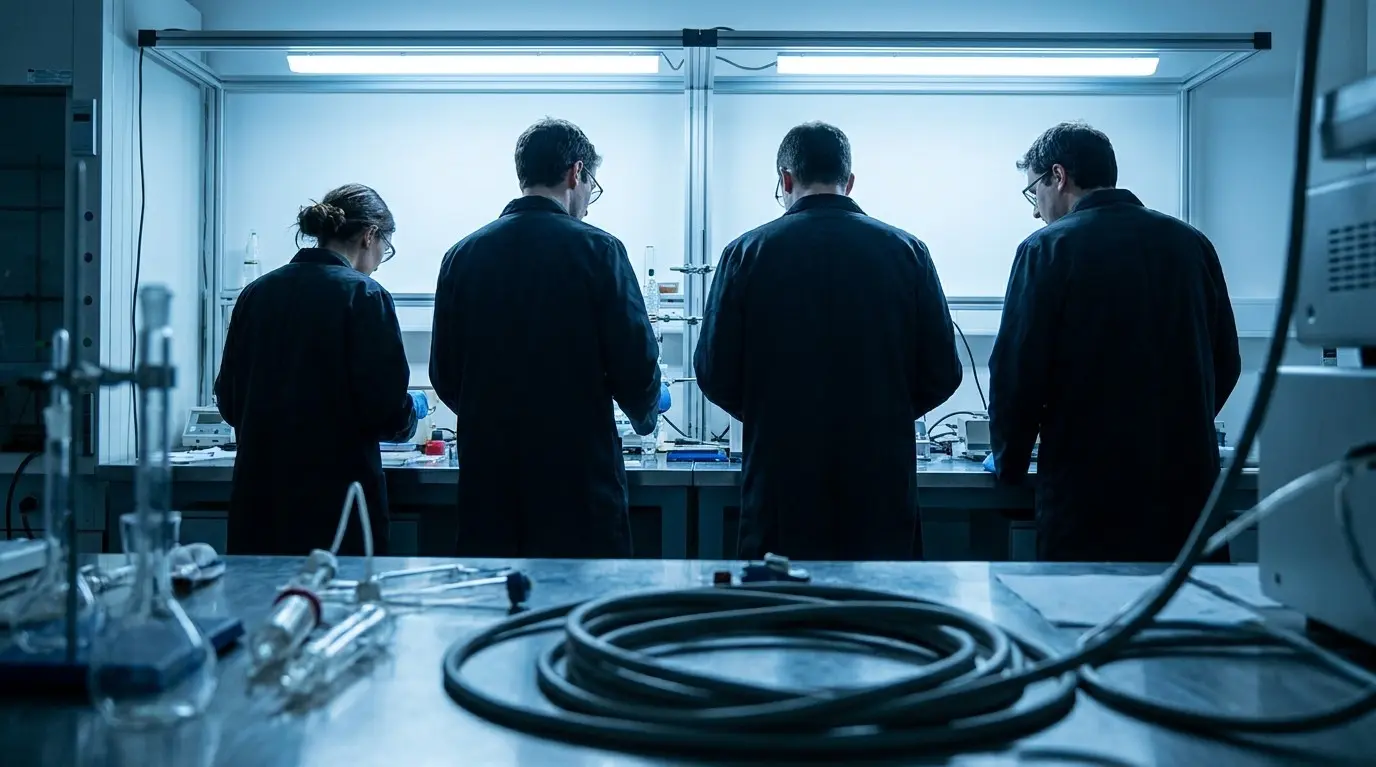
The Broadcom Quantum Laboratory, situated within Ginsburg Center for Quantum Precision Measurement, is actively supporting 26 researchers as of this symposium, a level of personnel investment signaling a focused expansion of quantum science work. The building was funded by several donors, including Broadcom. Translating theoretical advances into practical applications is important, a point emphasized by Manuel Endres, professor of physics. The first-floor symposium room, the site of the inaugural Broadcom symposium, features a ceiling constructed of curved wooden slats intended to visually represent the wave-like properties of quantum particles.
“That’s not only the computing power but also the interconnects. Interconnecting quantum computers is a daunting optical engineering challenge that relies on scaling the way we coherently transmit information over fibers,” Faraon explained.
I’m convinced that the future of quantum is being shaped right here in Pasadena.
Ray Jayawardhana, Caltech’s 10th President, Sonja and William Davidow Presidential Chair and professor of astronomy
Heterogeneous Processors: AI, XPUs, and Future Quantum Integration
Heterogeneous processors are becoming increasingly vital for advanced computation, with connections between processing units emerging as a key bottleneck. Kawwas emphasized the scaling challenges facing current AI systems, stating, “Today’s AI clusters are in the hundreds of thousands of XPUs or GPUs, and the hardest thing to scale is networking, the connectivity.” This observation highlights a shift towards systems incorporating CPUs, XPUs, GPUs and ultimately quantum processing units, or QPUs, demanding a re-evaluation of interconnect architectures.
Today’s AI clusters are in the hundreds of thousands of XPUs or GPUs, and the hardest thing to scale is networking, the connectivity.
Charlie Kawwas, president of Broadcom’s semiconductor solutions group
Quantum Error Correction Advances Promise Scalable Computation
Advances in quantum error correction are expected to accelerate the realization of practical quantum computation, according to discussions at the recent Broadcom Technology symposium. Researchers detailed anticipated breakthroughs that will address the inherent fragility of qubits, a primary obstacle to building stable and scalable quantum processors. The symposium also highlighted the important role of software in managing increasingly complex quantum systems.
Charlie Kawwas, president of Broadcom’s semiconductor solutions group, emphasized the need for sophisticated orchestration tools, stating, “We’ll need more and more capable software to orchestrate these very complex systems.” The interplay between hardware and software is becoming increasingly important as researchers strive to move beyond proof-of-concept demonstrations towards practical, fault-tolerant machines. Beyond immediate computational gains, scientists envision quantum technology enabling entirely new avenues of scientific exploration. The symposium also served as an opportunity to formally recognize Broadcom’s support with a custom sculpture presented to Kawwas.
“We created this piece to commemorate the new building and its history,” Ooguri said.
The Ginsburg Center image is engraved in it, representing that we are manipulating light to look into the inner workings of objects.
Kawwas
See today’s quantum computing news on Quantum Zeitgeist for the latest breakthroughs in qubits, hardware, algorithms, and industry deals.