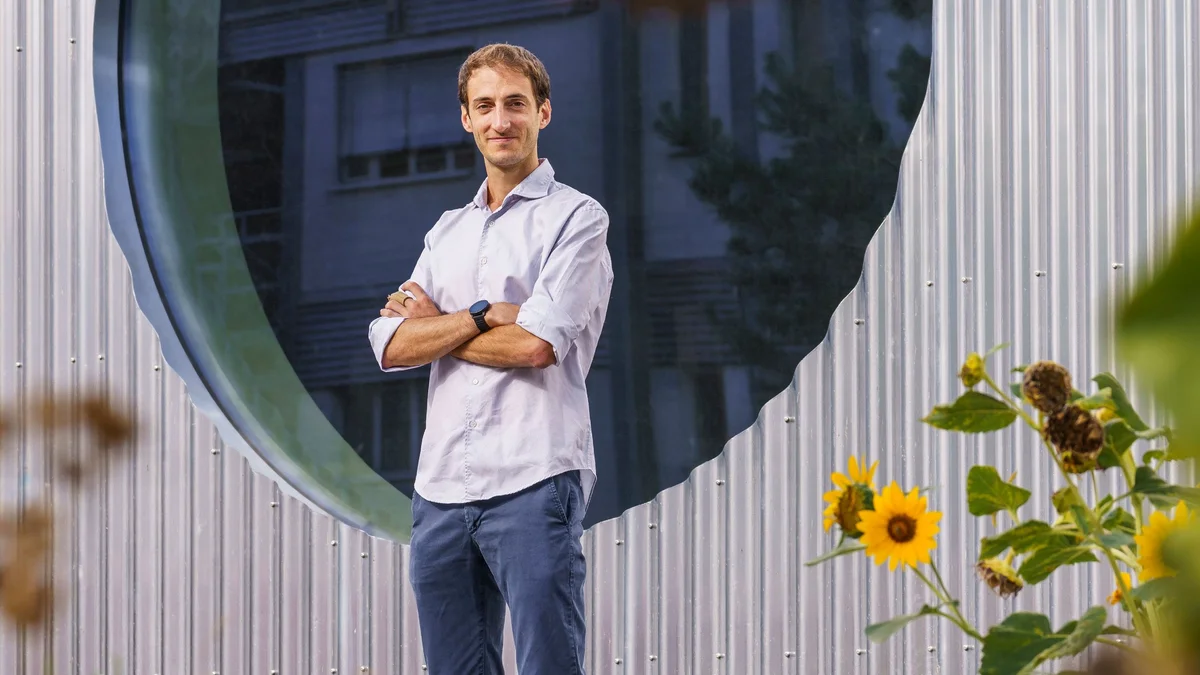
PSI physicist Giacomo Sala will receive approximately CHF 2.2 million from the European Research Council (ERC) to combine spintronics and quantum geometry in his Q-GEOMSPIN project. This novel approach, uniting established and emerging fields of physics, aims to create more efficient data storage and is now directly funded by the ERC thanks to Switzerland’s full association with EU research programs since the end of 2025.
“As far as I know, up to now no one has linked these two fields experimentally,” says Sala of the PSI Center for Neutron and Muon Science, suggesting his work could fill a gap in the understanding of spintronics. The five-year grant will support a team of researchers investigating previously overlooked spintronic effects.
ERC Grant Funds Spintronics & Quantum Geometry Combination
The European Research Council is funding Giacomo Sala’s investigation into how quantum geometry influences spintronic effects, a connection the researcher believes has been previously unexplored. Sala’s Q-GEOMSPIN project received approximately €2.3 million (CHF 2.2 million) to support five years of research at the Paul Scherrer Institute PSI, reflecting the ERC’s commitment to this novel approach.
Switzerland’s re-association with EU research programs at the close of 2025 enabled Sala to receive the funding directly from the ERC, streamlining the grant process and highlighting a recent shift in research access for Swiss-based scientists. The project builds on Sala’s prior work in both spintronics, explored during doctoral studies at ETH Zurich, and quantum geometry, investigated as a postdoctoral researcher at the University of Geneva.
He observed a gap in current spintronic understanding; theoretical physics suggests quantum geometry could predict, understand, and control certain spintronic phenomena, specifically through a subfield called quantum metric. Sala draws an analogy to gravity to explain the concept of quantum metric, noting how gravitational force dictates planetary orbits. The research aims to uncover previously overlooked spintronic effects, potentially leading to more efficient data storage and even new methods for energy harvesting and material design, though the immediate focus remains on fundamental understanding.
“Q-GEOMSPIN is purely fundamental research. But that is important, in order to develop applications from it.”
Q-GEOMSPIN Project Investigates Quantum Metric Effects on Electron Spin
Quantum geometry introduces a force-like element within materials impacting electron behavior; this quantum metric, akin to gravity, deflects electrons as they move through solids. Sala’s research focuses on linking this geometric property directly to electron spin, offering a potential new control mechanism for spintronic devices. This connection allows quantum geometry itself to become a factor influencing spin orientation, a departure from traditional spintronic approaches that rely on magnetic fields or material properties.
The ERC grant specifically supports fundamental investigation into these interactions, recognizing the potential for future applications despite the project’s primary focus. He draws a parallel to understanding electron movement, suggesting the quantum metric acts as an intrinsic property influencing their path. This research builds on established spintronics, which utilizes electron spin for information transmission, by incorporating the emerging field of quantum geometry.
The funding will facilitate detailed experimental investigation of these combined effects at the Paul Scherrer Institute PSI, allowing researchers to explore previously uncharacterized interactions between spin and quantum metric. The project aims to determine how manipulating quantum geometry can precisely control electron spin, potentially leading to more efficient and versatile data storage solutions.
“As far as I know, up to now no one has linked these two fields experimentally,”
Topological Materials & Nanotechnology Enable Q-GEOMSPIN Measurements
The availability of advanced facilities at the Paul Scherrer Institute will be central to Giacomo Sala’s investigation of quantum geometry’s influence on electron spin, enabling detailed material production and characterization. Specifically, the team will utilize the Swiss Light Source SLS and the newly established PICO cleanroom, managed by the Nanotechnology research group, for fabricating the nanoscale components essential to the Q-GEOMSPIN project. These resources allow for precise control over material properties and device construction, critical for observing subtle effects related to quantum metric.
The Swiss Spallation Neutron Source SINQ also presents potential avenues for exploration within the research, broadening the scope of experimental techniques available. Sala explains the underlying principle by drawing a parallel to gravity, stating, “It’s similar for electrons when they move through a solid.” Just as mass curves spacetime, quantum geometry curves momentum space, deflecting electrons as they travel through a material.
This curvature, resulting from the quantum metric, introduces a force-like effect on the electrons, potentially altering their spin orientation. This team will focus on topological materials, a class of substances exhibiting unique electronic properties, as a key area of investigation within the Q-GEOMSPIN framework. The project’s success relies on the interplay between these materials, advanced nanotechnology fabrication, and precise measurements, all facilitated by the infrastructure at PSI, and promises to reveal previously unexamined spintronic effects.
“It’s similar for electrons when they move through a solid,”
Giacomo Sala, experimental physicist from the PSI Center for Neutron and Muon Science
PSI Infrastructure Supports Search for Nonlinear Spintronic Phenomena
What distinguishes Sala’s work is the merging of spintronics and quantum geometry, creating a new research area with potential long-term implications for spintronic data storage. The PSI is acquiring a specialized cryostat with ERC funding, a cooling device capable of generating strong magnetic fields and reaching temperatures near absolute zero, approximately -273.15 degrees Celsius, to facilitate these measurements. Sala and his team will fabricate and measure structures only a few micrometres in size, passing an electric current through the samples while monitoring electron deflection.
Researchers are specifically seeking nonlinear effects, where minor changes in voltage or magnetic field produce significant measurement shifts, expecting these deviations to reveal insights into quantum geometry. PSI’s strategic research focus and unique infrastructure were key factors in Sala’s decision to locate his project, particularly the convergence of research lines within the new Quantum Matter and Materials Center, QMMC.
Source: https://www.psi.ch/en/news/media-releases/prestigious-research-grant-for-spin-quantum-combination


See today’s quantum computing news on Quantum Zeitgeist for the latest breakthroughs in qubits, hardware, algorithms, and industry deals.