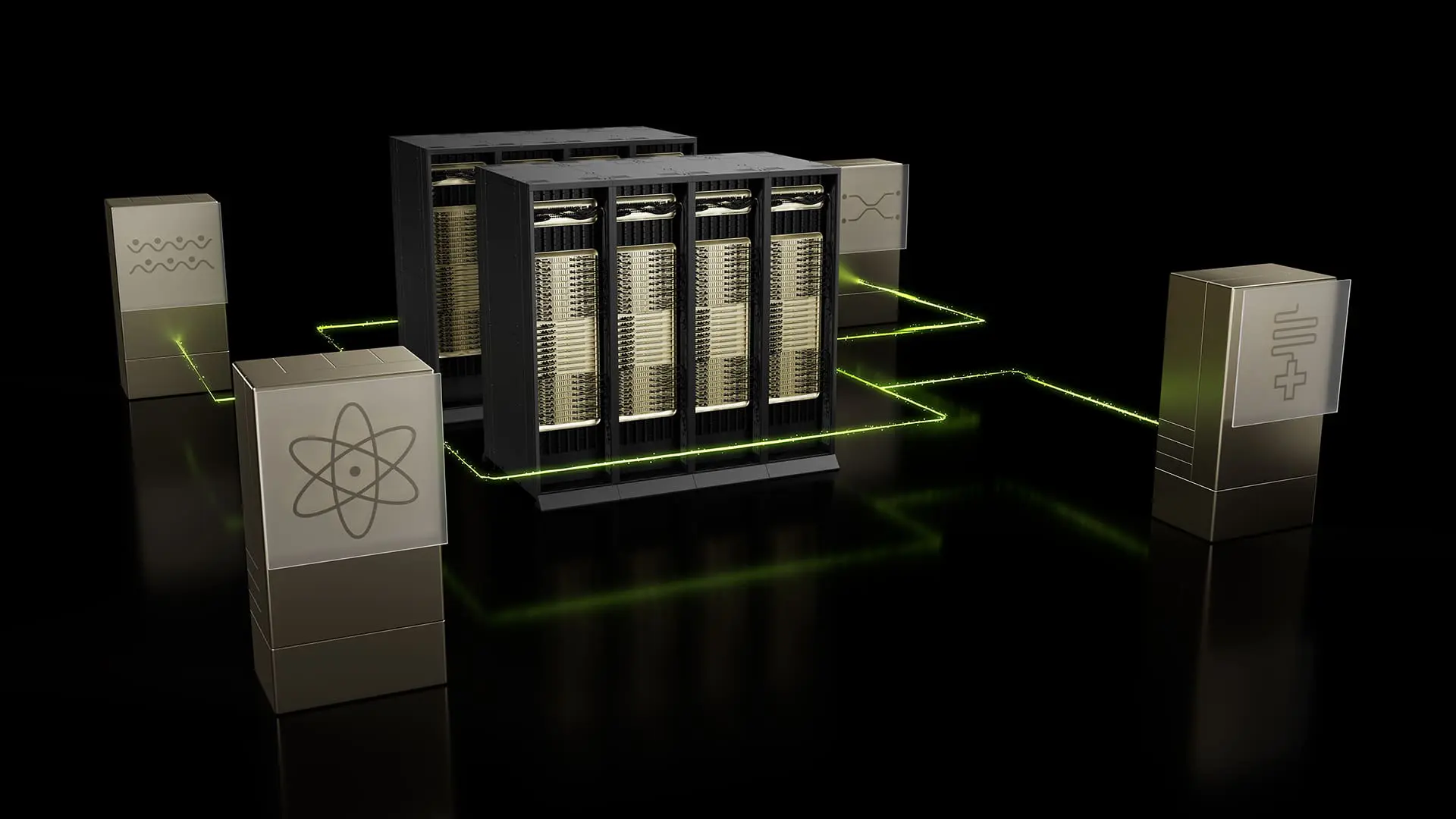
NVIDIA has announced the establishment of a research centre in Boston aimed at advancing quantum computing through collaboration with leading hardware and software developers. The NVIDIA Accelerated Quantum Research Center (NVAQC) will integrate quantum hardware with AI supercomputers to address challenges such as qubit noise and error correction, utilizing NVIDIA’s CUDA-Q platform and GB200 NVL72 systems.
Collaborating with innovators like Quantinuum, Quantum Machines, QuEra Computing, Harvard’s HQI, and MIT‘s EQuS group, the centre seeks to develop large-scale quantum supercomputers for drug discovery and materials development applications.
NVIDIA Announces Boston-Based Quantum Computing Research Center
NVIDIA has announced the establishment of a new quantum computing research centre in Boston, marking a significant step forward in advancing practical applications of quantum technology. This initiative reflects NVIDIA’s commitment to exploring the intersection of quantum computing and classical AI, aiming to unlock new possibilities for solving complex scientific challenges.
The centre will focus on developing robust error detection and correction protocols to enhance the reliability of quantum systems. Researchers will explore methodologies such as surface codes and topological error correction, which leverage quantum information structure to detect and correct errors without destroying delicate quantum states. This work is crucial for scaling up quantum systems to handle complex computations effectively.
In addition to advancing quantum error correction, the centre will emphasize the development of hybrid applications that combine quantum computing with classical AI techniques. These applications offer solutions beyond the capabilities of either approach alone, particularly in optimization problems within logistics and finance. Integrating quantum insights with classical processing power unlocks new possibilities for solving intricate scientific challenges.
The potential impact of NVIDIA’s work is substantial across various industries. As their technologies mature, healthcare, energy, and telecommunications sectors could benefit from more efficient data processing and problem-solving capabilities. The centre’s contributions pave the way for a future where quantum computing is transformative in addressing real-world issues with unprecedented efficiency.
More information
External Link: Click Here For More



See today’s quantum computing news on Quantum Zeitgeist for the latest breakthroughs in qubits, hardware, algorithms, and industry deals.