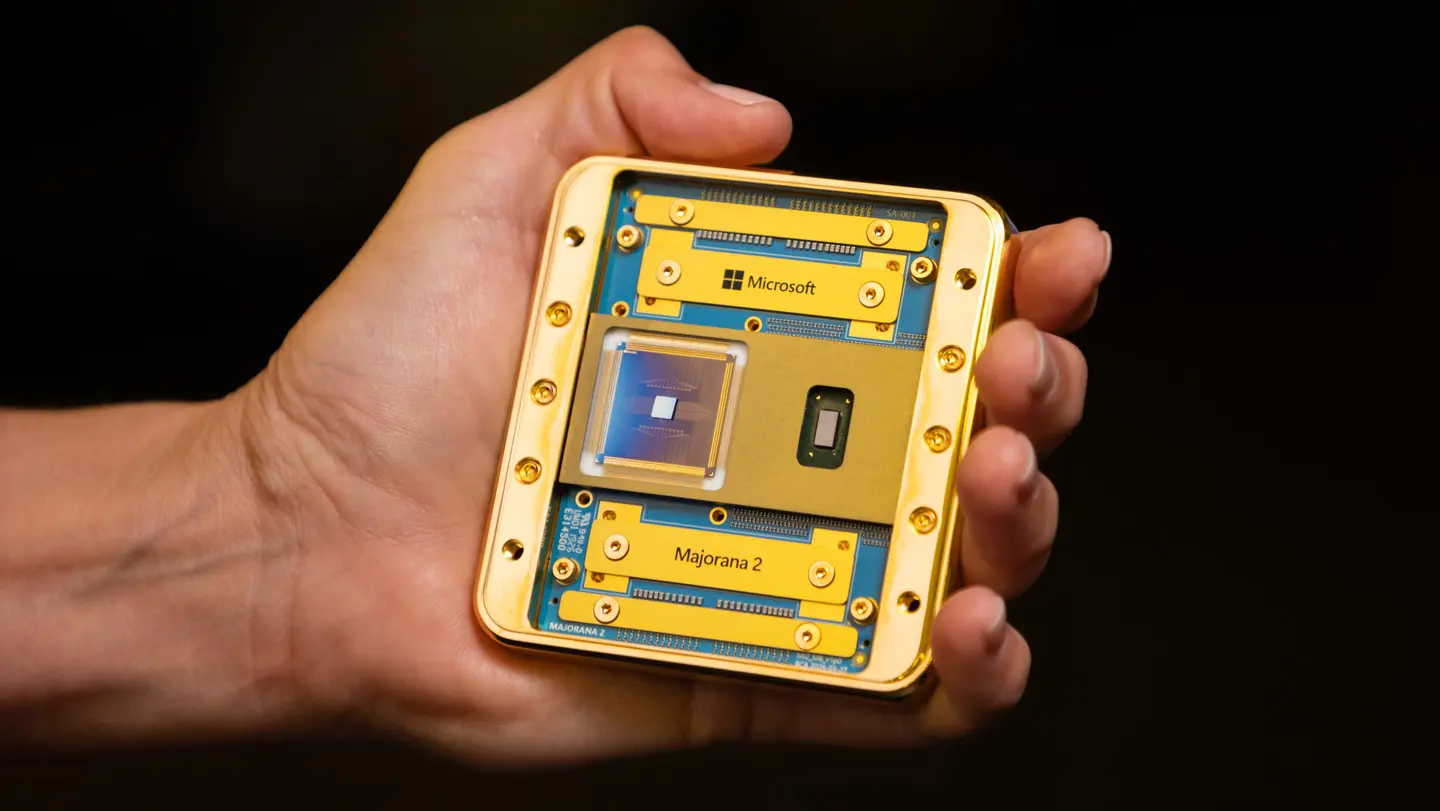
A material swap within Microsoft’s quantum chip, referred to as the Majorana 2 in a caption, has yielded a 1000-fold improvement in parity lifetime, a crucial measure of qubit stability, though skepticism persists within the field. Researchers replaced lead for the previously used material, aluminum, as the superconductor in the chip’s fabrication, and observed a jump in parity lifetime from milliseconds to approximately 20 seconds. This parity, indicating the number of electrons in tiny superconducting wires, is now maintained for a significantly longer duration, resisting random interference. “We’re seeing more than a 1000-fold improvement in this critical metric of the qubit based on this change,” said Microsoft physicist Chetan Nayak during a May 29 news conference; however, the upgrade follows a history of controversial claims and retractions in topological quantum computing, leaving some scientists unconvinced. The results are presented in a preprint paper and have not yet been peer-reviewed.
Majorana 2 Chip: Utilizing Topological Qubits
This improvement, detailed in a preprint paper posted on arXiv.org, stems from a deliberate material change during the chip’s fabrication; researchers used lead instead of a previously used superconducting material. This is an unusual choice, but appears to be central to the observed gains in qubit performance. The core of Microsoft’s approach relies on topological qubits, built from tiny superconducting wires where parity, the number of electrons, is a key indicator of qubit quality. These qubits are designed to be inherently resistant to the errors that plague conventional quantum computers, leveraging the principles of topology to protect information. The device aims to create and manipulate Majoranas, quasiparticles that exist at the ends of thin superconducting wires, with pairs of these Majoranas theoretically capable of storing information in a “nonlocal” manner, shared across the wire’s length.
Kartiek Agarwal of Argonne National Laboratory describes the researchers’ new method for probing these nonlocal properties as supporting the claim that these are indeed Majoranas. However, skepticism persists within the quantum computing community, fueled by a history of retracted papers and controversial claims in the field. Physicist Henry Legg of the University of St Andrews remains unconvinced, stating that the presented data only includes Z measurements, whereas demonstrating a functioning qubit requires both X and Z measurements. Microsoft previously reported both, but many experts remained unconvinced by the X measurements. Legg asserts, “Nothing in the presented data proves the existence of a topological qubit or Majoranas in these devices,” highlighting the high bar for acceptance in this demanding area of physics.
Lead Superconductor Improves Parity Lifetime to 20 Seconds
The pursuit of stable qubits remains a central challenge in realizing practical quantum computation, with current systems plagued by rapid decoherence and error rates. Microsoft is attempting to overcome these limitations with a novel approach centered on topological qubits, and recent modifications to the chip, researchers swapped some of the materials used to create the chip’s quantum bits during its fabrication, have yielded a substantial improvement in parity lifetime, a critical indicator of qubit quality. Previously, the qubit’s parity lifetime was measured in milliseconds; now, it is around 20 seconds, Microsoft researchers report in a paper posted on a Microsoft website and at arXiv.org, though it has yet to undergo peer review. Despite this progress, skepticism within the quantum computing community persists. Kartiek Agarwal of Argonne National Laboratory acknowledges the team demonstrated a new method probing the nonlocal properties of these Majoranas, stating, “This is fantastic progress,” but Legg maintains that the presented data falls short of definitively proving the existence of a functioning topological qubit.
Nothing in the presented data proves the existence of a topological qubit or Majoranas in these devices.
Skepticism Remains Regarding Microsoft’s Qubit Measurements
Microsoft’s recent unveiling of the chip, featuring a significant material alteration, has not fully quelled existing doubts within the quantum computing community. This shift in materials resulted in a parity lifetime extending to approximately 20 seconds, a substantial increase from previous measurements in milliseconds, but some researchers question whether this improvement translates to a genuinely functional topological qubit. The core of the skepticism centers on the need for comprehensive measurement to validate the existence of Majoranas, quasiparticles crucial to Microsoft’s topological approach.
We’re seeing this more than 1000x improvement in this critical metric of the qubit based on this change.




See today’s quantum computing news on Quantum Zeitgeist for the latest breakthroughs in qubits, hardware, algorithms, and industry deals.