

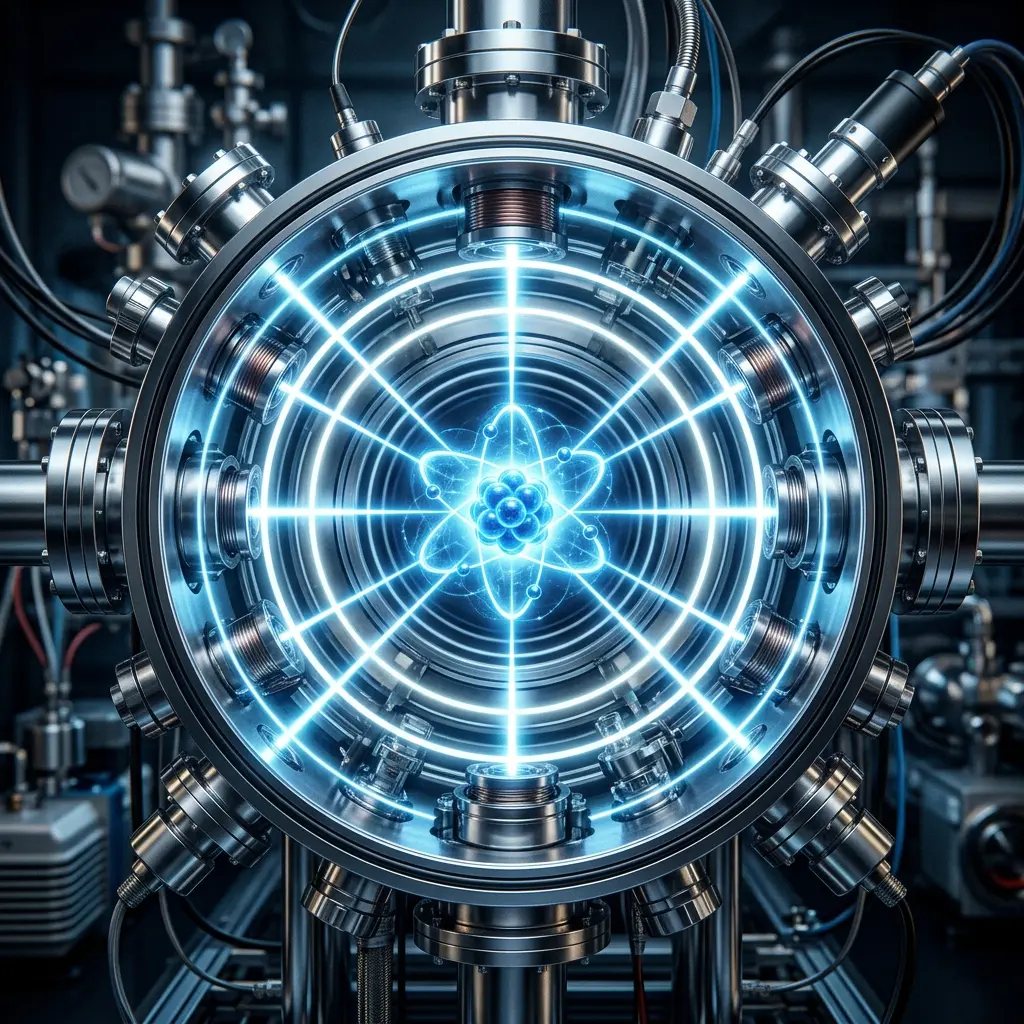
A new theoretical study has identified a previously unknown collective excitation in non-Hermitian fermionic superfluids, expanding the understanding of how these unconventional quantum systems behave. Gabriel Angelo V. Vila and Kristian Hauser Villegas developed a consistent theoretical framework showing that driven superfluids with complex pairing interactions support a collective mode absent from conventional Hermitian superfluids. Their analysis also reveals that this excitation possesses an energy gap without relying on the Anderson–Higgs mechanism, overturning a long-standing expectation for neutral superfluids.
Using a metricized formulation of non-Hermitian quantum mechanics, the researchers extended the standard Bardeen–Cooper–Schrieffer (BCS) theory through a pseudospin framework capable of describing non-Hermitian pairing dynamics. The model considers a driven BCS-type Hamiltonian with complex-valued pairing interactions and predicts a distinct collective mode that emerges solely because of the system’s non-Hermitian nature.
Unlike conventional superfluids, where resonance responses typically diverge, the study shows that the dynamical response of the non-Hermitian system remains finite at resonance. The researchers further demonstrate that the resonance spectrum depends explicitly on the initial phase of the complex superconducting order parameter, making the system’s response sensitive to its initial quantum state. As exceptional points emerge—a hallmark of non-Hermitian physics—these resonances disappear altogether.
The work also shows that the newly identified collective mode remains gapped even in the absence of the Anderson–Higgs mechanism, which ordinarily generates energy gaps through coupling to gauge fields. This finding suggests that non-Hermitian interactions alone can produce qualitatively different collective behavior, challenging existing theoretical descriptions of neutral superfluids.
Beyond introducing a consistent framework for non-Hermitian fermionic superfluids, the research highlights how gain, loss, and complex interactions fundamentally reshape collective excitations. These predictions provide new avenues for exploring driven quantum materials and could guide future experimental efforts to observe non-Hermitian collective modes in engineered many-body systems.
👉 More information
🗞 Collective modes in non-Hermitian fermionic superfluids
✍️ Gabriel Angelo V. Vila and Kristian Hauser Villegas
🧠 ArXiv: https://arxiv.org/abs/2607.18814

See today’s quantum computing news on Quantum Zeitgeist for the latest breakthroughs in qubits, hardware, algorithms, and industry deals.



