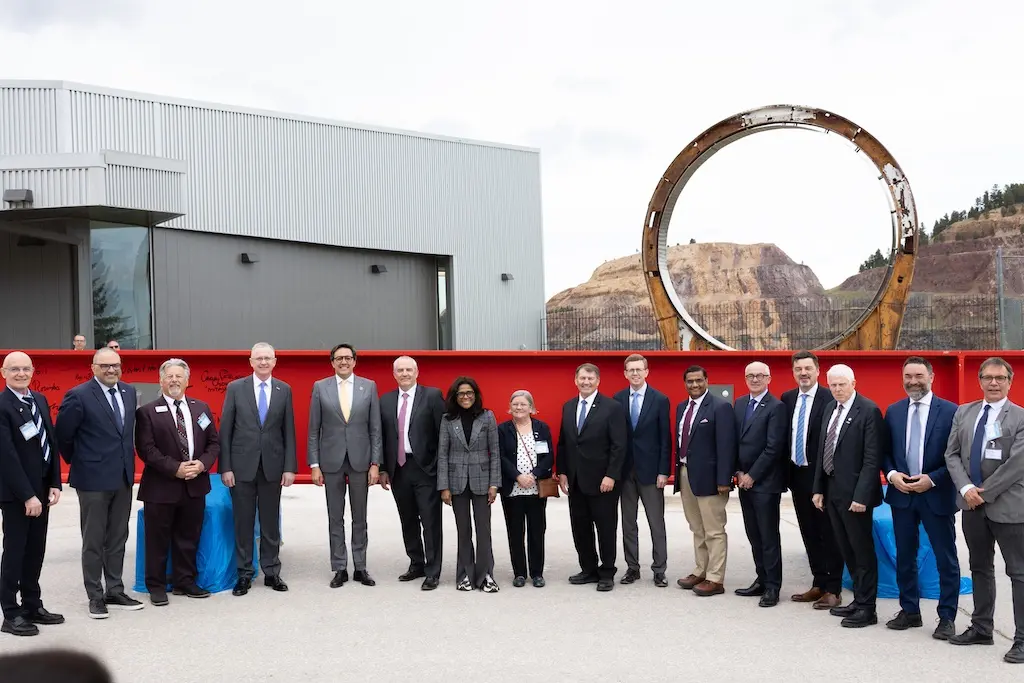
Approximately tonnes of steel beams are being lowered 1.5 kilometers underground at the Sanford Underground Research Laboratory (SURF) in South Dakota, marking substantial progress in the construction of the Deep Underground Neutrino Experiment (DUNE). The international collaboration, with a key role played by CERN, aims to understand neutrinos by sending them 800 kilometers from Fermilab in Illinois to SURF, allowing physicists to create detailed three-dimensional reconstructions of these elusive particles’ interactions. CERN Director-General Mark Thomson attended an event at SURF on May 7th to sign a beam destined for DUNE’s first detector module, each of which will be roughly the size of a five-story building. Thomson explained that this milestone highlights the strong scientific partnership between CERN and the United States.
These beams will form the structural core of the experiment’s two detectors, each planned to be the size of a five-story building, allowing for detailed measurement of neutrino interactions. Beyond neutrino research, this collaboration extends to accelerator technology; the US Department of Energy national laboratories are playing a critical role in providing superconducting magnets for CERN’s High-Luminosity Large Hadron Collider, demonstrating an exchange of expertise and resources.
CERN is contributing significantly to DUNE, not only in the development of prototype detectors but also by providing the two enormous cryostats essential for the experiment’s operation. The scale of DUNE promises a high level of detail in neutrino measurement, furthering understanding of these elusive particles and the fundamental forces governing the universe. This collaborative effort demonstrates a shared dedication to advancing particle physics through large-scale, international scientific endeavors.
This important milestone for DUNE is a testament to the strong scientific partnership between CERN and the United States.

See today’s quantum computing news on Quantum Zeitgeist for the latest breakthroughs in qubits, hardware, algorithms, and industry deals.