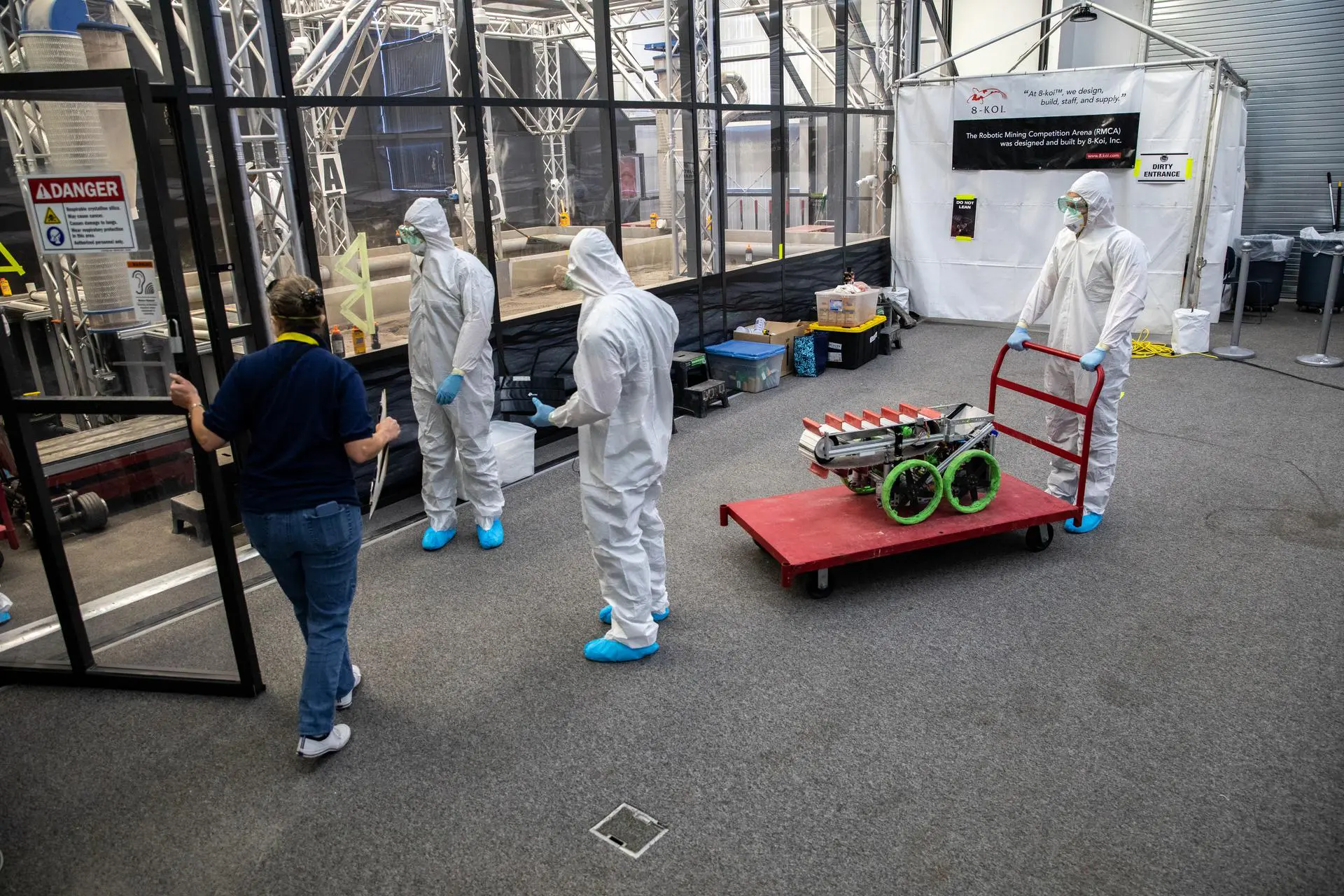
Fifty college teams are converging at the Kennedy Space Center this week to tackle a specific engineering challenge: building a protective berm from simulated lunar soil. NASA’s Lunabotics Challenge, running from May 19 to May 21, tasks students with designing, constructing, and operating robots capable of creating these barriers, a crucial skill for establishing sustainable lunar infrastructure. These are not simply robotics exercises; the rovers must demonstrate the ability to shield vital Artemis assets, potentially including a nuclear power plant from space radiation. “The task of robotically building berm structures will be important for preparation and support of crewed lunar missions,” says Kurt Leucht, a NASA software developer and In-Situ Resource Utilization researcher. NASA established the competition to engage students in STEM fields and directly support the agency’s future plans for returning to the Moon.
Lunabotics Challenge Supports Artemis Mission Preparation
The teams’ remotely operated rovers must autonomously construct a berm, a protective barrier, using simulated lunar regolith, a skill directly applicable to shielding future Artemis infrastructure from environmental hazards. This is not a theoretical exercise; the berms could safeguard equipment during landings and launches, provide shade for cryogenic propellant, and even protect a lunar nuclear power plant from space radiation. Beyond academic enrichment, the competition directly supports NASA’s long-term goals; Leucht explains that these teams are “literally helping NASA prepare for our future Artemis missions to the Moon” by developing essential engineering capabilities for lunar construction and resource utilization. The challenge runs from May 19 to May 21, with media invited to observe the robotic construction efforts on May 20.
Student Teams Design Robots for Lunar Regolith Berm Construction
Fifty college teams are currently focused on a specific engineering challenge: they are designing and constructing robots capable of autonomously building protective berms from simulated lunar regolith, a task directly relevant to upcoming Artemis missions. Unlike broader robotics exercises, this competition demands a practical construction skill, requiring the rovers to not simply collect material but to shape it into a functional barrier. This berm construction capability is envisioned as crucial for safeguarding vital lunar infrastructure, potentially shielding sensitive equipment like cryogenic propellant tanks and even a nuclear power plant from damaging space radiation.
These competing teams are not only building critical engineering skills that will assist their future careers, but they are literally helping NASA prepare for our future Artemis missions to the Moon.
Kurt Leucht, NASA software developer, In-Situ Resource Utilization researcher, and Lunabotics commentator located at Kennedy
Source: https://www.nasa.gov/news-release/nasa-invites-media-to-annual-lunabotics-robotics-competition/




See today’s quantum computing news on Quantum Zeitgeist for the latest breakthroughs in qubits, hardware, algorithms, and industry deals.