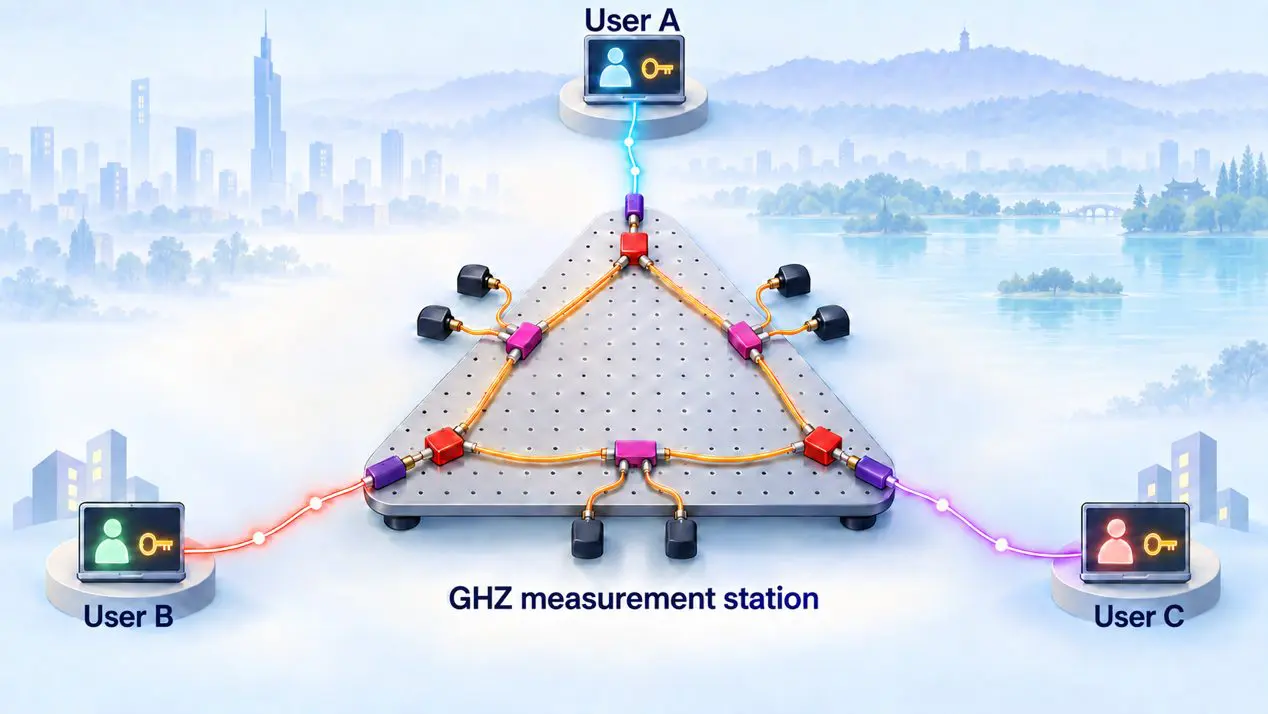
Nanjing University researchers have linked three users in a quantum communication experiment, establishing a shared secure key and moving beyond typical two-party quantum key distribution. The team reports demonstrating an asynchronous measurement-device-independent quantum cryptographic conferencing (AMDI QCC) protocol, designed to eliminate reliance on a trusted measurement station and safeguard against attacks on detection equipment.
By using a fiber-based multipath interferometer at a central GHZ measurement station, the system enables interference between signals, offering a path toward scaling multiuser quantum networks; “This change brings a fundamental improvement in how the key rate scales with transmission loss,” the researchers state. This advance addresses key challenges in building practical quantum networks by improving key generation rates and reducing control complexity. They achieved a maximum total system loss of 59.6 dB, compared with 21.5 dB and a secure key rate of approximately 4.470 × 10⁻⁹ bits per pulse.
Asynchronous Measurement-Device-Independent Quantum Cryptographic Conferencing Protocol
The new protocol achieved secure key generation with a maximum total system loss of approximately 59.6 dB, compared with approximately 21.5 dB attained in the same group’s prior polarization-encoded MDI quantum conferencing experiment. This leap in performance addresses a critical limitation of earlier multiuser quantum key distribution systems, where key generation rates diminished rapidly with increased transmission loss and user count. By moving beyond reliance on rare multiphoton coincidence events, the Nanjing University team circumvented a fundamental bottleneck hindering scalability.
Conventional measurement-device-independent quantum conferencing protocols depend on detecting multiple photons simultaneously, a process that becomes exponentially more difficult as network size increases. Professor Zeng-Bing Chen and Hua-Lei Yin’s group theoretically proposed an asynchronous approach, assembling key-generation events from single-photon detections recorded at varying times, and this work demonstrates its practical realization.
This asynchronous pairing, combined with classical post-processing of the data, allows the system to establish secure conference keys even with significant signal attenuation. Founded in 1984, the laboratory’s research extends to quantum many-body physics and the creation of quantum devices for both computing and sensing applications. A 2025 publication from Yu Yang’s group, appearing in Physical Review Letters, detailed long-range ZZ interaction via resonator-induced phase in superconducting qubits, demonstrating the laboratory’s ongoing contributions to foundational quantum technologies.
The laboratory’s active status and continued funding reflect China’s strategic investment in quantum information science, positioning it as a key player in the global effort to build secure quantum communication networks. The team’s illustration of a future metropolitan application, depicting the Nanjing landscape, suggests a vision of widespread quantum-secured infrastructure.
Improved Key Rates & Loss Tolerance in Three-User Networks
The Nanjing University team obtained a secure key rate of approximately 4.470 × 10⁻⁹ bits per pulse. This substantial improvement in loss tolerance builds on the earlier demonstration and strengthens the prospects for extending secure quantum conferencing to longer distances.
The ability to operate without strict phase locking between lasers further simplifies network implementation, reducing both cost and complexity for future deployments.




See today’s quantum computing news on Quantum Zeitgeist for the latest breakthroughs in qubits, hardware, algorithms, and industry deals.