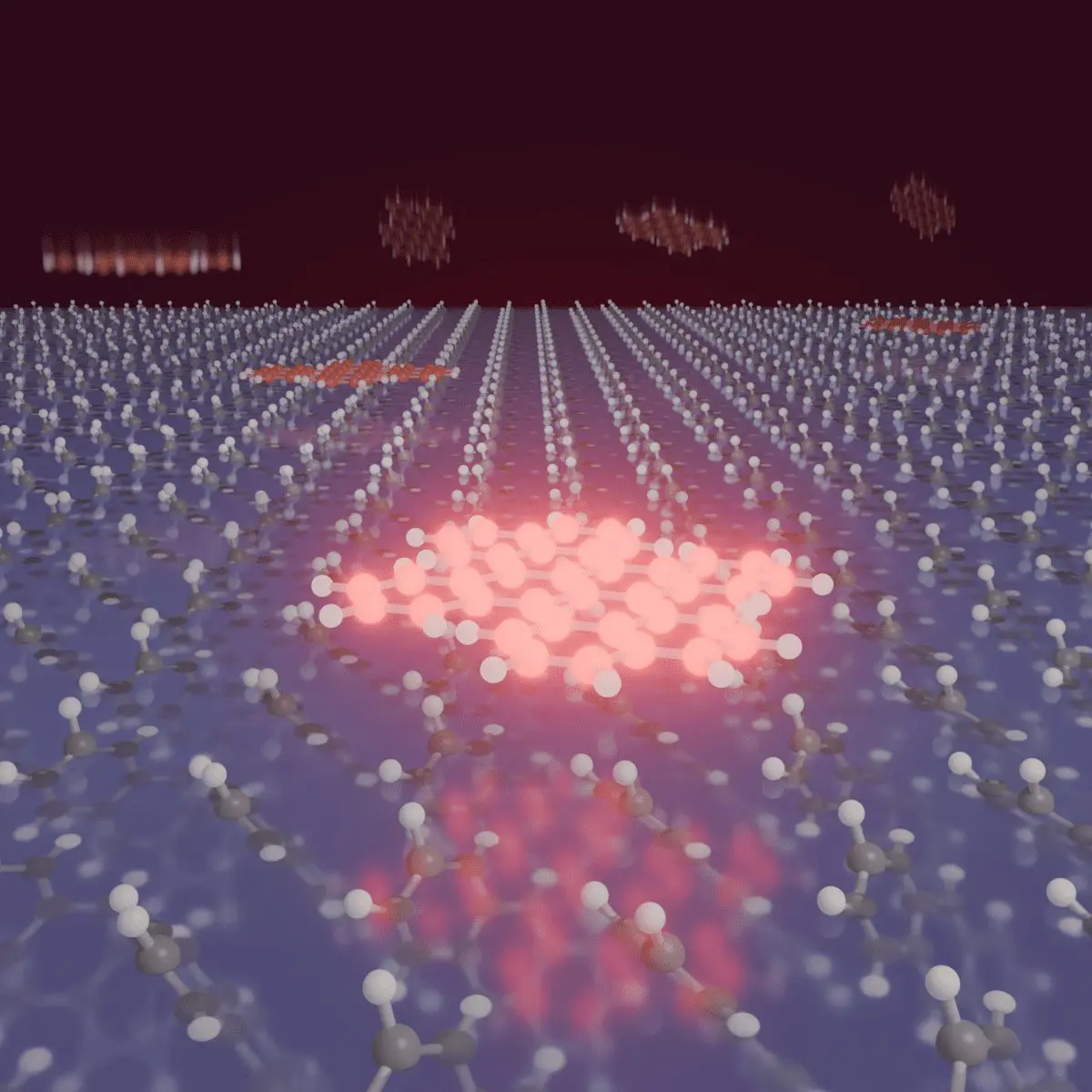
Researchers at the Max Planck Institute for the Science of Light (MPL) have, for the first time, achieved spectroscopic precision in interrogating molecules fixed to a surface, reaching what they term “the ultimate quantum limit.” This breakthrough addresses a longstanding challenge in quantum technologies; controlling the quantum properties of surface-bound molecules was previously considered impossible due to environmental instability and contaminants creating noisy surroundings. The team overcame this barrier by developing a technique to create exceptionally clean crystal surfaces through controlled evaporation and cryogenic cooling, allowing molecules to maintain quantum coherence. “The quality of quantum emitters can be evaluated by their coherence times, which indicates how long they keep their quantumness,” explains researcher Dr. Alexey Shkarin, indicating the scientists consistently reached a fundamental limit dictated by energy transfer to the environment, opening new avenues for molecular quantum technologies like single-photon generation and quantum communication.
Organic Crystal Evaporation Achieves Ultra-High Vacuum Surfaces
The team’s success, detailed in a recent Science publication, opens possibilities for both fundamental studies of molecule-surface interactions and the advancement of molecular quantum technologies. Optical quantum technologies, which rely on nanoscale objects interacting with light for functions such as single photon generation and quantum information storage, stand to benefit significantly from this development. Existing methods for maintaining quantum emitter coherence typically involve trapping atoms in vacuum or embedding them within bulk materials, limiting opportunities for direct manipulation. The MPL team circumvented the issue of surface contamination by exploiting the natural evaporation process of organic crystals; by placing a small crystal within a cryostat under vacuum, the outermost layers, and any adsorbed contaminants, sublimate, leaving an exceptionally clean surface. Alexey Shkarin is a researcher in the Nano-Optics Division at MPL.
Following the evaporation process, the crystal is cooled to just a few degrees above absolute zero, further minimizing sublimation and stabilizing the surface. Molecules are then deposited onto this pristine surface using a microfabricated oven. The researchers found that molecules placed in this environment consistently achieved the Fourier limit, a fundamental constraint on coherence time dictated by energy transfer to the surroundings, demonstrating a high level of environmental isolation. Further studies revealed that the surface itself influences the behavior of the adsorbed molecules, affecting their orientation, energy levels, and even vibrational characteristics, which could lead to future research combining this technique with atomic force and scanning tunneling microscopy for nanometer-scale control. Vahid Sandoghdar states that their future work will focus on combining this method with AFM and STM to gain local nanometer control over individual quantum emitters.
By placing their molecules on a clean surface of a crystal with a suitable molecular structure, the scientists found that their molecules consistently reached the Fourier limit, indicating that their surroundings are extremely quiet and stable.
Dr. Alexey Shkarin, researcher in the Nano-Optics Division at MPL
Fourier-Limited Coherence Times Validate Quantum Emitter Stability
The team, led by Prof. Vahid Sandoghdar, director at MPL and head of the “Nano-Optics” Division, overcame the longstanding challenge of surface contaminants which typically introduce noise that drastically reduces the coherence of quantum emitters. Their approach centers on a unique method of surface preparation, utilizing the natural evaporation of an organic crystal under vacuum to remove impurities before cooling the crystal to just a few degrees Kelvin above absolute zero. This precise control allows for the deposition of molecules onto an exceptionally clean surface using a microfabricated oven, enabling the observation of quantum properties approaching “the ultimate quantum limit.” The researchers evaluated the quality of these emitters by measuring their coherence times, a critical indicator of how long a quantum state can be maintained. Dr. Shkarin noted that the MPL team consistently observed coherence times matching the Fourier limit, confirming an exceptionally stable and quiet environment for the adsorbed molecules.
The quality of quantum emitters can be evaluated by their coherence times, which indicates how long they keep their quantumness.
Dr. Alexey Shkarin, researcher in the Nano-Optics Division at MPL



See today’s quantum computing news on Quantum Zeitgeist for the latest breakthroughs in qubits, hardware, algorithms, and industry deals.