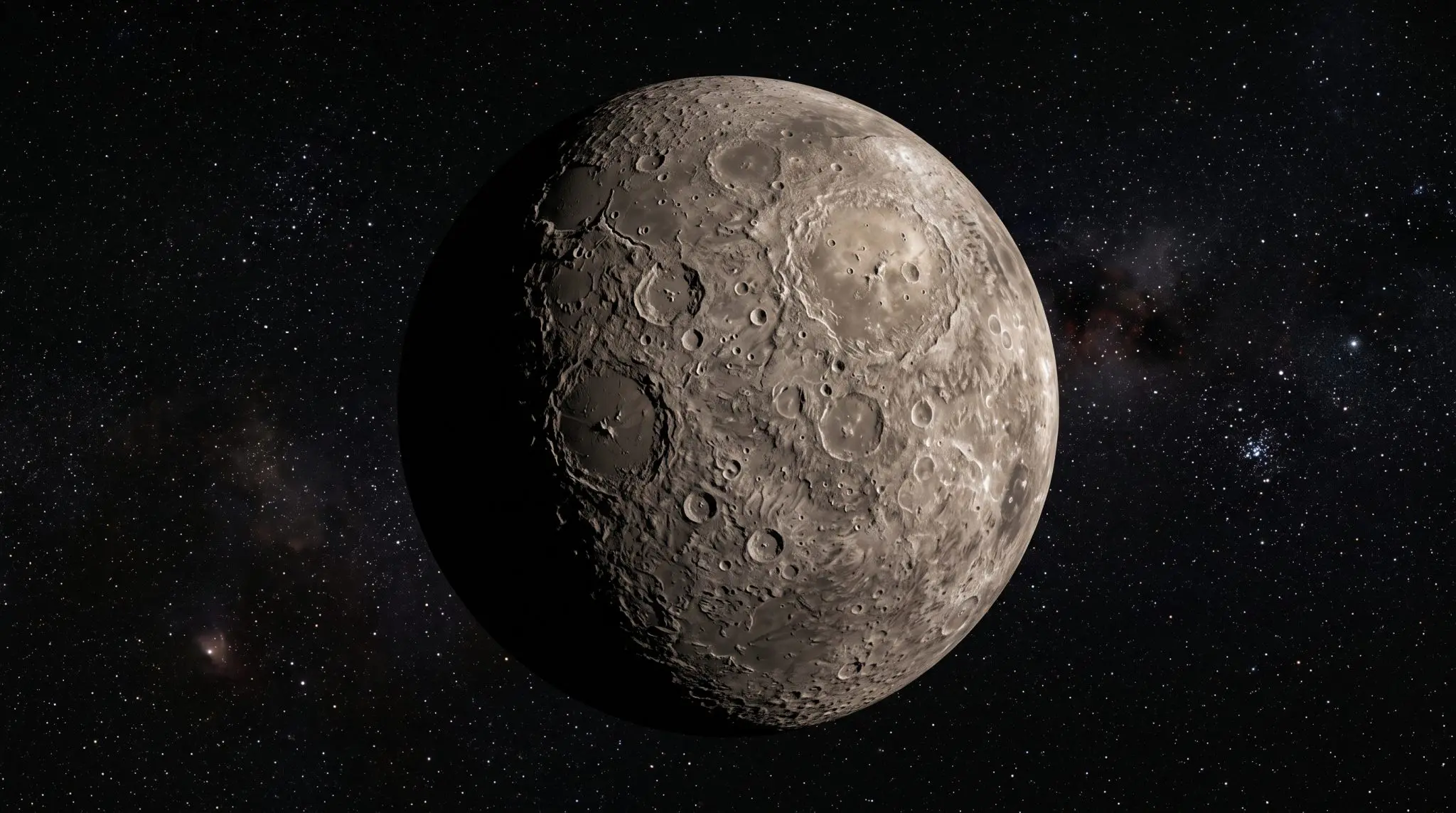
Scientists have confirmed the existence of a dynamic electron radiation belt at Mercury, resolving a decades-long debate that began with initial observations from Mariner 10 in the 1970s. The newly discovered belt can persist for several Earth days under weak solar wind forcing. Researchers integrated data from the MESSENGER mission with new analysis techniques and simulations to reveal the structured belt and its variable morphology subject to solar wind activity. This establishes Mercury as a unique natural laboratory for studying radiation-belt physics in an extreme and rapidly changing environment.
Mariner 10’s Initial Electron Detection at Mercury
Mariner 10 first indicated the presence of energetic electrons surrounding Mercury in the 1970s, a finding that initiated a scientific discussion lasting over four decades before recent analysis confirmed the initial observations. Approximately 40 years later, measurements from the MESSENGER mission cast doubt on the existence of a stable, trapped radiation belt at the innermost planet.
These later observations prompted a re-evaluation of the original Mariner 10 data and a search for conclusive evidence of a persistent electron reservoir. The ambiguity stemmed from the limitations of both missions’ instrumentation and the challenging environment around Mercury, where intense solar wind activity and a weak intrinsic magnetic field complicate particle detection.
MESSENGER’s Neutron Spectrometer (NS) detected energetic electrons continuously present for several minutes, but discerning between stably trapped particles and those repeatedly injected and lost proved difficult at the instrument’s 20-second resolution. This temporal resolution was comparable to the drift period of 100-keV electrons near Mercury, hindering definitive identification of a sustained radiation belt by making it difficult to distinguish between stably trapped electrons and the repeated injection of rapidly lost particles.
However, higher-resolution measurements from MESSENGER’s Gamma-Ray Spectrometer (GRS) revealed that some electrons completed multiple orbits around the planet before being lost, suggesting the possibility of stable trapping. Integrating these indirect measurements from both NS and GRS with advanced particle simulations and theoretical modeling, researchers have now demonstrated that Mercury can indeed host stable energetic electron populations for extended periods.
These populations, similar to radiation belts found throughout the Solar System, can persist for several Earth days under weak solar wind forcing. The team’s analysis revealed that the stability of the belt is linked to Mercury’s orbital position; it tends to be stable when Mercury is at aphelion, its farthest point from the Sun, and less stable during perihelion, its closest approach.
This population remains stable when Mercury is at aphelion under weak upstream forcing but becomes unstable under extreme driving, as electron drift orbits bifurcate when strong solar wind influence increases. Particle tracing simulations further clarified the dynamics, showing that during periods of intense solar wind forcing, electron drift orbits bifurcate about the magnetic equator, leading to rapid particle loss.
These simulations demonstrated that electrons can follow conventional drift paths near aphelion, remaining stably trapped, but transition to bifurcated orbits near perihelion, resulting in increased loss rates. The researchers identified a bounce unstable zone where electrons are lost in the southern hemisphere due to Mercury’s weaker magnetic field, further defining the boundaries of the stable radiation belt.
MESSENGER’s Indirect Energetic Electron Measurements
The team reconciled these indirect observations from both NS and GRS to identify instances of stable energetic electron structures within Mercury’s magnetosphere and contextualize them with particle tracing simulations. The presence of high-energy protons, resembling ring-current populations, collocated with the energetic electrons further complicates the system and offers additional avenues for research.
For example, analysis of two MESSENGER passes revealed a long-duration energetic electron event aligning with the bounce unstable zone, where electrons are expected to be lost in the southern hemisphere, and a second event composed of several impulsive injections with high loss rates. These findings demonstrate the complex interplay between solar wind forcing, magnetic field dynamics, and energetic particle behavior at Mercury.
Solar Wind Driving of Mercury’s Magnetosphere
The current work integrates MESSENGER’s sensitive indirect energetic electron measurements with particle simulations and theoretical modeling to reveal a structured radiation belt whose morphology is demonstrably influenced by solar wind activity. These simulations demonstrated that the belt’s instability is linked to the formation of ‘Shabansky’ orbits, where electrons bounce rapidly between the magnetic equator and the northern surface, accelerating their loss.
This makes Mercury a unique natural laboratory for studying energetic particle dynamics, particularly the processes of trapping and loss. The findings establish that even compact magnetospheres can host radiation belts and offer insights into the fundamental mechanisms governing their formation and evolution, potentially informing our understanding of similar phenomena occurring throughout the solar system and beyond.
Electron Drift Orbit Bifurcation Near Perihelion
This new work demonstrates that Mercury’s radiation belt isn’t a constant feature, but rather its stability is intrinsically linked to the planet’s orbital position and the intensity of the solar wind. Detailed analysis of MESSENGER data revealed that the behavior of electrons within the radiation belt changes dramatically depending on whether Mercury is near its closest approach to the sun, known as perihelion, or its farthest point, aphelion. When Mercury is at aphelion and experiences weak upstream forcing, the electron population remains relatively stable, executing conventional drift orbits around the planet.
However, as Mercury approaches perihelion and is subjected to more intense solar wind driving, these electron drift orbits bifurcate about the magnetic equator, leading to increased particle loss, disrupting the belt’s structure and reducing its duration. Two MESSENGER passes provided key data for this analysis; one during a period with stable electron signatures, and another during a period with fluctuating signals indicative of impulsive electron injections.
The first pass showed a long-duration energetic electron event with a high latitude edge aligning with a bounce unstable zone, suggesting a stable population. The second pass revealed a series of short-lived, impulsive events.
Stable Electron Populations During Aphelion
Particle tracing simulations demonstrate that this stability is pronounced when Mercury is at aphelion, the furthest point in its orbit from the sun, and subjected to weaker solar wind forcing. During these periods, electrons remain confined within the planet’s magnetosphere, completing multiple drift orbits around the planet without significant loss. However, this stability is not absolute.
Analysis of two MESSENGER passes revealed distinct differences in electron behavior depending on the prevailing solar wind conditions. “A long-duration energetic electron event reaching >100 keV occurred close to the planet,” the study reports, indicating a sustained population of trapped particles. These events were characterized by rapidly lost electrons. The researchers found that during these impulsive events, electrons drifted in what are known as ‘Shabansky’ orbits, a phenomenon where electron trajectories bifurcate about the magnetic equator.
The paper highlights the link between orbital dynamics and particle loss. This unique environment offers scientists a “natural laboratory for radiation-belt physics usually inaccessible at Earth: one of an extreme, rapidly driven state,” allowing for the investigation of phenomena rarely, if ever, observed elsewhere in the solar system.
This extreme environment allows for the investigation of previously inaccessible phenomena, furthering our understanding of radiation belt physics and space weather effects throughout the solar system.



See today’s quantum computing news on Quantum Zeitgeist for the latest breakthroughs in qubits, hardware, algorithms, and industry deals.