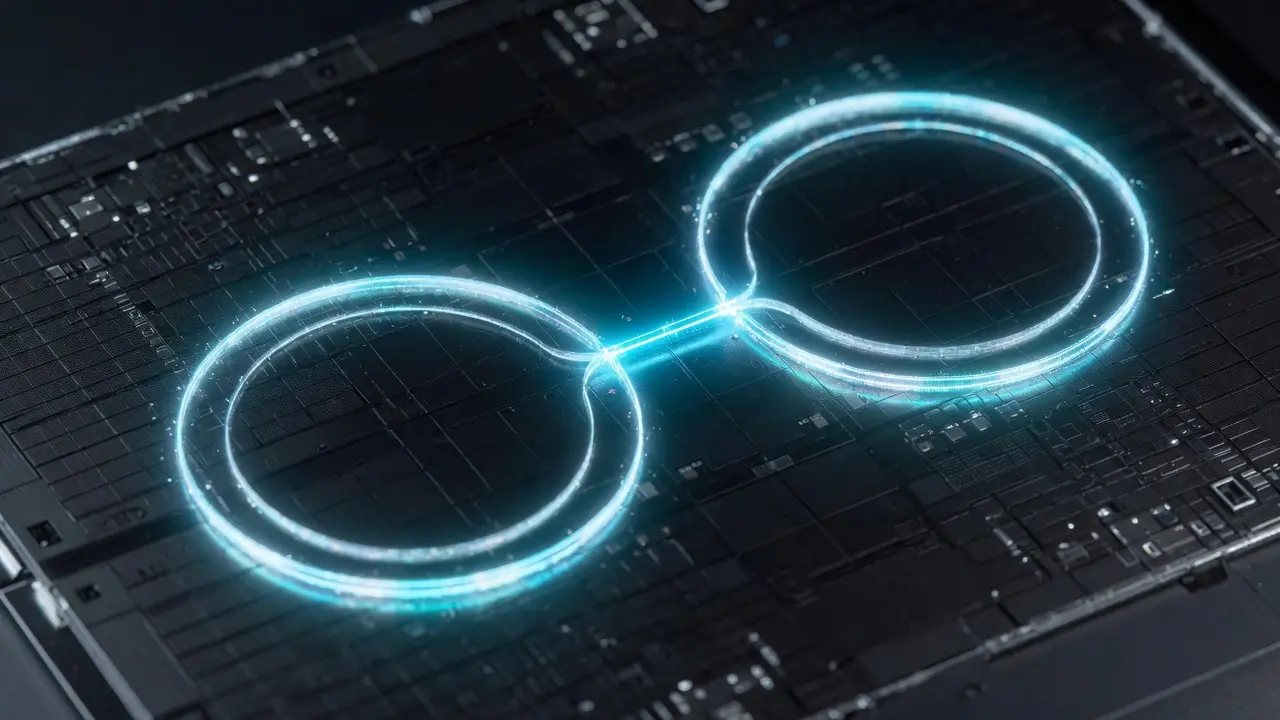
Researchers from RWTH Aachen University, the Max Planck Institute for the Science of Light, Delft University of Technology, Karlsruhe Institute of Technology, and the Université de Strasbourg show how to generate steady-state entanglement in a two-stage conversion setup between optical and microwave photon which employs resonantly coupled magnetic and mechanical excitations. Simulations show the setup achieves a maximum teleportation fidelity of 0.75, suggesting a viable resource for quantum information science applications.
Cavity Magnomechanical System Mediates Optics-Microwave Entanglement
Generating entanglement between optical and microwave photons offers a pathway to transfer quantum information between distant components, potentially bridging the gap between optical fiber networks and superconducting quantum processors. The work detailed in this research demonstrates a method for achieving steady-state output-entanglement, a persistent quantum link, in a continuous variable system using a cavity magnomechanical system. This approach bypasses limitations found in single-stage frequency converters, offering a more robust means of linking disparate quantum systems.
The system relies on a magnetic material functioning as both an optical cavity and a host for mechanical vibrations, coupled to a microwave resonator. The efficiency of this entanglement generation is determined by system design and the intensity of the optical drive, eliminating the need for precise control of intermediate coupling rates.
Yittrium Iron Garnet Disk Enables Hybrid Quantum Interactions
An Yittrium Iron Garnet disk, measured in micrometers, forms the core of a new approach to linking optical and microwave photons, potentially enabling efficient quantum information transfer between disparate systems. Simulations demonstrate that optimizing parameters for frequency conversion also maximizes the generation of entanglement, a critical resource for quantum technologies. This design bypasses limitations inherent in systems where strong interactions require precise tuning, offering a more stable platform for quantum networks.
The research team studied the unique properties of magnons, magnetic excitations, within the Yittrium Iron Garnet disk, coupling them to both mechanical vibrations and optical photons. This resonant coupling allows for a “two-stage conversion setup” where quantum information can be translated between the different frequencies, a process important for interfacing quantum computers and long-distance communication channels. The ability to achieve both efficient frequency conversion and high entanglement simultaneously represents an advancement, as these goals often present conflicting design constraints.
The team’s calculations reveal that the system can achieve a maximum teleportation fidelity of 0.75 under optimized conditions. Further analysis focused on the conditions needed to maximize entanglement between output optical and microwave modes, revealing that steady-state entanglement generation is possible in continuous variable systems. This is particularly valuable because maintaining entanglement over time is essential for practical applications, unlike many experiments that produce fleeting quantum links.
By applying a rotating wave approximation and neglecting certain terms in the Hamiltonian, researchers simplified the model while still accurately predicting the behavior of the hybrid modes formed by the coupled optical, microwave and magnonic systems. The resulting hybrid modes, with frequencies determined by the system’s parameters, are key to achieving efficient entanglement and frequency conversion. The capacity of this setup to generate entanglement is dependent on the strength of the interactions between the subsystems. The team’s work demonstrates a pathway to maximizing this interaction.
Cooperativity and Two-Stage Entanglement Generation
Optimizing both frequency conversion and entanglement simultaneously is key for practical quantum systems, and this work demonstrates a pathway to achieve that balance. The mechanical mode frequency, dictated by the system’s geometry, establishes the necessary frequencies for all other modes, while the magnon mode frequency is adjustable via an external magnetic field. Numerical analysis indicates resonance can be achieved at a specific frequency for optimized performance.
The study also considered the impact of real-world noise on entanglement, acknowledging that measurement chain noise would likely reduce usable entanglement. Mitigation strategies include exploring more efficient designs, such as microstructured crystals, which have already been fabricated and tested. A large mechanical Q-factor ensures entanglement generation at reasonable optical pump powers, even with a relatively small base-value of optomechanical cooperativity.
Magnon-Phonon Interaction Lifts Conversion Constraints
Researchers harnessed the resonant interaction between magnons and phonons, magnetic and mechanical excitations, to mediate entanglement in a hybrid system, effectively bypassing limitations encountered in single-stage converters. This process uses pair-creation and annihilation, inducing two-mode squeezing that generates entanglement suitable for quantum information protocols like state transfer. This approach differs from previous work by focusing on a blue optical detuning case, where the drive frequency exceeds the cavity resonance frequency, establishing the conditions for efficient entanglement generation.
The study reports, indicating a viable resource for applications requiring reliable quantum communication. The researchers incorporated resonant magnon-phonon and magnon-microwave couplings with radiation pressure interaction between optical photons and phonons to achieve this level of entanglement, maximizing output by operating the system near instability without demanding precise matching of cooperativities. The design offers a potential route toward scalable quantum networks and integrated quantum technologies, where efficient entanglement distribution is paramount.
Blue-Detuned Drive Activates Photon-Phonon Pair Creation
Mechanical degrees of freedom is an important intermediary for engineered interactions between traveling and output modes within this system, enabling efficient coupling to photons by hosting microwave-frequency phonons inside an optical and microwave cavity. This cavity enhances coupling strength through photon confinement. The radiation-pressure interaction between optical photons and phonons activates photon-phonon pair creation when driven by an optical source tuned to a frequency one phonon frequency higher than the cavity resonance, a technique known as blue detuning.
The system’s design incorporates optical and microwave modes that connect to external ports, such as optical fibers and microwave cables, allowing for signal transmission and measurement. This interaction then distributes those correlations among the system’s components, phonons, magnons and ultimately, the entangled optical and microwave outputs, creating a multipartite steady-state entanglement.
The researchers used parameters detailed in Tab. 2 to define the behavior of hybrid modes at specific frequencies, allowing for precise control over the entanglement process. A blue-detuned drive activates a two-mode squeezing interaction, generating entangled pairs of excitations, and distributing that entanglement across the system’s constituents.
The team accounted for both intrinsic and input noise contributions, including thermal and vacuum fluctuations, within their calculations, modeling the system’s dynamics using Heisenberg-Langevin equations. These equations, expressed in matrix form, describe the interplay between creation and annihilation operators, dissipation rates and external noise sources, providing a comprehensive framework for understanding the system’s behavior and optimizing entanglement generation.
Teleportation Protocol Benchmarks Entanglement Capacity
The fidelity of continuous variable teleportation, a key metric for assessing quantum communication potential, reached 0.75 in a recent simulation of a novel optomechanical system. This level of performance, detailed in new work, suggests a viable path toward transferring quantum information between optical and microwave photons, bridging a significant gap in quantum networking. The system uses a Yittrium Iron Garnet (YIG) disk to generate and manipulate the entangled states necessary for the Vaidman, Braunstein and Kimble (VBK) teleportation protocol.
This protocol relies on mixing an unknown quantum state with one half of an entangled pair, then performing measurements to reconstruct the state on the other half. Quantifying entanglement capacity required solving the coupled equations of motion governing each mode within the system, accounting for both intrinsic decay and coupling to output ports.
Researchers modeled the open dynamics using Heisenberg-Langevin equations, revealing that entanglement can be maximized simultaneously with frequency-conversion efficiency. The resulting intra-cavity entanglement, between the optical and microwave modes, is then distributed to the output modes, making it accessible for experimental verification and state teleportation. The team’s simulations, based on a mounted YIG-disk geometry, find a maximum teleportation fidelity of 0.75 for the proposed setup.
This improvement is significant because it demonstrates a pathway toward building practical quantum interfaces. The analysis assumes ideal measurement apparatuses, a simplification acknowledging current technological limitations. The level of entanglement achieved, quantified as 1, indicates a strong correlation between the output modes, essential for reliable state transfer.
Optimized Conditions Maximize Teleportation Fidelity (0.75)
Simulation results indicate a maximum teleportation fidelity of 0.75 is achievable with the proposed system, a key metric for assessing the viability of quantum state transfer between optical and microwave photons. This fidelity was determined using a model based on a micrometer-scale Yittrium Iron Garnet disk, with performance assessed through both simulations and estimations of realistic parameters. The fidelity’s dependence on port coupling efficiencies reveals a detailed relationship beyond simple frequency conversion, with matching efficiencies proving important for maximizing entanglement.
The research also explored the impact of optical and microwave photon mode linewidths on teleportation fidelity, linking these to the conditions required for maximizing entanglement. This represents an improvement over fully classical local approaches to the same task.
Optical Fiber and Microwave Cable Serve as Output Ports
Optical fibers and microwave cables function as output channels in a system for entangling light and microwave photons. This design allows for the direct accessibility of entangled states, a necessary step toward practical applications like quantum state teleportation between different types of quantum processors. The system uses an Yittrium Iron Garnet disk to mediate the entanglement, with optical and microwave signals coupled to external ports for observation and use.
The ability to generate steady-state output-entanglement, rather than fleeting instances, is a key feature of this approach. This persistent entanglement is achieved through a cascade of interactions beginning with a blue-detuned coherent drive activating photon-phonon pairs within the disk. These vibrations then couple to magnons, collective spin excitations and ultimately to microwave photons, distributing the quantum correlation across the system. Maximizing entanglement does not necessitate perfectly matched coupling strengths between the optical and microwave components, a simplification that eases design constraints.
Optical signals are channeled through a whispering gallery mode within the disk, coupling to an optical fiber, while microwave signals interact with a ring resonator. A thicker disk was deliberately chosen to amplify the optomechanical interaction strength, which is the primary source of entanglement.



See today’s quantum computing news on Quantum Zeitgeist for the latest breakthroughs in qubits, hardware, algorithms, and industry deals.