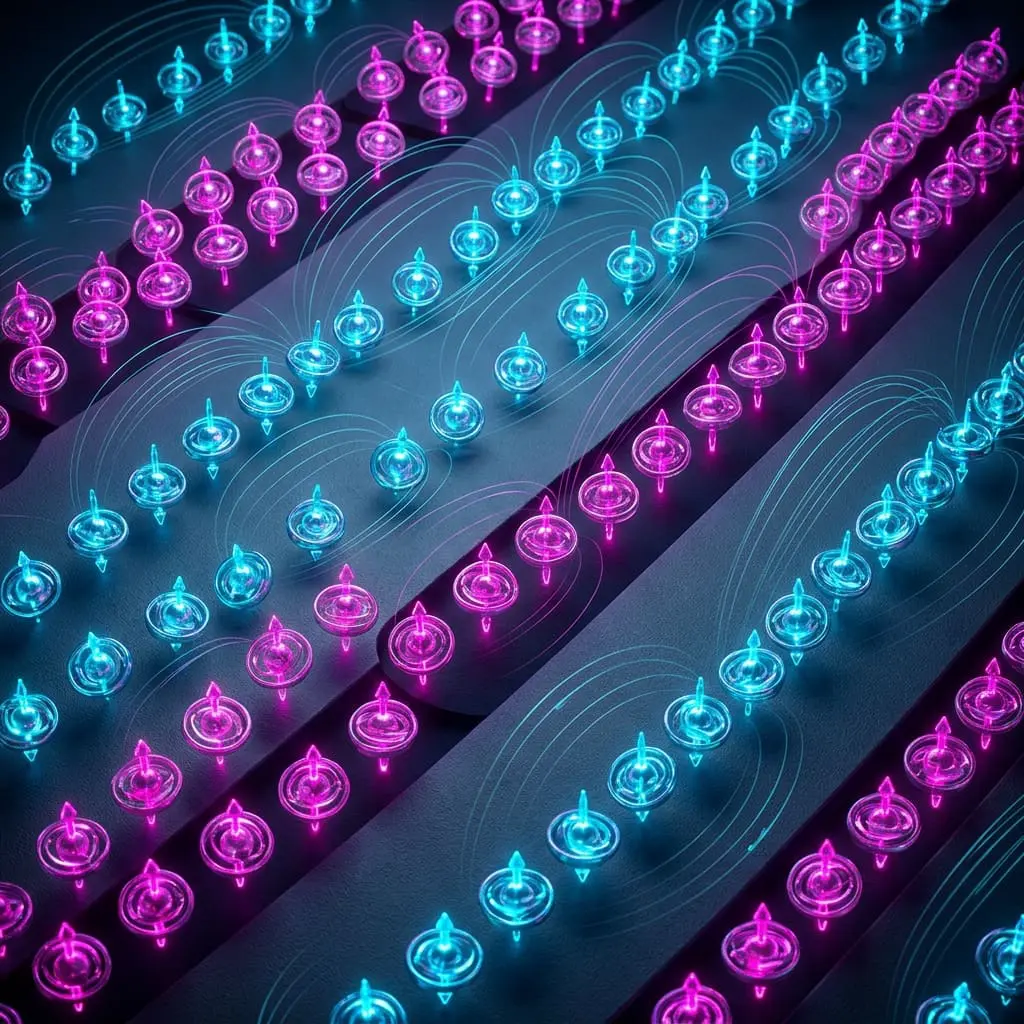
Massachusetts Institute of Technology researchers have simplified the creation of entangled spin states, reducing the experimental resources needed from a scaling factor of O(Nq) to a fixed cost, independent of the number of qubits, Nq, within ensembles ranging from approximately 10 to 100 emitters. The team, based in the Department of Electrical Engineering and Computer Science and the Research Laboratory of Electronics, achieved this by reframing the challenges posed by inherent variations in solid-state defects, leveraging those differences as a resource rather than an obstacle. Specifically, an optimized pulse sequence, a Carr-Purcell-Meiboom-Gill (CPMG) based protocol, enhances ensemble-average coherence times by more than a factor of 7 relative to traditional methods. This approach also maintains single-qubit gate fidelities exceeding % for errors (normalized relative to Rabi-drive strength) up to 0.3, while maintaining fidelities above 99% even for errors as large as 0.4, demonstrating robustness against parameter variations.
Optimized Pulses Correct Inhomogeneities in Spin Ensembles
Coherence, the duration for which a quantum state remains stable, has been demonstrated in spin ensembles with a factor of seven increase through the implementation of carefully designed control pulses. This marks a significant step toward scalable quantum technologies. Researchers at the Massachusetts Institute of Technology and ETH Zürich have developed an optimized pulse sequence, based on a Carr-Purcell-Meiboom-Gill (CPMG) protocol, that actively mitigates the impact of variations within ensembles of quantum emitters. These inhomogeneities, stemming from slight differences in the emitters’ characteristics, traditionally complicate quantum control and limit the duration of quantum information storage. The team’s approach fundamentally alters how these imperfections are addressed; instead of attempting to eliminate these variations, a costly and often impractical endeavor, they leverage a single, globally applied control pulse to automatically correct for them across the entire ensemble.
This simplification represents a substantial reduction in the complexity and cost of quantum experiments, potentially broadening access to advanced quantum research. The researchers state that these techniques provide foundational tools, including global unitary control, phase denoising, remote entanglement, and compilation, for scalable quantum computing architectures based on heterogeneous spin ensembles. Crucially, this optimized pulse sequence doesn’t compromise the fidelity of individual qubit operations. Single-qubit gate fidelities exceeded % for errors (normalized relative to Rabi-drive strength) up to 0.3, demonstrating a remarkable robustness against parameter variations like pulse-length and frequency detuning. Even with larger errors, up to 0.4, fidelities remained above 99%, suggesting a system less sensitive to precise calibration.
This resilience is particularly important for solid-state qubits, which are inherently prone to imperfections. The researchers anticipate sharply reduced heating when driving a global resonant optimal dynamical decoupling across numerous silicon-vacancy spins, potentially resolving the long-standing trade-off between spin coherence and scaling to larger qubit numbers. The team’s findings offer a practical toolkit for building large-scale quantum processors from imperfect solid-state hardware, bringing measurement-based quantum computing closer to realization.
CPMG Protocol Enhances Silicon-Vacancy Coherence Times
The pursuit of stable quantum bits, or qubits, continues to rely heavily on solid-state defects, particularly silicon-vacancy (SiV) centers in diamond. Maintaining qubit coherence remains a significant hurdle, as current systems grapple with inherent imperfections within these materials, leading to variations in the energy levels of individual SiV centers and ultimately limiting the duration of quantum information storage. Researchers are now refining techniques to mitigate these issues, moving beyond simple averaging to actively correct for these inhomogeneities and extend coherence times, the period for which a qubit reliably holds quantum information. This enhancement is particularly notable given the challenges of maintaining high-fidelity operations while simultaneously addressing these imperfections. This optimized approach doesn’t merely extend coherence; it does so without sacrificing the precision of individual qubit operations.
Single-qubit gate fidelities exceeded % for errors (normalized relative to Rabi-drive strength) up to 0.3, while maintaining fidelities above 99% even for errors as large as 0.4, demonstrating a remarkable robustness against variations in pulse length and frequency. This tolerance for error is a critical step towards practical quantum computing, reducing the need for extremely precise calibration and control. The team has significantly simplified the experimental requirements for creating optically heralded spin cluster states. The implications extend beyond coherence and fidelity, as this reduction in heat dissipation is vital for maintaining the ultracold temperatures required for quantum computation, paving the way for systems with significantly more qubits. The team’s modified single-photon entanglement protocol also yields order O(, 10^4) more entanglement links than bang-bang sequences, with theoretical guarantees of order Ω(Nq) unique links, further bolstering the potential for complex quantum networks.
Scalable Entanglement via Modified Single-Photon Protocol
Pratyush Anand, Louis Follet, Odiel Hooybergs, and Dirk R. Englund, along with their team, have developed a modified single-photon entanglement protocol designed to dramatically simplify the resources needed for creating entangled states within spin ensembles. Their work addresses the inherent imperfections present in solid-state qubits, specifically silicon-vacancy centers in diamond, which traditionally complicate quantum control. A key breakthrough lies in the team’s ability to leverage the natural diversity among these emitters, rather than attempting to eliminate it. This improvement, relative to traditional interleaved bang-bang-based CPMG, is particularly significant given the limitations of current dilution refrigeration systems and the trade-off between spin coherence and scaling. The experimental complexity of creating optically heralded spin cluster states has been substantially reduced; conventional methods require resources scaling with the number of qubits, denoted as O(, 10^4).
This simplification is coupled with remarkable robustness against parameter variations. 4, demonstrating the system’s resilience to imperfections in pulse length and frequency detuning. The implications of this work extend beyond improved coherence and scalability, offering enhanced fidelity, scalability, and robustness, paving the way for more complex and powerful quantum systems.
Reduced Heating Enables Scaling to Nq > 1
The pursuit of scalable quantum computing has long been hampered by a fundamental trade-off: maintaining qubit coherence while increasing system size. Recent advances from a team at the Massachusetts Institute of Technology, however, suggest a path toward overcoming this limitation, with implications for building larger, more stable quantum processors. Their work, focused on ensembles of silicon-vacancy (SiV) centers in diamond, demonstrates a significant reduction in heat generation alongside improved coherence times, critical steps toward realizing practical quantum computation. A key breakthrough lies in the optimization of control pulses applied to these spin ensembles. Researchers achieved a factor of more than seven improvement in coherence times using a modified Carr-Purcell-Meiboom-Gill (CPMG) protocol, relative to traditional interleaved bang-bang-based CPMG.
This enhancement is particularly notable because it was accomplished while simultaneously addressing the inherent imperfections present in real-world quantum systems. The researchers acknowledge that among the major challenges are inhomogeneities in emitter fine structure, which complicates quantum control, but their framework leverages this diversity to simplify experimental demands. The optimized pulse sequence minimizes heat dissipation within the dilution refrigeration systems essential for maintaining the extremely low temperatures required for qubit operation.
Heterogeneous Spin Ensembles for Quantum Computing Architectures
The pursuit of stable quantum computation often centers on uniformity, creating qubits that are as identical as possible. However, recent work challenges this assumption, demonstrating that embracing the inherent diversity within spin ensembles can dramatically simplify quantum architectures. Researchers are now leveraging the natural variations present in these ensembles, specifically, imperfections in the energy levels of individual emitters, not as obstacles, but as a resource for streamlined control and enhanced performance. Conventionally, establishing optically heralded spin cluster states across Nq emitters required experimental resources scaling with O(Nq). 4, demonstrating an ability to maintain high performance despite significant parameter variations. The optimized pulse sequence also minimizes heat generation within dilution refrigeration systems, addressing a critical bottleneck in scaling quantum processors. This combination of improved coherence, robustness, and reduced overhead represents a significant step toward realizing large-scale, practical quantum computers built from solid-state materials, bringing measurement-based quantum computing closer to reality.




See today’s quantum computing news on Quantum Zeitgeist for the latest breakthroughs in qubits, hardware, algorithms, and industry deals.