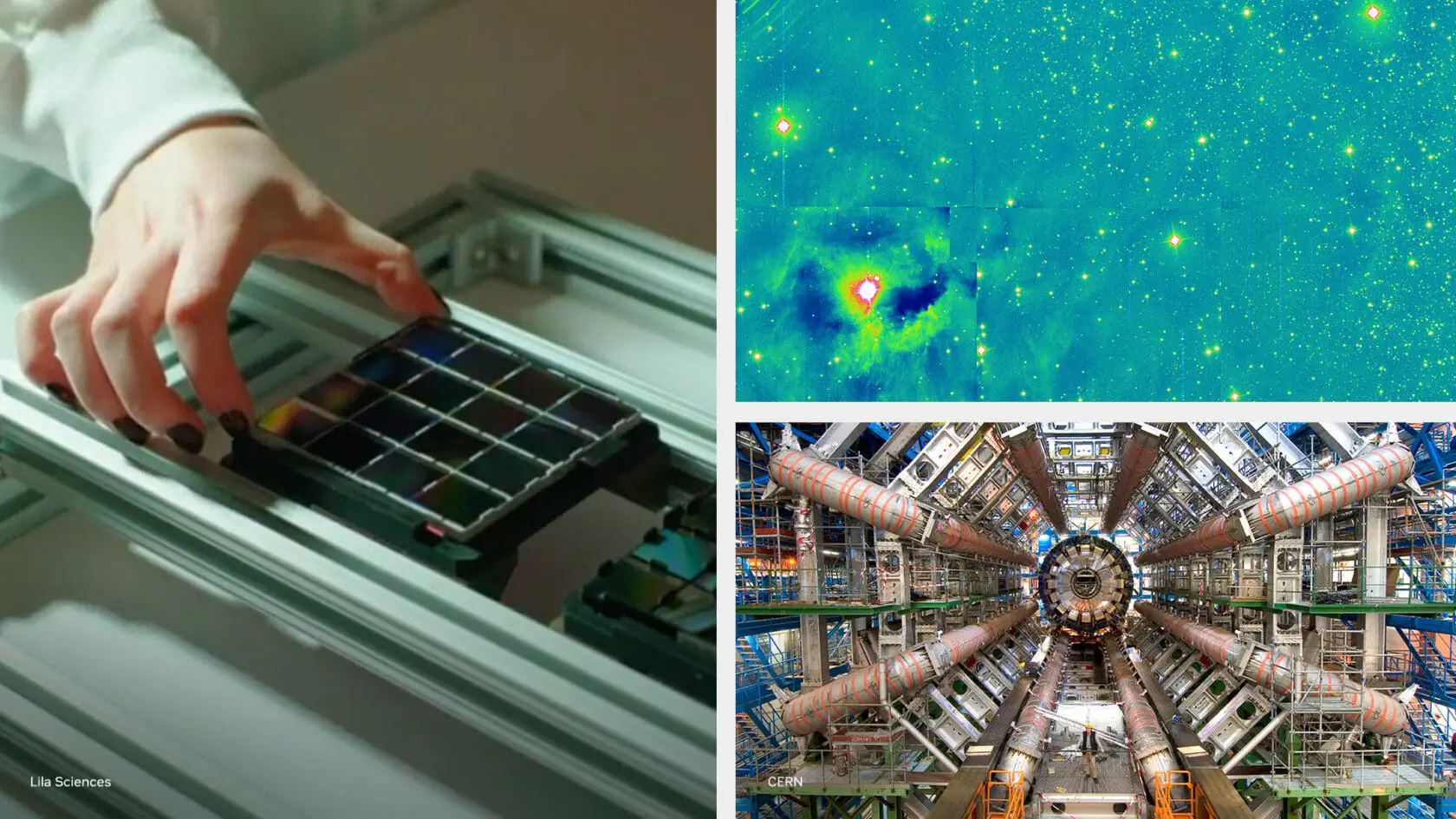
Loading and reading data from the Rubin Observatory’s Legacy Survey of Space and Time (LSST) is now 14,900 times faster thanks to NVIDIA’s cuPhoton reference code, realized on NVIDIA GB200 NVL72 systems. This performance improvement, introduced at the ISC conference this week, accelerates the processing of FITS images, the standard astronomical file format, captured by the largest digital camera ever built. Beyond astronomy, new NVIDIA software, including the DAQIRI library and ALCHEMI microservices, with two ALCHEMI NIM microservices released in March, can unlock scientific discoveries across fields ranging from chemistry to particle physics. CuPhoton also enabled up to 8,400 times faster signal processing and analysis using 32 NVIDIA Grace Blackwell superchips, meaning quicker insights from the billions of galaxies and faint objects imaged by the LSST camera.
cuPhoton Accelerates Astronomical Data Analysis with LSST Images
This performance improvement, realized on NVIDIA GB200 NVL72 systems, promises to reduce the time required to analyze the immense datasets generated by the LSST camera, the largest digital camera ever constructed. Developed in collaboration with Princeton University and Harvard University, cuPhoton is designed to handle the petabytes of data produced by modern telescopes and experiments, functioning as a reference code for scientists seeking to extract information from multidimensional datasets. This capability is crucial for the LSST, which will capture images of billions of galaxies and faint objects, requiring rapid processing to identify and characterize celestial phenomena. The speedup isn’t merely about faster data handling; it’s about unlocking the potential within the data itself. Researchers at Princeton and Harvard will be among the first to utilize cuPhoton for processing and analysis of massive data collected from observatories and dark energy surveys. NVIDIA explains that this will lead to quicker discovery in astrophysics and astronomy.
DAQIRI Enables Real-Time Data Streaming for CERN’s ATLAS Experiment
The pursuit of data acquisition and analysis in high-energy physics demands constant innovation, and current systems often struggle to keep pace with the sheer volume generated by experiments like CERN’s ATLAS. Traditional data handling methods are frequently constrained by fixed hardware, leading to data loss when instruments exceed storage and processing capabilities. NVIDIA’s newly released DAQIRI library addresses this bottleneck. Short for Data Acquisition for Integrated Real-time Instruments, DAQIRI functions as a high-performance networking library, designed to stream data from rapid detectors and sensors directly into NVIDIA software. This capability was demonstrated through a research project named A-GHOST, a collaboration between scientists from CERN, the University of Chicago and University College London, operating within the framework of CERN openlab. A-GHOST utilizes DAQIRI to perform real-time AI analysis on collision data recorded by the ATLAS Experiment.
Critically, the system analyzes data that would normally be discarded, over 99 percent of it, due to storage limitations, allowing researchers to identify potentially significant signals previously lost. This represents a leap forward in the ability to extract meaningful insights from complex experimental data. The development of DAQIRI isn’t simply about increasing processing speed, but about fundamentally altering the scope of what can be analyzed. By handling data streams as they arrive, DAQIRI ensures no information is lost, opening doors to discoveries that were previously inaccessible. This approach allows scientists to move beyond pre-selected data subsets and explore the entirety of the experimental output, potentially revealing unexpected phenomena and refining existing models.
NVIDIA ALCHEMI Microservices Speed Chemical and Materials Discovery
Lila Sciences is demonstrating the power of accelerated materials discovery, having partnered with NVIDIA to achieve a 50 times speedup in high-throughput materials screening using ALCHEMI. This collaboration, showcased at NVIDIA GTC San Jose, identified stable material candidates with a significantly increased probability of successful synthesis. Further accelerating the process, the ALCHEMI VASP microservice, expected to be available later this summer, delivered a 30 percent improvement in calculating magnetic properties for these shortlisted materials. ALCHEMI’s impact extends beyond individual calculations; specialized kernels for TensorNet provided Lila with a 6 times speedup in both training and inference, while simultaneously reducing memory usage by a factor of three. This allowed for simulations previously requiring weeks to be completed in mere days, enabling the simultaneous evaluation of multiple materials within GPU memory.
The applications span materials discovery, screening novel compositions at scale, to energy research, specifically identifying active catalysts for chemical and fuel production, and electromagnetics, focused on understanding complex magnetic behaviors. Andy Beam, cofounder and chief technology officer of Lila Sciences, said that the work showcases a powerful computing stack assembled to accelerate discovery at a scale no individual scientist could achieve alone. NVIDIA released in March two ALCHEMI NIM microservices for batched geometry relaxation (BGR) and batched molecular dynamics (BMD), allowing researchers to simulate millions of molecules concurrently to determine stable structures and model their movements over time. A forthcoming microservice for the Vienna Ab initio Simulation Package (VASP) is projected to deliver a 3 times speedup for geometry optimization by leveraging the NVIDIA Multi-Process Service. Developers can also utilize the ALCHEMI Toolkit to accelerate the training of AI surrogate models and construct customized, high-performance atomistic simulation workflows, effectively streamlining the entire materials science pipeline.
Lila Sciences Demonstrates Accelerated Scientific Workflows with ALCHEMI
Lila Sciences is demonstrating a significant acceleration of materials science workflows through integration with NVIDIA’s ALCHEMI platform, effectively shrinking research timelines from weeks to days. Further refining the process, Lila Sciences then accelerated the calculation of magnetic properties by 30 percent for shortlisted candidates with the ALCHEMI VASP microservice, expected to be available later this summer. ALCHEMI functions as the foundational simulation layer, generating the data that fuels the broader scientific loop. Lila Sciences complements this with other NVIDIA technologies, including Megatron-LM, Nemotron, BioNeMo, Triton, and Omniverse libraries, creating a comprehensive accelerated pipeline. The company’s approach isn’t limited to simulation; it extends to evaluating multiple materials simultaneously, opening new avenues for rapid innovation.



See today’s quantum computing news on Quantum Zeitgeist for the latest breakthroughs in qubits, hardware, algorithms, and industry deals.