Following two incidents of GPS disruption at Dallas and Denver airports in 2022, each lasting more than 24 hours and creating risks for pilots, Lincoln Laboratory is partnering with Frequency Electronics Inc. (FEI) to move its quantum MagNav sensor toward industrial testing on aerial platforms. The system uses Earth’s magnetic fields to provide navigation in environments where GPS signals are unavailable, offering an important alternative to the nation’s current position, navigation, and timing infrastructure.
“GPS is our workhorse for knowing where we are, and it’s becoming increasingly susceptible to interference,” says Linh Pham, MagNav sensor project lead at Lincoln Laboratory’s Advanced Quantum Technologies Group, “We need to address our nation’s overreliance on GPS.”
Diamond Sensor Enables Vector Magnetic Navigation
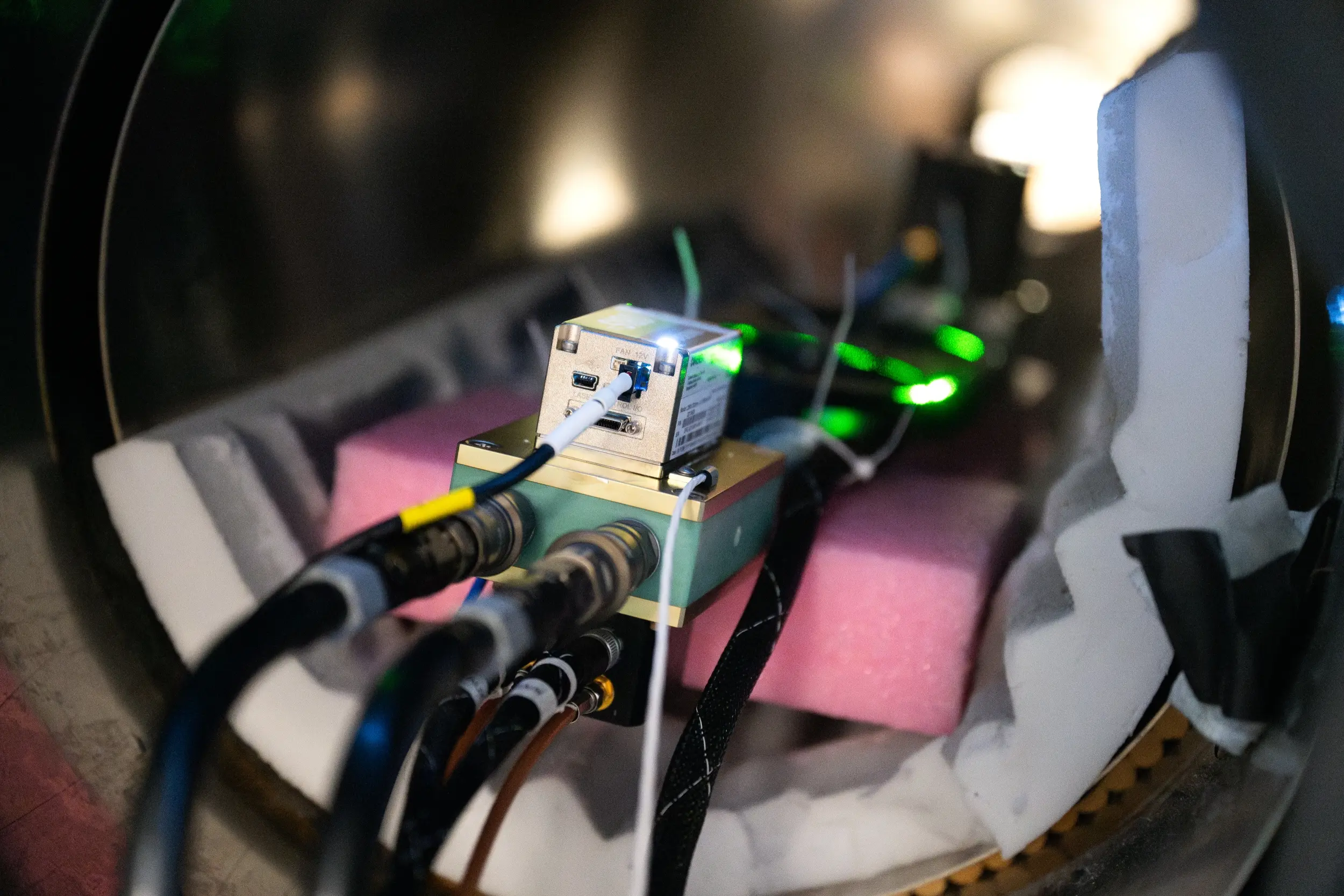
Lincoln Laboratory’s magnetic sensor head is undergoing integration into a testing aircraft. Unlike existing magnetic navigation sensors that only measure field magnitude, this new device measures the vector, capturing both magnitude and direction without significant performance degradation.

The development of this sensor required specialized expertise in diamond materials engineering, rapid prototyping and aerial systems solutions, allowing the Laboratory to move beyond theoretical designs to a field-ready prototype. Lincoln Laboratory emphasizes its unique ability to not only design and build such sensors but also to continuously analyze and test their performance throughout the project lifecycle, stating, “Lincoln Laboratory has the ability not only to design and build this type of sensor but also to embed analysis and testing of its real-world function throughout the lifetime of the project.” This comprehensive approach is intended to ensure long-term stability and reliability, an essential factor for navigation systems.
Frequency Electronics Inc. (FEI) is partnering in this transition, facilitating the testing and integration of the sensor onto aerial platforms, with a long-term goal of creating a scalable, chip-scale version of the technology. “Our long-term vision is to build an integrated chip-scale version of this technology, which could make vector MagNav sensing manufacturable and scalable to tens of thousands of units,” Pham added.
The team is also focused on improving sensor performance, reducing its size, weight and power consumption as they chart a path to sensor manufacturability, stating, “We are currently charting a path to sensor manufacturability; performance improvements; and reduced size, weight, and power – all with the shared goal of significant operational improvements.” The ultimate aim is to provide a robust alternative to GPS, particularly in environments where satellite signals are unavailable or unreliable, and to achieve “Chip scale means it can be put on smaller platforms, and scalable means low cost for industrial proliferation.”
GPS Vulnerabilities Drive MagNav Technology Development
Lincoln Laboratory is working with Frequency Electronics Inc. (FEI) to test and integrate the sensor onto a platform for aerial applications. This transition addresses a key challenge in technology transfer, moving the sensor from a controlled laboratory setting into the unpredictable conditions of real-world operation. The focus on miniaturization is paramount, as successful deployment requires a compact design suitable for integration into various aerial vehicles used for intelligence, reconnaissance and surveillance.
Leidos, Inc. is concurrently developing algorithms designed to fully use the sensor’s unique capabilities, expanding its potential beyond basic navigation. Army Combat Capabilities Development Command Army Research Laboratory, where the Laboratory’s MagNav team is tailoring the sensor for specific Army applications. The Laboratory’s rigorous testing procedures, including verification of long-term stability within magnetic shields, demonstrate a commitment to reliability.
This focus on stability is essential for accurate navigation, as even minor deviations can compound over time and distance. “More information means more accuracy,” emphasizes the importance of the vector sensor’s ability to measure not just magnetic field strength, but also direction, providing a more complete navigational picture. The partnership with FEI signifies a move beyond laboratory demonstrations toward practical implementation, potentially reducing reliance on vulnerable satellite-based positioning systems.
2026 Flight Tests Validate Sensor Performance
Recent flight tests confirmed the performance of Lincoln Laboratory’s quantum MagNav sensor in challenging navigational conditions building on earlier successes from 2022. These tests, conducted throughout 2025 and 2026, demonstrated accurate navigation even in areas with minimal magnetic variation, a scenario where traditional scalar magnetic sensors struggle. The system achieved a twofold improvement in accuracy compared to scalar platforms in typical conditions, validating its potential as a robust alternative to GPS.
Frequency Electronics Inc. (FEI) is now actively collaborating to refine the sensor for broader military and industrial applications, a transition facilitated by the Defense Innovation Unit’s Transition of Quantum Sensing program in 2025. This partnership signifies a shift from demonstrations to practical implementation, with a focus on scaling production of the sensor.
Beyond aerial applications, the U.S. The sensor’s foundation lies in diamond engineered with nitrogen-vacancy centers, initially developed by the Laboratory’s diamond quantum sensing team in 2016 and subsequently ruggedized for field deployment. These ongoing efforts aim to deliver a reliable navigation solution across air, undersea and space environments, independent of vulnerable satellite signals.
FEI Partnership Advances Industrial Transition of MagNav
Frequency Electronics Inc. This transition followed initial testing of the technology on a helicopter in 2022 and a move to sponsored research through the Air Force Research Laboratory in 2023, marking a clear progression from internal funding to external validation. The partnership focuses on preparing the sensor for widespread adoption, building on successful flight tests conducted throughout 2025 and 2026. The sensor’s reliance on Earth’s crustal magnetic field offers a distinct advantage over GPS, as this natural signal is unaffected by weather, structures, or jamming attempts.
This inherent resilience is critical for applications requiring uninterrupted navigation in contested or remote areas. The laboratory’s work spans several areas including ISR Systems and Technology, Space Systems and Technology, Advanced Quantum Technologies and ISR Systems and Architectures.



See today’s quantum computing news on Quantum Zeitgeist for the latest breakthroughs in qubits, hardware, algorithms, and industry deals.