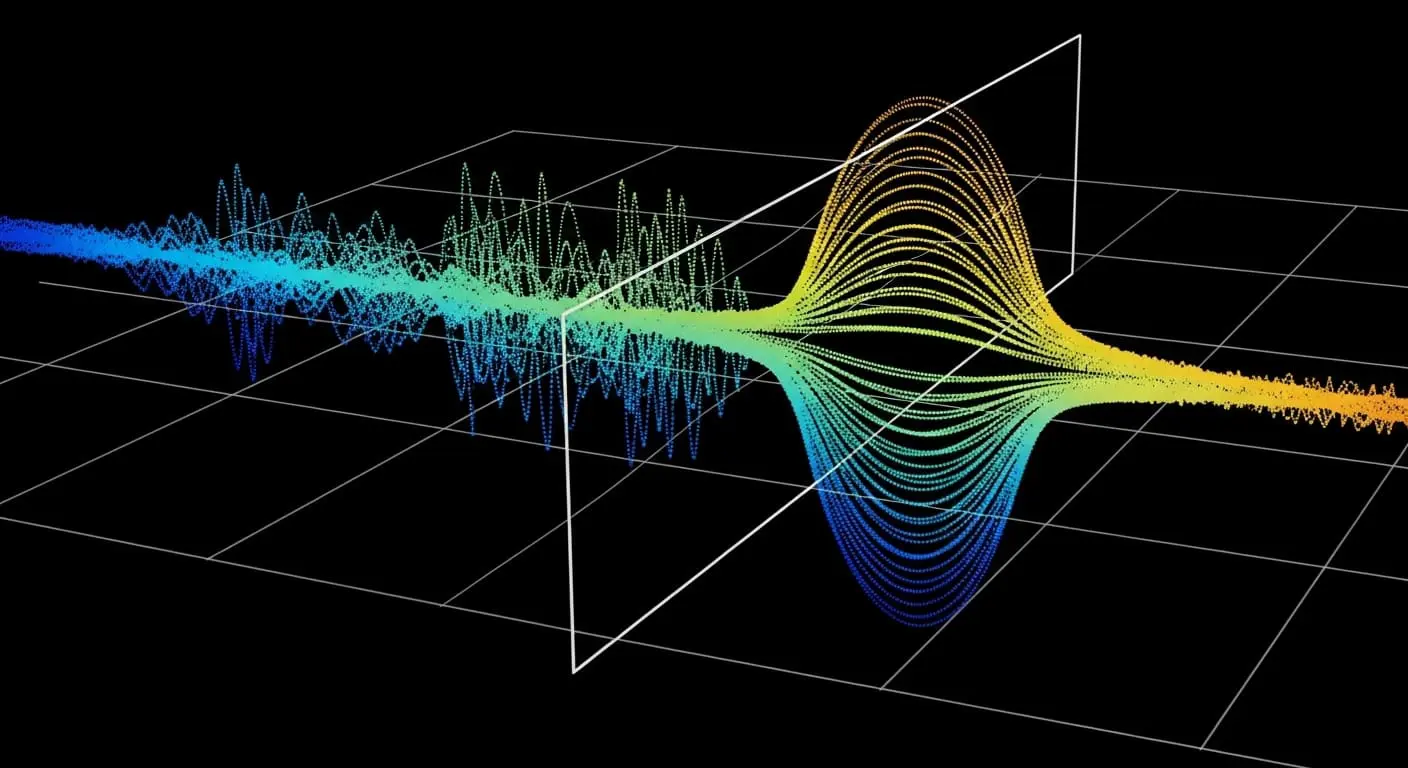
Yumin Li and colleagues are constructing a new family of Calderbank-Shor-Steane (CSS) codes by leveraging Low-Density Generator Matrix (LDGM) codes, a technique combining established code types to improve quantum error correction. Decoding these codes relies on iterative message passing over an associated graph, a method for identifying and correcting errors within quantum systems. The researchers utilize discrete Density Evolution (DDE) to optimize performance for a common source of quantum errors. According to the paper, “The proposed construction offers high flexibility and easiness in the design, producing quantum codes that possess excellent error correction capabilities,” suggesting a pathway toward more reliable fault-tolerant quantum computation by controlling and bounding the weight of stabilizer generators.
Yumin Li and colleagues detail a method where both generator and parity-check matrices undergo row operations to achieve a desired quantum rate, allowing for precise control over the code’s structure and bounding the weight of stabilizer generators. Performance optimization targets this through the utilization of discrete Density Evolution (DDE), a method for analyzing code behavior under noise. This targeted optimization allows researchers to tailor the codes for environments prone to specific types of quantum errors, enhancing their reliability and making them particularly well-suited for fault-tolerant quantum computation due to their controlled stabilizer generator weights and strong error correction abilities.
Quantum error correction increasingly relies on sophisticated code structures to combat decoherence, but practical implementation demands codes that balance performance with design complexity.
Source: https://arxiv.org/abs/2607.15159
See today’s quantum computing news on Quantum Zeitgeist for the latest breakthroughs in qubits, hardware, algorithms, and industry deals.