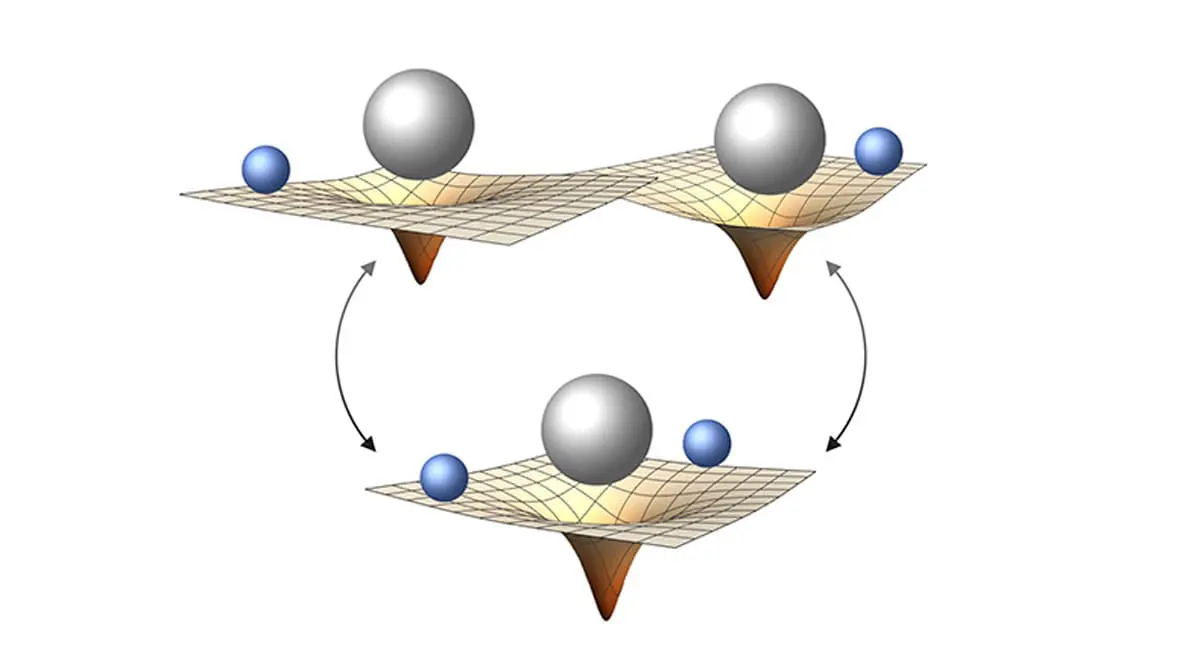
Researchers from Kyushu University, the University of Waterloo, and Stockholm University have developed a new theoretical framework called “Relativity of Spacetime Superpositions” to discern potential experimental signatures of quantum gravity. Building on the established understanding that gravitational wave detectors have confirmed spacetime can be curved, flat, or ripple with waves, the team explored how quantum mechanics might further affect its behavior. Publishing their findings in npj Quantum Information, the researchers demonstrate that scenarios described as a “quantum superposition of gravity” can often be explained by quantum particles experiencing ordinary gravity within spacetime. “What we found is that some of these scenarios can be viewed from two equally valid perspectives,” explains Associate Professor Joshua Foo of Kyushu University’s Institute for Advanced Study and lead author of the study, clarifying that the work identifies which experimental signatures would genuinely necessitate a quantum description of gravity.
Relativity of Spacetime Superpositions Framework Explained
Gravitational wave detectors have already established that spacetime can exhibit curvature, flatness, or wave propagation, providing a crucial foundation for investigating quantum effects. One interpretation describes gravity as being in a quantum superposition, while the other describes quantum particles moving in an ordinary gravitational field. This is akin to different map projections representing the same terrain; a quantum gravity effect might, in many instances, be explained by standard gravity acting on quantum particles. Magdalena Zych of Stockholm University emphasizes that this doesn’t disprove quantum gravity, but rather refines the search for definitive proof. The search for a unified theory of quantum gravity continues to challenge physicists, demanding reconciliation between the quantum realm and Einstein’s description of gravity, but interpreting potential experimental evidence remains a significant hurdle.
Understanding how gravity and quantum mechanics fit together is one of the greatest challenges in physics,” concludes Foo.
Identifying Genuine Quantum Gravity Experimental Signatures
Researchers are increasingly focused on discerning genuine signatures of quantum gravity, a field attempting to reconcile Einstein’s theory of general relativity with the principles of quantum mechanics. This framework doesn’t seek to prove or disprove quantum gravity, but rather to refine the search for its experimental evidence. The team’s work addresses a core difficulty: distinguishing between scenarios where gravity itself is quantum, and those where quantum particles simply experience ordinary gravity within a curved spacetime. They demonstrate that many proposed “quantum superposition of gravity” scenarios are mathematically equivalent to standard quantum particles moving within a classical gravitational field. This refined approach promises to streamline the design of future experiments aimed at unlocking the secrets of quantum gravity.
Many researchers have proposed experiments that could potentially reveal the quantum nature of gravity,” explains Associate Professor Joshua Foo of Kyushu University’s Institute for Advanced Study and lead author of the study.
See today’s quantum computing news on Quantum Zeitgeist for the latest breakthroughs in qubits, hardware, algorithms, and industry deals.