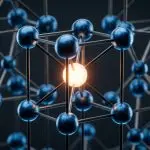
Increasing bond dephasing induces a topological transition within the non-Abelian Kitaev spin liquid; this process converts Ising⊠Ising order into toric-code order and creates intrinsically mixed-state topological order. Introducing disorder into a special quantum material called a Kitaev spin liquid can alter its fundamental topological order and create an unusual form of symmetry known as supersymmetry.
Computer simulations confirm theoretical predictions about this change in behaviour within these materials. These findings offer insights into unconventional critical phenomena and may help develop more strong methods for future quantum computation efforts. Researchers discovered that introducing disorder into a special quantum material, a Kitaev spin liquid, can fundamentally alter its topological order and create an unusual form of symmetry called supersymmetry.
A Kitaev spin liquid is a highly entangled state of matter where electrons behave like tiny magnets with fluctuating interactions, creating emergent quasiparticles with unique properties. This work builds on understanding how imperfections affect these materials and could pave the way for more strong methods in future quantum computation efforts.
The team demonstrated that increasing “bond dephasing” within this system drives a transition from one type of order to another, specifically converting Ising⊠Ising order into toric-code order; imagine the toric code as a grid structure protecting information from noise. At the boundary between ordered and disordered regions, they found evidence of ghostly particles, Majorana systems which are their own antiparticle, developing an unexpected symmetry.
Vectorizing Quantum States Circumvents Simulation Sign Problems
Monte Carlo simulations were central to understanding how imperfections affect the Kitaev spin liquid, necessitating a novel approach to tackle complex quantum systems. A “vectorized picture” was employed, effectively duplicating the system’s quantum state alongside its original form. This technique mapped interactions between time-reversed Majorana fermions (ghostly particles that are their own antiparticle) onto simpler terms, sidestepping a common problem in simulating interacting quantum materials known as the “sign problem”.
By doubling computational space and focusing on relationships within it, sign-problem-free Monte Carlo methods accurately modelled bond dephasing and its effect on topological order. ν=1.27 ±0.03 and ηbsimeqηfsimeq0.40 were yielded by these simulations, aligning with theoretical predictions for supersymmetry, a result enabled by accurate modelling unavailable through other techniques. This improvement over previous estimates allowed investigation into a mixed-state topological transition in the non-Abelian Kitaeva spin liquid; prior approaches struggled due to limitations simulating strongly interacting quantum systems. Increasing bond dephasing converts Ising⊠Ising order into toric-code order within what’s termed a “Choi state”, establishing intrinsically mixed-state topological order upon unfolding.
Monte Carlo simulations reveal mixed-state topology and emergent supersymmetry in Kitaev spin
Condensing an inter-copy fermion pair effectively links particles across different representations of the density matrix; however these numbers currently describe behaviour within idealised models. This transformation provides insight into complex quantum phenomena that were previously inaccessible to simulation.
Disorder and Bond Dephasing Drive Phase Transitions in Kitaev Spin Liquids
Introducing disorder can fundamentally alter the quantum order of Kitaeva spin liquids, though definitively establishing whether these materials will deliver on promises of strong quantum computation remains open. Simulations demonstrate how increasing “bond dephasing”, loss of coherence due to environmental interactions, drives transitions between distinct phases, identifying observable signatures like fractionalized spin strings detectable experimentally. The process converts one arrangement of electron interactions into another known as toric code while creating an unusual form of topological organisation termed intrinsically mixed-state topological order. Bridging the gap from idealised models towards practical topological quantum computation requires overcoming key materials science challenges in creating stable Kitaeva spin liquids and potentially unlocking new avenues for robust computation here; even with acknowledged uncertainties surrounding definitive proof of supersymmetry within their computational limits, this work offers valuable insight into exotic quantum materials.
This research demonstrated a transition in the behavior of a Kitaev spin liquid caused by bond dephasing, loss of coherence due to environmental interaction. Monte Carlo simulations yielded values of ν=1.27 ±0.03 and ηbsimeqηfsimeq0.40, consistent with supersymmetric predictions; these results suggest emergent supersymmetry at the interface between ordered and disordered states, observable through fractionalized gauge-invariant spin strings. These findings provide insight into complex quantum phenomena within this material system.
👉 More information
🗞 Mixed-State Topological Transition and Emergent Fractionalized Supersymmetry in the Non-Abelian Kitaev Spin Liquid
✍️ Hong Yao (Tsinghua University); Shao-Kai Jian (Tulane University); Zhou-Quan Wan
🧠 ArXiv: https://arxiv.org/abs/2610.38741



See today’s quantum computing news on Quantum Zeitgeist for the latest breakthroughs in qubits, hardware, algorithms, and industry deals.