

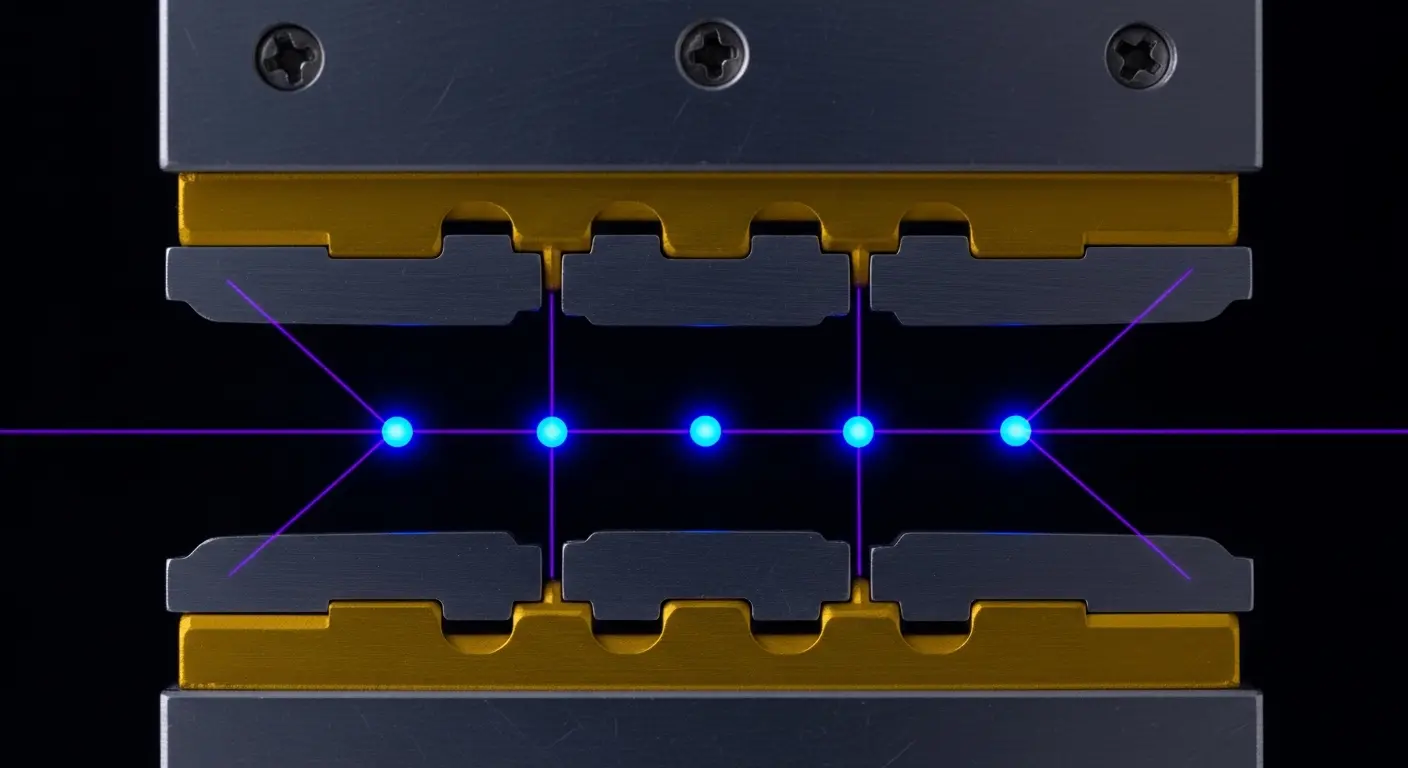
Scientists at the University of Sussex have demonstrated a novel technique for the in situ removal of transport-blocking defects on surface-electrode ion traps. Toby Maddock and colleagues present a method utilising a Q-switched Nd:YAG laser to ablate these defects directly within the vacuum system, thereby circumventing the need for time-consuming and potentially disruptive venting and re-baking procedures. This advancement is particularly significant for complex ion-shuttling architectures. Even brief interruptions can severely impact experimental timelines and data integrity. It is attractive due to the widespread availability of the necessary laser hardware. Following laser ablation, the team observed near-unit shuttling success rates and acceptable micromotion levels, indicating a rapid and reliable method for restoring ion transport pathways without halting ongoing experiments.
In situ laser ablation restores functionality to cryogenic ion traps
Success rates in ion shuttling reached near-unit levels after defect removal, representing a substantial improvement over previous methods for addressing such obstructions. Traditional approaches frequently necessitated complete experimental halts when obstructions exceeded 65μm in size, requiring days of downtime for system refurbishment and carrying the risk of misalignment during reassembly. This new in situ technique bypasses that lengthy process, rendering surface-electrode ion traps less vulnerable to disruption from microscopic debris such as particulates or material flakes. The advancement allows for continuous operation of complex ion-shuttling architectures, which are crucial for experiments demanding uninterrupted data acquisition, particularly those operating at cryogenic temperatures between 47 and 50 Kelvin. Maintaining these ultra-low temperatures is energetically expensive and technically challenging, making any reduction in downtime highly valuable.
A neodymium-doped yttrium aluminium garnet (Nd:YAG) laser, emitting at a wavelength of 532nm, proved effective in ablating the obstructing material. The laser was operated in Q-switched mode, producing short, high-energy pulses. Ablation was initiated at fluences exceeding 1 joule per square centimetre for aluminium, a value consistent with established understanding of bulk material ablation thresholds. The choice of 532nm wavelength is advantageous due to its relatively high absorption in many common trap materials, maximising the energy deposited into the defect. Micromotion levels, a critical indicator of trapped ion stability and a measure of anomalous acceleration experienced by the ion, remained within acceptable limits following laser treatment, aligning with thresholds previously established for precise ion control, typically below a few millihertz. Although near-unit success rates in ion transport were achieved after defect removal, current results are limited to aluminium and stainless steel, and further work is needed to assess efficacy across a wider range of trap materials and contaminant compositions. This opens avenues for future research into optimising laser parameters, such as pulse duration and energy, and exploring the technique’s applicability to other materials commonly used in ion trap construction, such as gold or silicon, potentially broadening its impact on the field. The precise control of laser parameters is vital to avoid damaging the surrounding trap structure.
The significance of this work extends beyond simply restoring functionality. Surface-electrode ion traps are increasingly employed in quantum information processing, precision spectroscopy, and simulations of quantum systems. These applications often require maintaining coherence for extended periods, and any disruption to the trap environment can lead to decoherence and loss of information. By enabling rapid defect remediation without interrupting the experiment, this technique helps to preserve coherence and improve the reliability of these sensitive measurements. Furthermore, the ability to address defects in situ is particularly beneficial for experiments involving large numbers of ions or complex trap geometries, where identifying and removing obstructions manually would be extremely difficult.
Addressing material limitations and surface effects will optimise trap performance
Surface-electrode ion traps are becoming increasingly vital tools for advancing quantum technologies, but their delicate operation is frequently compromised by microscopic obstructions originating from outgassing, particle contamination, or even the trap material itself. These obstructions create electric field distortions that impede ion transport and can lead to ion loss. While this laser-based remediation offers a compelling solution, a significant question remains regarding its effectiveness with the diverse range of materials used in trap construction. Different materials exhibit varying ablation thresholds and may produce different types of debris upon laser irradiation. Understanding these material-specific effects is crucial for optimising the laser parameters and ensuring effective defect removal without causing collateral damage. Furthermore, the long-term effects of laser ablation on the trap surface need to be carefully considered.
Understanding how repeated laser ablation might subtly alter the trap surface, potentially introducing new sources of noise or instability, is also a key area for investigation. Laser ablation can create surface roughness, alter the surface chemistry, and even induce stress in the material. These changes could affect the electric field distribution near the trap electrodes and impact ion confinement. Characterisation of the ablated surface using techniques such as scanning electron microscopy and atomic force microscopy will be essential to assess the extent of these modifications. Readily available hardware enhances the practicality of this technique for many research groups already equipped for ion trap work. Avoiding lengthy system downtime is a significant advantage, particularly for complex ion-shuttling experiments where maintaining cryogenic temperatures during maintenance is challenging and expensive. Further investigation will likely centre on ensuring long-term trap stability, quantifying the potential for surface modifications resulting from the ablation process, and developing automated defect detection and remediation strategies.
Future work could also explore the use of different laser wavelengths and pulse shapes to further optimise the ablation process and minimise collateral damage. The development of real-time monitoring techniques to assess the effectiveness of defect removal would also be highly beneficial. Ultimately, this in situ laser ablation technique promises to be a valuable tool for maintaining the performance and reliability of surface-electrode ion traps, paving the way for more robust and efficient quantum technologies.
The researchers successfully removed a performance-limiting defect from a surface-electrode ion trap using a 532nm pulsed laser. This in situ technique avoids the need to dismantle and rebuild the vacuum system, which is particularly beneficial for complex ion-shuttling experiments. Following laser ablation, the device demonstrated near-unit success rates in ion transport across the previously obstructed area, with acceptable micromotion levels. The authors intend to focus on ensuring long-term trap stability and quantifying any surface modifications caused by the ablation process.
👉 More information
🗞 Ablation Removal of Transport-Blocking Defects in Surface-Electrode Ion Traps
🧠 ArXiv: https://arxiv.org/abs/2605.06312



See today’s quantum computing news on Quantum Zeitgeist for the latest breakthroughs in qubits, hardware, algorithms, and industry deals.



