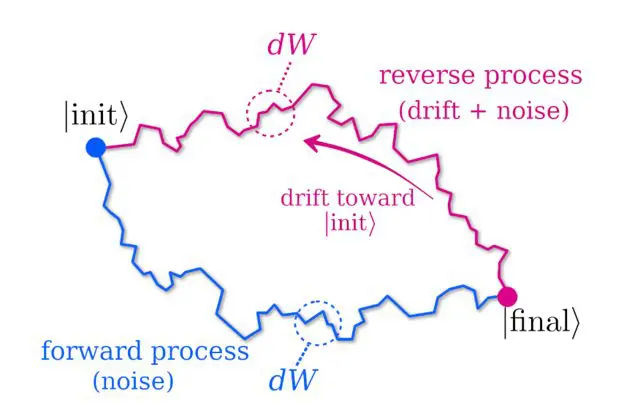
Drawing a connection between 1970s mathematics and recent advances in artificial intelligence, Einar Gabbassov of the Institute for Quantum Computing has found a way to potentially reverse quantum information loss. The Perimeter Institute PhD student took inspiration from diffusion models, image generation tools like DALL-E and SORA that reconstruct images from noise, to tackle the problem of fragile quantum data. Gabbassov derived a quantum analog to the reverse process used in these AI models, equations that had not previously been known, as detailed in a paper published this week in Physical Review Research. “The classical forward and reverse processes used by image generation models are described by a stochastic differential equation, and this equation was derived in the 1970s,” says Gabbassov. “It’s mathematics developed decades ago, later adapted to machine learning.”
Diffusion Models Inspire Quantum Information Recovery
Einar Gabbassov, a PhD student at the Institute for Quantum Computing and Perimeter Institute, has applied principles from diffusion models, commonly used in image generation, to the challenge of reversing quantum information loss, a problem previously lacking a defined quantum solution. These models, like DALL-E and SORA, function by systematically adding noise to data and then learning to reconstruct the original signal, a process rooted in mathematical frameworks established in the 1970s. This derivation fills a gap in quantum mechanics, where equations adequately describe information loss but lacked a corresponding reverse process. The research suggests that, under specific conditions, previously lost quantum information can be actively reconstructed, offering new avenues for error correction and quantum computing stability. This connection between artificial intelligence and fundamental physics demonstrates how insights from machine learning can inspire solutions in seemingly disparate fields, potentially reshaping approaches to preserving quantum states.
“The classical forward and reverse processes used by image generation models are described by a stochastic differential equation, and this equation was derived in the 1970s. It’s pretty old mathematics, later adapted to machine learning,”
Stochastic Schrödinger Equations Describe Quantum Reverse Processes
Gabbassov’s work centers on stochastic differential equations, initially formulated in the 1970s and later utilized in diffusion models like DALL-E and SORA, which generate images by progressively adding and then removing noise. This new formulation addresses scenarios where quantum information, typically lost through environmental interactions, might be recoverable under specific conditions. The research builds on existing equations describing quantum information loss, providing a mathematical description for the inverse process. Gabbassov’s approach suggests that, while challenging, reversing quantum information loss is not entirely prohibited by the laws of physics, opening avenues for further investigation into quantum error correction and information preservation techniques. The equations provide a theoretical foundation for exploring the limits of quantum reversibility and potentially mitigating the effects of noise in quantum systems.
“In quantum mechanics, we have equations that describe the forward processes of information loss, but there are no known analogs of the quantum reverse process. I wondered whether it was possible.”
See today’s quantum computing news on Quantum Zeitgeist for the latest breakthroughs in qubits, hardware, algorithms, and industry deals.