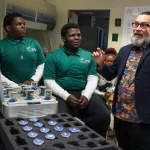
University of Illinois students competed with established start-ups as one of ten finalists in NASA’s Space to Soil Challenge, presenting a new approach to Earth observation data management in Washington, D.C. The team developed LOOP, or Lightweight Onboard Observation Pipeline for Small Satellites, designed to autonomously prioritize data collection and transmission. Led by AE Ph. D. student Phoenix Alpine, the multidisciplinary team included students from aerospace and materials science, and aimed to overcome the limitations of small satellite resources.
LOOP Pipeline Prioritizes Data with Onboard AI Processing
Rather than transmitting all collected data back to ground stations, LOOP utilizes artificial intelligence to assess and prioritize information before downlink, significantly reducing bandwidth requirements and maximizing mission efficiency. The system’s core innovation lies in its autonomous decision-making capability; LOOP analyzes multispectral satellite imagery to identify features like winter cover crops, then determines which observations are most valuable based on pre-set criteria and real-time conditions.
“Their design uses on-board processing to determine what targets to capture on a given pass based on cloud and weather forecasts, what images and data to keep based on their quality and if certain criteria/metrics need to be transmitted to the ground or if the target needs to be observed again,” explained Matt Hausman, the team’s faculty advisor. This selective transmission is particularly crucial for CubeSats, small satellites with limited resources and communication capabilities.
Developing accurate and efficient AI models for onboard processing presented a significant hurdle, according to team member Dibyansh Choudury. The team carefully balanced model complexity, accuracy, power consumption, and processing speed, recognizing that incorrect classifications could lead to the loss of valuable data. They also had to consider the risk of incorrect classifications, because mistakes could lead to valuable data being discarded or less important data being prioritized.
The resulting system, according to Choudury, not only classifies images but also intelligently manages data storage and transmission, allowing the satellite to function more effectively within its constraints. “Instead of transmitting every image back to Earth, LOOP uses onboard AI models to evaluate the value of the collected data,” he stated. “The system determines what should be captured, stored, and downlinked, allowing the satellite to prioritize the most useful information while reducing unnecessary data transmission, making the mission more efficient and better suited for the constraints of a CubeSat.”
Instead of transmitting every image back to Earth, LOOP uses onboard AI models to evaluate the value of the collected data.
Dibyansh Choudury




See today’s quantum computing news on Quantum Zeitgeist for the latest breakthroughs in qubits, hardware, algorithms, and industry deals.