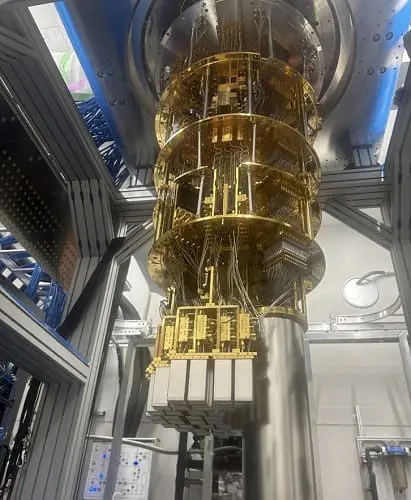
Fujitsu Limited and RIKEN have developed a 256-qubit superconducting quantum computer at the RIKEN RQC-FUJITSU Collaboration Center in Japan, announced on April 22, 2025. This system represents a fourfold increase in qubits from their previous 64-qubit model, launched with support from the Japanese Ministry of Education, Culture, Sports, Science and Technology (MEXT) in October 2023. The new quantum computer incorporates high-density implementation techniques and addresses key technical challenges, including cooling within a dilution refrigerator.
It will be integrated into Fujitsu’s hybrid quantum computing platform, offering global access to companies and research institutions starting in early fiscal 2025. This advancement enables users to tackle more complex computational tasks, such as analyzing larger molecules and implementing advanced error correction algorithms.
Fujitsu Limited and RIKEN have developed a 256-qubit superconducting quantum computer, marking a significant advancement in quantum computing technology. This system builds on their previous 64-qubit model, leveraging high-density implementation techniques to achieve a fourfold increase in qubit count. The new system is designed to address complex computational challenges more effectively than its predecessor.
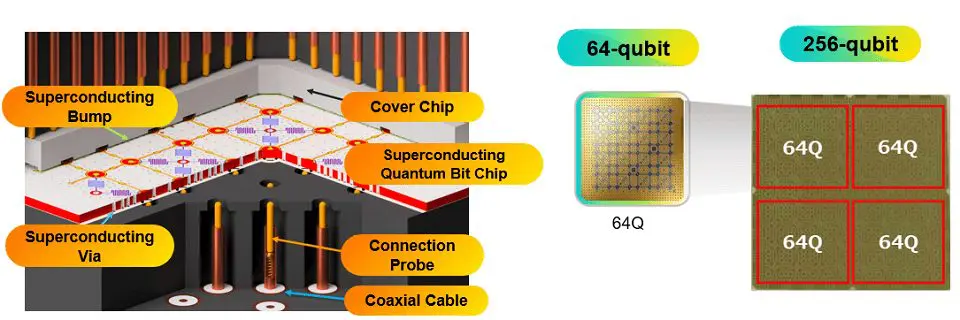
The integration of a scalable 3D connection structure allows for efficient interconnectivity between qubits without requiring extensive redesigns. This supports larger-scale computations while maintaining stability and precision. Additionally, the system’s advanced thermal design ensures effective cooling within the dilution refrigerator, optimizing performance and reliability by addressing heat dissipation challenges critical to superconducting qubit operation.
Integration into hybrid quantum computing lineup
The development of the 256-qubit superconducting quantum computer represents a substantial advancement in quantum computing technology. This system builds upon their previous work with a 64-qubit model, achieving a fourfold increase in qubit count through high-density implementation techniques. The integration of a scalable 3D connection structure allows for efficient interconnectivity between qubits without requiring extensive redesigns, supporting larger-scale computations while maintaining stability and precision.
The system’s advanced thermal design ensures effective cooling within the dilution refrigerator, optimizing performance and reliability by addressing heat dissipation challenges critical to superconducting qubit operation. This solution maintains the ultra-low temperatures necessary for qubit coherence and reduces error rates, essential for scaling up quantum systems.
Fujitsu and RIKEN are now focused on developing a 1,000-qubit system, an ambitious goal that requires further refinement of manufacturing processes to achieve higher qubit densities while preserving coherence. This effort emphasizes the importance of advancing superconducting quantum computer architectures for practical applications in optimization problems, material science, and complex simulations.
Overcoming technical challenges related to thermal management and interconnectivity remains critical for scaling up to a 1,000-qubit system. Advanced thermal design techniques will be essential to maintain ultra-low temperatures necessary for superconducting qubits while ensuring reliable performance at scale. These advancements reflect Fujitsu and RIKEN’s commitment to advancing quantum computing technology for real-world applications.
Integration into hybrid quantum computing lineup
Fujitsu and RIKEN’s development of the 256-qubit superconducting quantum computer represents a substantial advancement in quantum computing technology. This system builds upon their previous work with a 64-qubit model. It achieves a fourfold increase in qubit count through high-density implementation techniques. The integration of a scalable 3D connection structure allows for efficient interconnectivity between qubits. It does not require extensive redesigns. This supports larger-scale computations while maintaining stability and precision.
The system’s advanced thermal design ensures effective cooling within the dilution refrigerator. It optimizes performance and reliability. This is done by addressing heat dissipation challenges that are critical to superconducting qubit operation. This solution maintains the ultra-low temperatures necessary for qubit coherence and reduces error rates, essential for scaling up quantum systems.
Fujitsu and RIKEN are now focused on developing a 1,000-qubit system. This is an ambitious goal that requires further refinement of manufacturing processes. The aim is to achieve higher qubit densities while preserving coherence. This effort highlights the need to advance superconducting quantum computer architectures. These advancements are crucial for practical applications in optimization problems. They are also important for material science and complex simulations.
Overcoming technical challenges related to thermal management and interconnectivity remains critical for scaling up to a 1,000-qubit system. Advanced thermal design techniques will be essential to maintain ultra-low temperatures necessary for superconducting qubits while ensuring reliable performance at scale. These advancements reflect Fujitsu and RIKEN’s commitment to advancing quantum computing technology for real-world applications.
More information
External Link: Click Here For More




See today’s quantum computing news on Quantum Zeitgeist for the latest breakthroughs in qubits, hardware, algorithms, and industry deals.