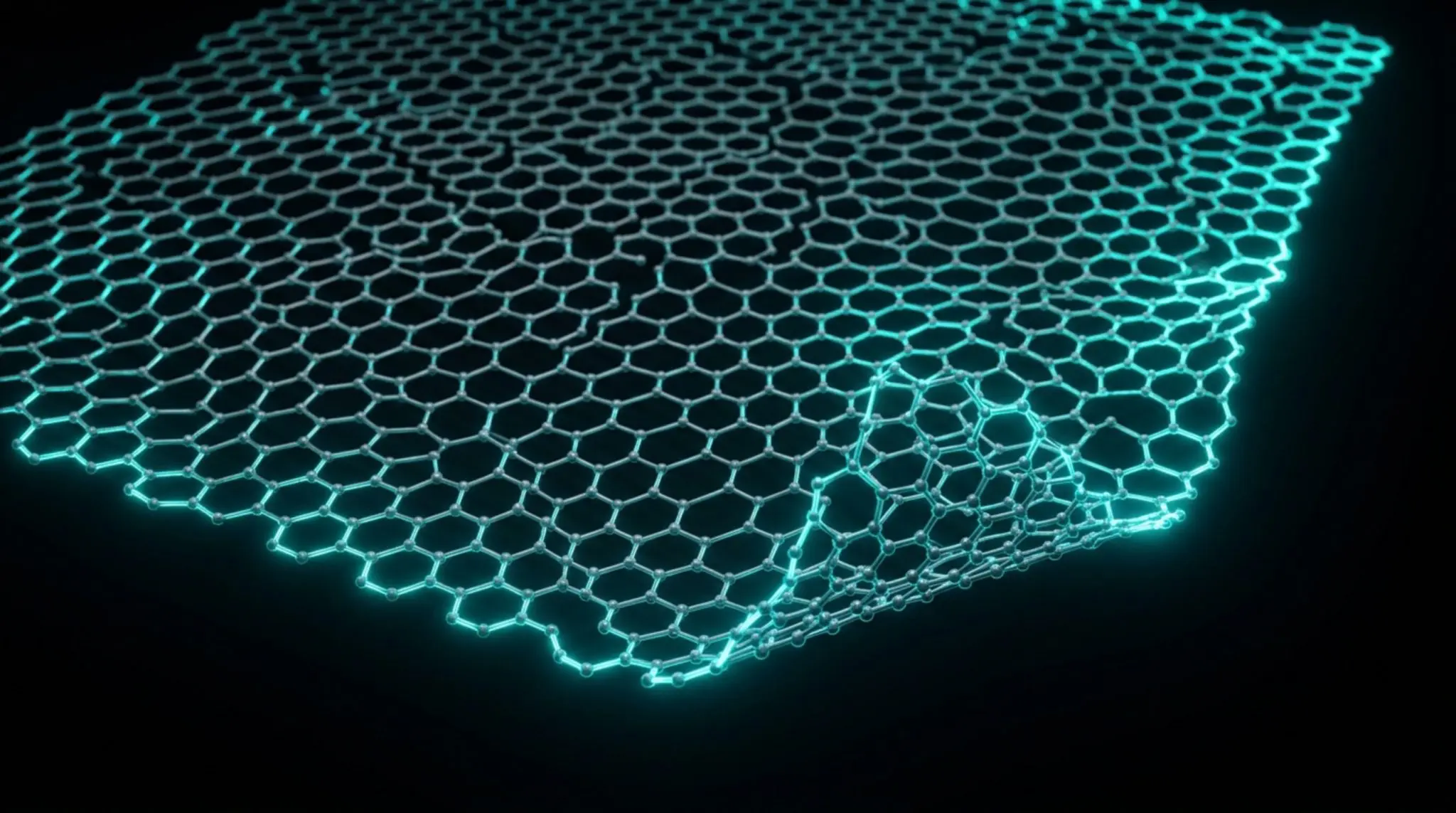
Daniel M. B. Lesko, Tobias Weitz, Simon Wittigschlager, Weizhe Li, Christian Heide, Ofer Neufeld, and Peter Hommelhoff, affiliated with Friedrich-Alexander-Universität Erlangen-Nürnberg, the University of Central Florida, the Technion – Israel Institute of Technology, and the Max Planck Institute for the Structure and Dynamics of Matter, have demonstrated optical control of electrons within light-dressed graphene, a capability previously difficult to achieve in light-dressed band structures. By focusing circularly polarized femtosecond laser pulses on monolayer graphene, the team generated a Floquet topological insulator, a state of matter exhibiting unique quantum properties.
They observed photocurrent circular dichroism, the all-optical anomalous Hall effect, and FTI valley-polarized currents, which could enable ultrafast control in topotronics and attosecond physics. The results show strong sub-cycle phase-sensitivity.
Graphene as a Starting Point for Floquet Topology
Graphene’s unique electronic structure has enabled the first demonstration of optical control over electrons within a light-induced topological state, a feat previously elusive in investigations of light-dressed band structures. This approach differs from earlier work primarily conducted in synthetic systems like photonic waveguides and cold atoms, bringing the potential of tunable topological insulators directly to solid-state materials.
The team’s method, called Harmonic Floquet Spectroscopy, relies on a two-color laser setup where a fundamental frequency light field ‘dresses’ the graphene, modifying its band structure and inducing topological gaps. This dressing process opens topological band gaps at harmonics of the dressing energy, allowing the researchers to probe topological physics in a unique way.
A second harmonic pulse, with twice the frequency, then controls electrons within this newly formed band structure, generating photocurrents. “We generate our FTI by light dressing graphene, and subsequently control electrons using a second harmonic optical field within this new light-dressed band structure generating photocurrents,” the researchers report, highlighting the core principle of their technique. They observed strong sub-cycle phase-sensitivity in the generated photocurrents, indicating that the electron dynamics are occurring on an attosecond timescale, faster than a single cycle of the driving laser.
This sensitivity allows for ultrafast control within topologically protected electronics, potentially leading to advancements in spectroscopy and attosecond physics. The experimental setup involved focusing the laser pulses onto an epitaxial monolayer graphene strip, with the relative phase between the two frequencies carefully controlled using a collinear two-color interferometer.
Circularly Polarized Light Generates Floquet Topological Insulators
This work extends beyond simply creating new electronic states with light; it establishes a method for actively steering electrons within these states. The team’s approach centers on a two-color laser technique, initially “dressing” the graphene with a circularly polarized fundamental laser field. This dressing process modifies the material’s band structure, creating topological band gaps and, crucially, a non-trivial topological insulating phase after the dressing process, in the resulting FTI state.
The resulting FTI exhibits a Berry curvature, a quantum mechanical property linked to electron behavior, with the same sign in both valleys of the material, a characteristic essential for topological insulation. This method allows for probing topological physics in a region of the dressed band structure that has not been previously explored in FTI research. The ability to observe photocurrent circular dichroism, a measure of how the photocurrent changes with the polarization of light, and the all-optical anomalous Hall effect confirms the observation of signatures of the Berry curvature.
Harmonic Floquet Spectroscopy: A New Control & Probing Method
Daniel M. B. Lesko and colleagues at Friedrich-Alexander-Universität Erlangen-Nürnberg and the University of Central Florida have demonstrated a novel technique, Harmonic Floquet Spectroscopy, for both generating and probing a Floquet topological insulator (FTI) within monolayer graphene. This approach moves beyond simply creating light-dressed materials with altered electronic properties; it actively controls electron behavior using precisely tailored optical fields. The team’s method utilizes a two-color laser technique to first “dress” the graphene, inducing a topological state, and then dynamically controls electrons within that state with a second harmonic field.
Traditional measurements rely on direct current or low-frequency fields, but this work employs an all-optical method, revealing phenomena not previously observed in these materials. The researchers found that strongly dressing the band structure opens topological band gaps at these harmonics, allowing for unique control and analysis of electron behavior.
This is achieved by focusing circularly polarized femtosecond laser pulses onto the graphene, generating the FTI state and subsequently driving electron dynamics with a second harmonic pulse. A key element of the experimental setup is a collinear two-color interferometer, allowing precise control over the phase difference between the fundamental and second harmonic laser pulses. This phase control, denoted as φω-2ω, directly maps the sub-optical-cycle motion of the Floquet state onto the generated photocurrents.
By utilizing graphene, a well-understood topologically trivial semi-metal, the team established a baseline for observing the induced topological changes. This Harmonic Floquet Spectroscopy technique offers a new pathway for exploring and controlling topological phenomena in materials, opening possibilities for advancements in spectroscopy, and novel quantum materials.
Second Harmonic Fields Dynamically Control FTI Electrons
The ability to manipulate electron movement within a light-induced state of matter represents a step toward advanced material control, and recent work demonstrates this capability within a specifically engineered form of graphene. Daniel M. B. Lesko, Tobias Weitz, Simon Wittigschlager, Weizhe Li, Christian Heide, Ofer Neufeld, and Peter Hommelhoff have, for the first time, demonstrated dynamic control of electrons in a Floquet topological insulator (FTI) created by dressing graphene with light, utilizing a second harmonic optical field to steer their behavior.
This approach moves beyond simply creating topological properties with light to actively governing electron trajectories, opening possibilities for ultrafast, topologically protected electronics. This light-dressing process modifies the material’s electronic band structure, creating new quasi-static states governed by the Floquet theorem; these states can exhibit unique quantum and topological properties absent in the original material.
Crucially, the researchers then employed a second harmonic field to control electrons within this newly formed FTI state, revealing sub-cycle phase-sensitivity in the resulting photocurrents. This sensitivity, linked to the attosecond motion of electrons, allows for unprecedented temporal resolution in controlling electron dynamics.
By utilizing a collinear two-color interferometer, the researchers could independently vary both the ellipticity and the phase, denoted as φω-2ω, of the second harmonic pulse. This all-optical approach distinguishes this work from traditional measurements relying on DC or low-frequency fields, and is expected to reveal new phenomena not previously observed in solid-state FTIs.
Topological Band Gaps Open at Harmonics of Dressing Energy
The process begins with “dressing” the graphene with a fundamental laser field, modifying its electronic band structure and opening topological band gaps at harmonics of the dressing energy. The ability to selectively control electrons at these harmonic frequencies is key to manipulating their behavior. The observation of photocurrent circular dichroism, the all-optical anomalous Hall effect, and FTI valley-polarized currents further validates the creation of a true Floquet topological insulator, where electrons exhibit distinct behaviors based on their momentum.
This level of control isn’t simply about creating new states of matter with light, but actively steering electron movement. Daniel M. B. Lesko, Tobias Weitz, Simon Wittigschlager, Weizhe Li, Christian Heide, Ofer Neufeld, and Peter Hommelhoff of Friedrich-Alexander-Universität Erlangen-Nürnberg demonstrated these findings.


See today’s quantum computing news on Quantum Zeitgeist for the latest breakthroughs in qubits, hardware, algorithms, and industry deals.