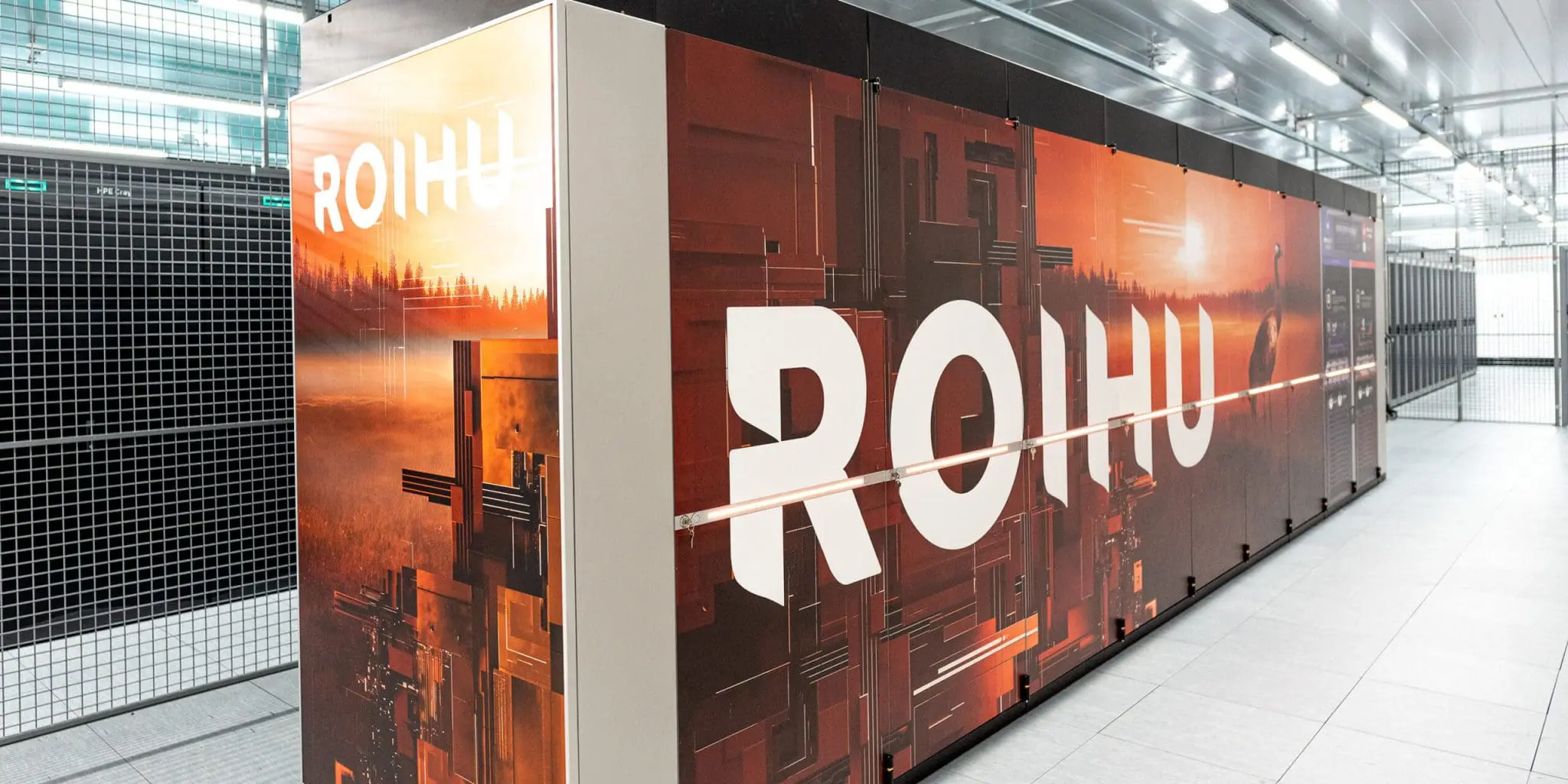
Finland’s high-performance computing capacity has received a substantial boost with the official opening of the Roihu supercomputer for research use, immediately tripling the nation’s computing power and beginning the phase-out of the older Mahti and Puhti systems. In the latest Top500 ranking, published June 23 at the ISC26 conference, Roihu-G ranked 91st and Roihu-C achieved 193rd, signaling a significant jump in Finland’s presence on the list of the world’s fastest supercomputers. Roihu also secured 12th place in the Green500 ranking, operating entirely on renewable hydropower with excess heat channeled into the district heating network of Kajaani. Despite requests for capacity totaling twice its original size, the decommissioned Puhti supercomputer will be distributed to 11 universities, 9 universities of applied sciences, and two research institutes to further bolster local research infrastructure.
Roihu Supercomputer Deploys Eviden BullSequana XH3000 Architecture
The system, built upon Eviden’s BullSequana XH3000 hybrid architecture, is expected to triple the nation’s overall computing capacity and fully supersede the older Puhti and Mahti systems by summer’s end. This transition is about more than increased processing power; Roihu’s performance is already demonstrable, achieving 91st and 193rd rankings for its Roihu-G and Roihu-C partitions respectively in the latest Top500 list published at the ISC26 conference in Hamburg on June 23rd. Beyond raw speed, Roihu distinguishes itself through a commitment to sustainability, securing 12th place in the Green500 ranking of energy-efficient supercomputers. This approach demonstrates a holistic view of resource management, addressing both computational needs and broader environmental concerns. Applications for the air-cooled Puhti exceeded expectations, with requests for capacity totaling approximately twice the system’s original size, indicating a strong demand for localized high-performance computing resources. “Puhti’s high-memory nodes and GPU nodes were particularly in demand,” reflecting the evolving needs of modern scientific research and education.
Roihu will triple Finland’s national computing capacity and will fully replace the Puhti and Mahti systems by the end of the summer.
Puhti System Donation Supports Finnish Research & Education
Following the successful deployment of the Roihu supercomputer, Finland’s previous system, Puhti, is transitioning to support research and education across the nation; CSC will donate the decommissioned supercomputer to a network of Finnish institutions. The demand for Puhti’s resources significantly exceeded availability, with applications from eighteen organizations requesting a total capacity approximately twice the size of the original system. The distribution of Puhti in smaller units reflects a strategic effort to maximize its continued utility, enabling scientific computing, simulations, imaging analytics, and advancements in artificial intelligence research. Beyond research applications, the system will also be utilized for educational purposes, including training in HPC expertise, data analytics, and data center simulations. Maintaining the liquid-cooled Mahti supercomputer presents greater logistical challenges, and its potential donation is currently under direct negotiation with prospective recipients.
This tiered approach to decommissioning and redistribution ensures that valuable computing resources remain accessible to the Finnish scientific community, even as the nation advances to newer, more powerful systems like Roihu, which ranked 91st in the latest Top500 list and 12th in the Green500 ranking, demonstrating a commitment to both performance and sustainability. Puhti’s storage will remain accessible until October 15th, providing a transition period for data migration and continued research efforts.




See today’s quantum computing news on Quantum Zeitgeist for the latest breakthroughs in qubits, hardware, algorithms, and industry deals.