IDrive Inc.’s SSMTheory Group has demonstrated a quantum error-correcting code capable of encoding 130 logical qubits into 192 physical qubits, achieving an encoding rate of approximately 67 percent, a high figure for protecting fragile quantum information. The research, led by IDrive researcher Raghu Kulkarni, leverages the geometry of the Face-Centered Cubic (FCC) lattice, the densest possible arrangement of spheres in three dimensions and a concept central to the Kepler conjecture, to address challenges in quantum computing and theoretical physics. The team’s work includes self-contained code allowing reproduction of all reported results in under a minute on a standard laptop, a level of accessibility uncommon in the field. These findings, detailed in two peer-reviewed publications in Elsevier’s Physics Open, present a reproducible construction on a physically realizable lattice that could potentially be implemented on various hardware platforms.
Face-Centered Cubic Lattice Enables High-Rate Quantum Error Correction
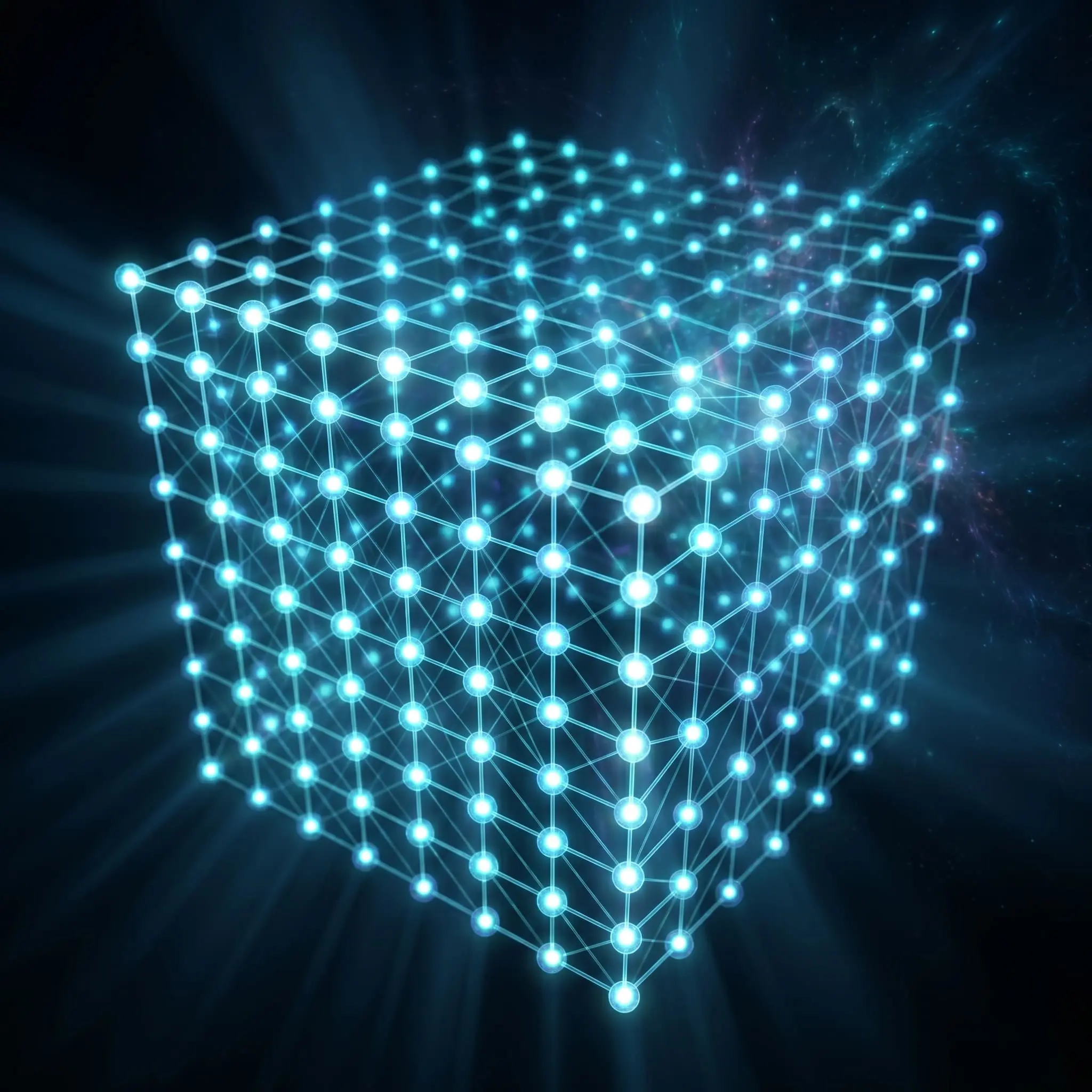
A newly developed quantum error-correcting code leverages the geometry of densely packed spheres to achieve an unusually high encoding rate, bringing practical quantum computing closer to reality. Researchers at IDrive Inc.’s SSMTheory Group have demonstrated the ability to encode 130 logical qubits into 192 physical qubits; this roughly 67 percent encoding rate surpasses many existing methods, reducing the substantial overhead typically required to protect fragile quantum information. By strategically positioning quantum bits on the edges of this FCC lattice, where each site connects to twelve neighbors, the team constructed a code with unique properties.
This emphasis on reproducibility is deliberate, as Raghu Kulkarni, an IDrive researcher who is also the CEO of IDrive Inc., explains: “We’ve tried to be precise about what each result establishes, and we’re sharing this work to invite scrutiny and collaboration from the wider research community.” While many quantum error correction codes prioritize maximizing the distance between encoded qubits for robust error suppression, this approach trades off encoding rate. The IDrive team’s code operates at a fixed error-correcting distance, offering a different balance that may prove advantageous for specific hardware implementations, including those based on neutral atoms, photons, or superconducting circuits. The research extends beyond error correction, with two peer-reviewed papers published in Physics Open exploring the FCC lattice’s potential to model fundamental aspects of particle physics and the vacuum of space itself, suggesting a deep connection between the geometry of crystal packing and the laws governing the universe.
FCC Geometry Models Particle Mass via Information Verification Costs
The pursuit of stable quantum error correction continues to drive innovation in both hardware and theoretical code design, with researchers increasingly exploring unconventional geometries to maximize information retention. Recent work from the SSMTheory Group at IDrive Inc. extends this geometric framework to propose a model linking particle mass to information verification costs. This efficiency is particularly significant given the substantial overhead typically associated with protecting fragile quantum states from decoherence. However, the implications extend beyond improved error correction. “The FCC lattice has a remarkable structure, and we wanted to see how far its geometry could be pushed, first as a practical quantum error-correcting code, and then as a lens on deeper questions in physics,” said Raghu Kulkarni, an IDrive researcher who is also the CEO of IDrive Inc., who leads the SSMTheory Group.
One paper models particles as defects within this code, identifying a particle’s mass with the “thermodynamic cost of verifying that defect,” drawing on Landauer’s principle. Remarkably, the calculated “verification costs” for specific defect geometries, 1, 207, 273, align with the mass ratios of the electron, muon, pion, proton, and neutron, without requiring any fitted parameters.
The FCC lattice has a remarkable structure, and we wanted to see how far its geometry could be pushed – first as a practical quantum error-correcting code, and then as a lens on deeper questions in physics.
Raghu Kulkarni, CEO of IDrive Inc.
Vacuum Crystallization on FCC Lattice Derives Baryonic Matter Properties
Raghu Kulkarni, an IDrive researcher and CEO of IDrive Inc., is leading research that bridges quantum error correction with fundamental particle physics, publishing findings in Elsevier’s Physics Open. Beyond error correction, the SSMTheory Group extends this framework to model the very fabric of reality, positing the physical vacuum as a quantum error-correcting code built on the same FCC lattice. In a paper titled “Matter as incomplete crystallization,” researchers simulate the early universe, demonstrating how a vacuum can self-assemble from a disordered state into the ordered FCC lattice through a geometric phase transition. Baryonic matter, according to this model, arises from incomplete crystallization, specifically, a single extra node trapped within the lattice.
From this premise, the research derives several fundamental properties of matter, including the fractional electric charges of quarks (-1/3 and +2/3), the three color charges governing the strong interaction, and even the proton-to-electron mass ratio of approximately 1836, all without requiring any adjustable parameters. “Contributing to the peer-reviewed physics literature is a genuine milestone for our research effort,” Kulkarni states, emphasizing the team’s commitment to open scrutiny and collaboration within the scientific community.
Contributing to the peer-reviewed physics literature is a genuine milestone for our research effort.
Raghu Kulkarni, CEO of IDrive Inc.


See today’s quantum computing news on Quantum Zeitgeist for the latest breakthroughs in qubits, hardware, algorithms, and industry deals.