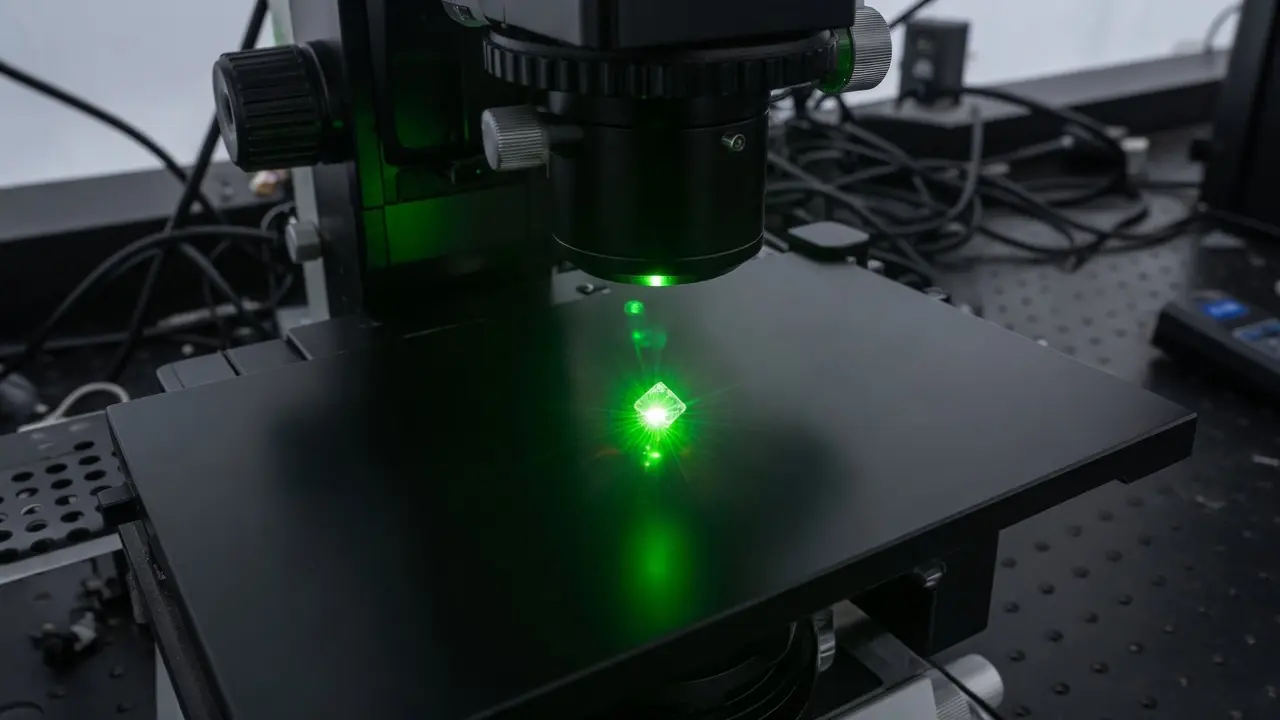
Researchers at Ferdinand-Braun-Institut (FBH) report achieving a record data transmission rate of 1.5 Gigabit per second using ultraviolet light, a feat accomplished with wavelengths under 235 nanometers. This wireless optical communication demonstration, developed in collaboration with the University of Strathclyde and the University of Cambridge, suggests ultraviolet light could offer a solution where radio frequency spectrum is congested. FBH is now extending its capabilities to offer diamond processing for quantum technologies, including the fabrication of 200-nanometer diamond pillars with embedded atomic defects.
FBH Develops Diamond Processing for Quantum Sensors & Memories
Ferdinand-Braun-Institut (FBH) is now fabricating 200-nanometer diamond pillars, embedding atomic-scale defects within the crystalline structure to create building blocks for advanced quantum technologies. This manufacturing capability, recently unveiled by the Berlin-based institute, focuses on producing nanoscale components for quantum computing, sensing and communication systems. The platform extends beyond simple fabrication, offering a complete suite of diamond processing techniques from initial surface preparation to precise ion implantation.
Reducing strain and damage during processing is a key focus, ensuring the delicate quantum states within the diamond remain stable. The institute’s diamond processing platform addresses a critical need for high-quality, precisely engineered diamond structures. These structures are essential for creating color centers, defects in the diamond lattice that act as qubits, the fundamental units of quantum information. Controlling the placement and characteristics of these defects is paramount, and FBH’s capabilities allow for their creation at the atomic scale.
This precision is vital for building reliable and scalable quantum devices, a challenge that has long hampered progress in the field. The ability to manufacture these pillars supports research into novel quantum memories and sensors, potentially enabling more robust and efficient quantum systems. Beyond diamond pillar fabrication, FBH is also applying its expertise in photonics to enhance quantum systems.
Researchers have successfully demonstrated the SUPER (Swing-UP of the quantum EmitteR population) method for generating single photons in diamond-based quantum systems using femtosecond laser pulses to control tin vacancy center qubits. This controlled generation of single photons is an important element for applications like quantum networks and quantum computing.
The team, a collaboration between FBH and Humboldt-Universität zu Berlin, published their findings in Nature Communications, detailing how the new method facilitates the controlled generation of light particles. The institute’s advancements extend to imaging technologies as well, demonstrating a hyperspectral mid-infrared imaging method that uses “sensing with undetected photons.” This technique, developed in collaboration with Fraunhofer IPM Freiburg, transfers the measurement of molecular fingerprints to the detection range of silicon-based cameras.
This innovation allows for real-time analysis of material properties without requiring complete image processing, promising faster and more sustainable quality control processes. The institute’s commitment to pushing the boundaries of both materials science and photonics is evident in this diverse range of research activities.
The institute’s recent achievements are part of a broader trend towards miniaturization and integration in quantum technologies. The demand for higher production output and technological advancements is driving innovation in areas like high-power diode lasers, which are essential for laser materials processing. FBH’s work on diamond processing and single-photon generation positions it as a key player in this rapidly evolving landscape. The institute’s participation in projects like QYRO, focused on developing compact quantum gyroscopes for satellite navigation, further demonstrates its commitment to translating research into practical applications.
Far-UVC LEDs Achieve 1.5 Gbps Record Data Transmission
Researchers at FBH, the University of Strathclyde, and the have demonstrated 1.5Gbps wireless data transmission using far-UVC micro-LEDs, establishing a record for optical communication at wavelengths below 235nm. The demonstration points to ultraviolet light as a potential complement to radio-frequency links where spectrum congestion and solar interference create challenges. The team successfully transmitted data over a 30-centimeter link. The “Epi-Techno-Digital” project, involving IKZ, FBH and HU Berlin, further demonstrates the institute’s commitment to collaborative research and innovation.
GaN-on-W Substrates Enhance Thermal Performance of Power Devices
Researchers propose tungsten substrates as a cost-effective thermal solution for gallium nitride (GaN) power devices, addressing a key limitation in high-performance electronics. This approach developed collaboratively by scientists and Ferdinand-Braun-Institut (FBH), aims to improve heat dissipation without significantly increasing manufacturing expenses. The adoption of GaN technology hinges on overcoming challenges related to heat buildup, as excessive temperatures degrade performance and lifespan.
The proposed tungsten substrates offer a potentially simpler and more affordable alternative, providing a pathway to wider adoption of GaN power electronics. This is particularly relevant as demand for more efficient power systems continues to rise across multiple sectors.
Scientists have successfully manufactured 200-nanometer diamond pillars demonstrating precise control over material structure at the nanoscale. These pillars serve as building blocks for future quantum devices, enabling the exploration of novel quantum phenomena and applications. The institute’s commitment to innovation is also evident in its work with laser technology. A high-precision laser system developed for use in microgravity conditions has enabled the creation of atomic quantum gas mixtures with a high particle flux.
Scientists have launched a manufacturing platform that can carve diamonds at the nanoscale while embedding individual atomic-scale defects. Simultaneously, FBH is actively exploring methods to reduce the cost of diode laser pump sources, important for the development of future fusion power plants.
The project aims to develop new semiconductor materials for energy-efficient artificial intelligence and communication systems, addressing the growing energy demands of data centers. The institute’s capabilities extend to the fabrication of 3D-printed ceramic components for space applications, offering a lightweight and precise platform for sensitive optical and atomic sensors.
Marc Christ, recipient of the Applied Photonics Award 2026 developed a technology platform that makes key components of atomic quantum sensors smaller, more robust and suitable for practical applications. FBH offers diamond processing services for research and industry, supporting the development of diamond-based quantum memories and quantum sensors, ranging from surface preparation to controlled ion implantation and the fabrication of nanoscale structures.
MAIUS-B System Enables Record Quantum Gas Flux in Microgravity
An international team reported their findings in Nature Communications, detailing experiments where Bose-Einstein condensates consisting of rubidium and potassium were generated and examined in a low-gravity environment. This achievement builds on ongoing efforts to understand fundamental quantum phenomena and their potential applications in precision measurement and sensing. FBH is also expanding its capabilities in materials science to support these advancements, now offering a diamond processing platform for developing nanoscale components for quantum communication, sensing and information processing.
FBH Advances Micro-Integrated Quantum Sensor Technology
The institute’s advancements extend to high-speed data transmission, having demonstrated a wireless optical communication link achieving 1.5 gigabits per second using far-UVC LEDs. This record-breaking data rate, achieved through the use of ultraviolet light, offers a potential solution for environments where radio-frequency links are limited, or a complementary approach to existing technologies.
The ability to transmit data even without a direct line of sight expands the possibilities for secure and reliable communication in diverse settings. FBH is also showing the increasing role of 3D printing in photonic systems engineering, demonstrating how additive manufacturing is becoming a key technology for creating customized components.
At the Photonics West 2026 conference in San Francisco, the institute exhibited a modular photonic building block system, where components can be flexibly combined depending on the application. This approach allows for rapid prototyping and customization of photonic circuits, accelerating the development of new devices and systems. Scientists are working on perfecting single-photon sources, using ultrafast laser pulses to bring diamond-based quantum internet closer to reality. This work builds on the institute’s expertise in laser materials processing and its ability to create high-precision diamond structures.



See today’s quantum computing news on Quantum Zeitgeist for the latest breakthroughs in qubits, hardware, algorithms, and industry deals.