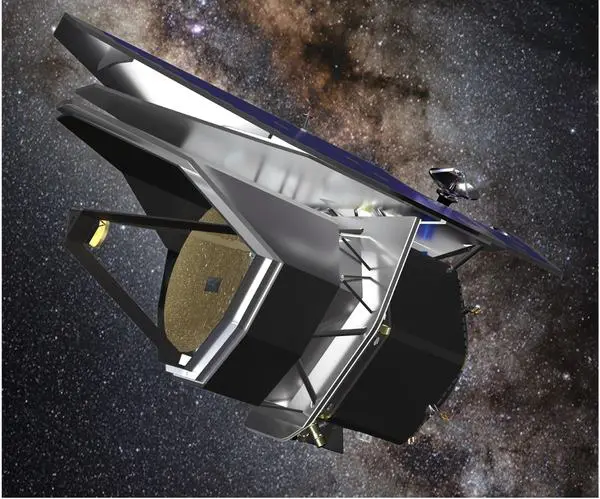
Caltech and the Jet Propulsion Laboratory will collaborate on PRIMA, a $1 billion space telescope designed to observe the universe in far-infrared light. The observatory will cool its telescope and detectors to hundreds of degrees below zero to minimize interference and achieve image clarity. Caltech’s IPAC is the mission science center, where raw data from the telescope is received, processed, and archived for use by astronomers seeking to answer some of the universe’s deepest mysteries.
IPAC will also be responsible for scheduling astronomers’ time and use of the telescope. “PRIMA represents a giant leap for far-infrared astronomy,” says Caltech President Ray Jayawardhana, “helping reveal fundamental cosmic processes that have long been hidden from view.”
PRIMA Mission: Caltech and JPL’s Roles in Development
The development of PRIMA’s ultrasensitive far-infrared cameras relies on technology originating from a 1999 invention by Jonas Zmuidzinas and Rick LeDuc, superconducting microwave kinetic inductance detectors, or MKIDs. These detectors, which minimize thermal noise and achieve clear images, represent decades of refinement at Caltech and JPL, building on a foundation of infrared astrophysics expertise. Caltech’s recent advancements in quantum research, including the demonstration of a 6,100-qubit neutral atom array on September 25, 2025, directly inform the precision engineering required for these detectors and the associated data processing systems.
JPL will lead mission architecture and systems engineering for the $1 billion observatory, building on its long-standing relationship with Caltech, though that arrangement will soon change; NASA will compete for the Jet Propulsion Laboratory management contract, ending Caltech’s sole source agreement established in the 1930s, an announcement made on May 25, 2026. Despite this shift, the collaboration remains central to the mission’s success, with JPL responsible for integrating the spacecraft and payload.
IPAC, a Caltech-managed center, will not only receive and archive data from PRIMA but also manage the scheduling of astronomers’ time and use of the telescope, a role it has honed over four decades, beginning with support for the Infrared Astronomical Satellite in the 1980s.
Researchers anticipate using PRIMA to study hundreds to thousands of galaxy outflows, mapping their demographics and revealing the physics driving galaxy evolution, as well as understanding the role of molecular outflows in shaping star formation and the growth of supermassive black holes. “I am particularly excited about how PRIMA will help us discover and understand the role of powerful molecular outflows in galaxies over cosmic time,” one scientist noted.
PRIMA represents a giant leap for far-infrared astronomy, born from decades of daring ingenuity at Caltech and JPL.
Caltech President Ray Jayawardhana, the Sonja and William Davidow Presidential Chair and professor of astronomy
MKIDs/KIDs Detectors Enable Ultrasensitive Far-Infrared Observations
The foundation for PRIMA’s sensitivity lies in microwave kinetic inductance detectors, or MKIDs/KIDs, initially conceived in 1999 by Caltech’s Jonas Zmuidzinas and JPL engineer Rick LeDuc during a conversation at a local coffee shop. These detectors, built from superconducting materials, represent a departure from traditional far-infrared sensors and allow for the detection of faint signals previously obscured by thermal noise.
Initial tests in 2007 at the Caltech Submillimeter Observatory confirmed the technology’s viability. Over the last five years, a Caltech-JPL team, including members of JPL’s Microdevices Laboratory, focused on refining KID arrays for the demanding conditions of space travel and the sensitivity required for PRIMA.
This engineering effort yielded prototype arrays demonstrating flight readiness, an important step in securing the mission’s success. “Our program of developing these detectors over three decades has led to PRIMA,” says Zmuidzinas, recently honored with the 2026 James Craig Watson Medal from the National Academy of Sciences for his detector technologies.
The award recognizes not only the detectors’ performance but also their potential to reveal new insights into the universe. Caltech’s June 19, 2026 dedication of a 70,000-square-foot facility for quantum science underscores this investment, while a research partnership with Broadcom further advances research in this field.
Our program of developing these detectors over three decades has led to PRIMA.
Zmuidzinas, who, this past January, was awarded the 2026 James Craig Watson Medal from the National A
PRIMA’s Instrument Suite: PRIMAger and FIRESS Capabilities
The PRIMA observatory’s imaging polarimeter, PRIMAger, will map expansive regions of the sky, collecting data across a 1.8-meter telescope field of view, a capability important for understanding large-scale cosmic phenomena. This instrument will measure the polarization of far-infrared light, revealing details about magnetic fields and the physical processes shaping interstellar dust and gas. Complementing this broad-sky view is FIRESS, a high-resolution spectrometer designed for detailed, multimode spectroscopy, allowing scientists to analyze the composition and dynamics of distant objects with precision.
FIRESS will operate across a wavelength range of 24 to 235 micrometers, enabling the detection of spectral lines emitted by molecules and atoms in various cosmic environments. This spectral resolution will allow astronomers to determine the temperature, density, and velocity of gas clouds, as well as identify the chemical composition of planetary atmospheres and interstellar dust grains.
The instrument’s ability to conduct multimode spectroscopy, measuring multiple polarization states simultaneously, will further enhance its sensitivity and provide a more complete picture of the observed sources. Caltech’s expertise in developing microwave kinetic inductance detectors (MKIDs) is central to FIRESS’s performance, enabling the precise measurement of faint signals.
The combination of PRIMAger and FIRESS provides a synergistic approach to far-infrared astronomy, allowing researchers to both survey large areas of the sky and conduct in-depth studies of individual objects. Data from both instruments will be processed and archived at Caltech’s IPAC, which will also be responsible for scheduling astronomers’ time and use of the telescope.
The PRIMA mission is humanity’s next window into the deep universe. It will unveil the obscure across cosmic time to better understand the formation of planets, stars, black holes, and even how water on Earth came to be.
Nicky Fox, associate administrator, Science Mission Directorate, NASA Headquarters in Washington, in
IPAC’s Data Archiving and Science Community Support
Caltech’s Infrared Science Archive (IRSA) will become the permanent home for data gathered by the PRIMA observatory, joining a collection spanning over 20 NASA missions already maintained by IPAC. This builds upon decades of experience; IPAC previously supported operations for observatories like the Spitzer Space Telescope, which operated from 2003 to 2020, and the recently launched SPHEREx mission from March 2025, ensuring continuity of infrared astronomical data access.
The archive’s expansion demonstrates Caltech’s sustained commitment to long-term data preservation, a critical component of modern astrophysics, and utilizes a robust infrastructure developed over forty years starting with the Infrared Astronomical Satellite (IRAS) in the 1980s. Approximately 75 percent of PRIMA’s observing time will be allocated to the broader scientific community through a peer-review process, a commitment to open access that has already generated significant interest.
The team has received nearly 200 observational proposals from over 400 astronomers, indicating a strong demand for access to PRIMA’s unique capabilities and data. This proactive engagement with the astronomy community, facilitated by IPAC’s scheduling responsibilities, ensures that the observatory’s resources are utilized effectively and that scientific discoveries are maximized. Says Rachel Akeson (PhD ‘97), the deputy director of IPAC, highlighting the institute’s readiness to manage the influx of data and proposals.
IPAC’s role extends beyond data archiving and scheduling to encompass calibration and science data processing, essential steps in transforming raw telescope readings into usable scientific results. This comprehensive support system is enabled by Caltech’s recent investment in quantum technologies. Caltech dedicated a new 70,000-square-foot facility on June 19, 2026 for research in quantum science, including the development of microwave kinetic inductance detectors (MKIDs) central to PRIMA’s performance.
Source: https://physics.caltech.edu/news/nasa-confirms-prima-mission-key-roles-for-caltech-jpl-and-ipac



See today’s quantum computing news on Quantum Zeitgeist for the latest breakthroughs in qubits, hardware, algorithms, and industry deals.