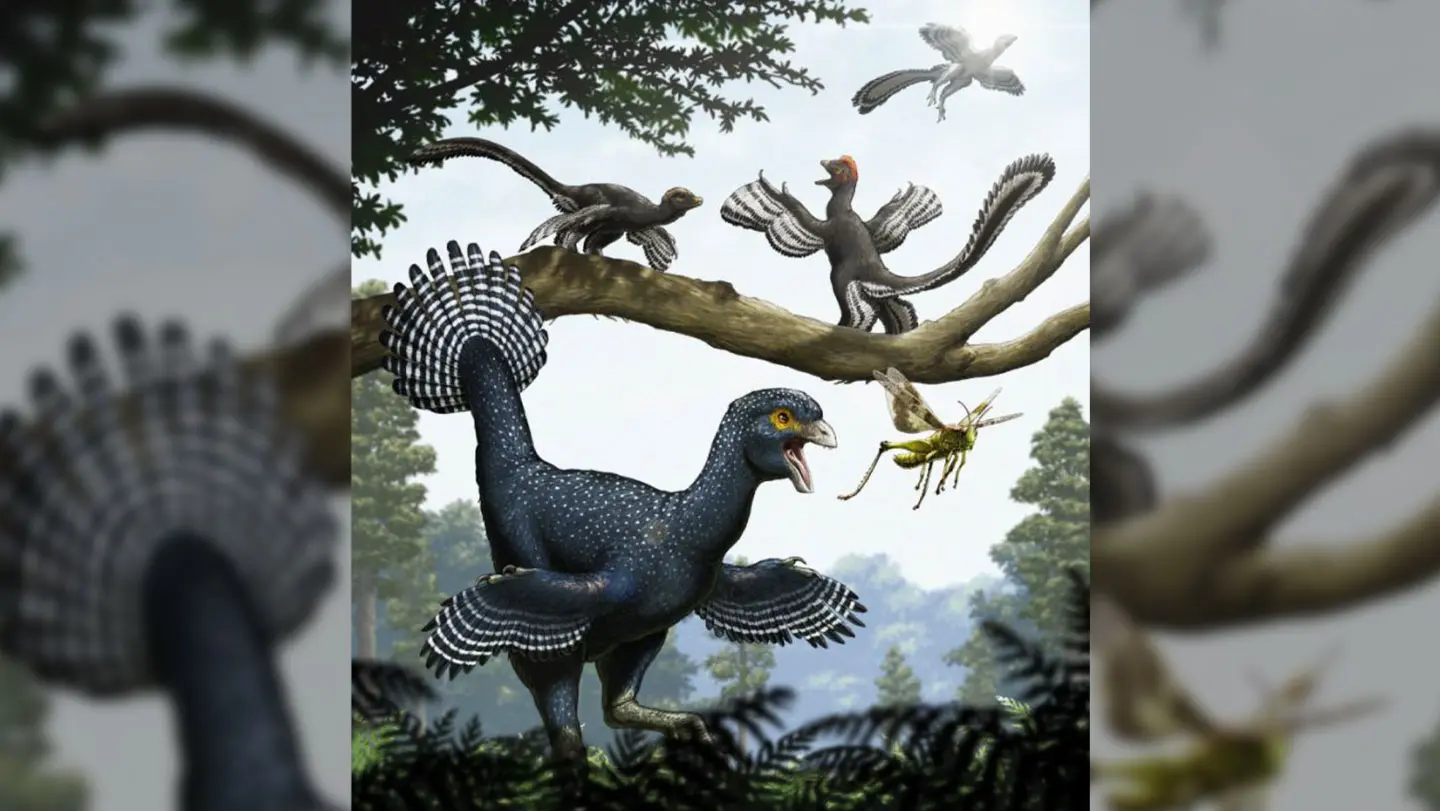
Robotic and computer-simulated dinosaurs are offering a new perspective on the evolution of flight, suggesting that wings may have initially served a purpose other than taking to the skies. Researchers focused on pennaraptorans, small, feathered dinosaurs whose “protowings” were likely unsuitable for flight, according to Minyoung Son, a vertebrate paleontologist at the University of Minnesota in Minneapolis. Inspired by observations of modern bird behavior in the American West, zoologist Piotr Jablonski hypothesized that dinosaur feathers were first used for display and hunting; he thought that early winged dinosaurs may have behaved similarly to modern birds. Experiments involving a robot dinosaur named Robopteryx and computer animations demonstrate that flush displays were more effective with protowings, indicating a potential hunting tactic where wings lured insects into the open. The study was published in Scientific Reports on January 25.
Robotic “Robopteryx” Tests Insect Responses to Wing Displays
A robotic dinosaur is reshaping our understanding of feather evolution, suggesting display and hunting preceded flight. Researchers are increasingly turning to active experimentation to reconstruct the behaviors of extinct animals, moving beyond traditional fossil analysis. A central question driving this work is whether early feathered dinosaurs utilized proto-wings for purposes other than achieving lift. Zoologist Piotr Jablonski’s observations of modern bird behavior provided a surprising starting point; he noted that some birds employ wing and tail displays to startle insects into the open, creating hunting opportunities.
Field tests conducted in Seoul, South Korea, with wild grasshoppers revealed that flush displays were demonstrably more effective with the protowings attached. Further experimentation utilized computer-animated Caudipteryx and domesticated locusts, measuring neural responses to different wing movements; the team found that visual displays were more effective at eliciting a neural response from the insects when the animated Caudipteryx had protowings, instead of just bare forelimbs. Paleontologist Corwin Sullivan of the University of Alberta in Edmonton, Canada, acknowledges the research, stating that the findings “elegantly and persuasively” demonstrate the possibility of this behavior, though definitive proof remains elusive.
Neural Responses Confirm Protowings Enhance Visual Stimulation
Recent investigations into the origins of avian flight are shifting focus from aerodynamic necessity to visual signaling. Researchers are actively reconstructing dinosaur behavior through innovative experimentation, moving beyond traditional paleontological methods of fossil analysis. Evidence suggests that pennaraptorans, small feathered dinosaurs, may have initially utilized proto-wings not for lift, but as a hunting strategy, a hypothesis stemming from observations of modern bird behavior. Son notes that the surface area of these early wings would have been too small to create the aerodynamic force needed to lift pennaraptorans off the ground, and lacked the asymmetrical shape required for efficient flight. Field tests in Seoul, South Korea, using the robot, dubbed Robopteryx, demonstrated that grasshoppers exhibited a greater flight response when confronted with the robot displaying its protowings versus without them. Further investigation involved computer-animated Caudipteryx displays presented to domesticated locusts, with electrodes connected to the nerve cord and abdomen measuring neural activity.
Caudipteryx as a Model for Pennaraptoran Protowings
Son notes that fossil evidence suggests these dinosaurs “don’t have the aerodynamic feathers yet,” indicating a functional purpose other than powered flight. To investigate potential pre-flight functions, the team, led by Piotr Jablonski, initially constructed a robotic dinosaur modeled after the turkey-sized Caudipteryx. This robot, nicknamed Robopteryx, was deployed in a natural area in Seoul, South Korea, to observe the responses of wild grasshoppers (Oedaleus infernalis) to wing displays. Jinseok Park, an ornithologist now at the Max Planck Institute for Biological Intelligence in Planegg, Germany, conducted hundreds of trials, comparing grasshopper flight responses with and without the robot’s detachable protowings. The results of the study, published in Scientific Reports, showed that flush displays were more effective with the protowings. Building on these findings, the researchers transitioned to computer animation, presenting Caudipteryx displays to domesticated locusts and monitoring their neural activity. This invasive procedure involved connecting electrodes to the locusts’ nerve cords and abdomen to measure responses to different wing movements.
what this shows, rather elegantly and persuasively, is that it’s possible,” says paleontologist Corwin Sullivan of the University of Alberta in Edmonton, Canada.
Flush Displays as a Potential Pre-Flight Function
This observation sparked the hypothesis that feathered dinosaurs, specifically pennaraptorans, may have initially employed their developing wings for a similar hunting tactic, before the evolution of powered flight. To investigate this, the team focused on Caudipteryx, a turkey-sized pennaraptoran with well-preserved fossils, constructing a robot named Robopteryx. Further experimentation transitioned to computer animation, allowing researchers to examine the neural responses of domesticated locusts to different wing movements; electrodes were connected to the insects’ nerve cords and abdomen to measure activity. The results of the study published in Scientific Reports indicated that animated Caudipteryx displays elicited a stronger neural response in locusts when featuring protowings rather than bare forelimbs.
what this shows, rather elegantly and persuasively, is that it’s possible,” says paleontologist Corwin Sullivan of the University of Alberta in Edmonton, Canada.



See today’s quantum computing news on Quantum Zeitgeist for the latest breakthroughs in qubits, hardware, algorithms, and industry deals.