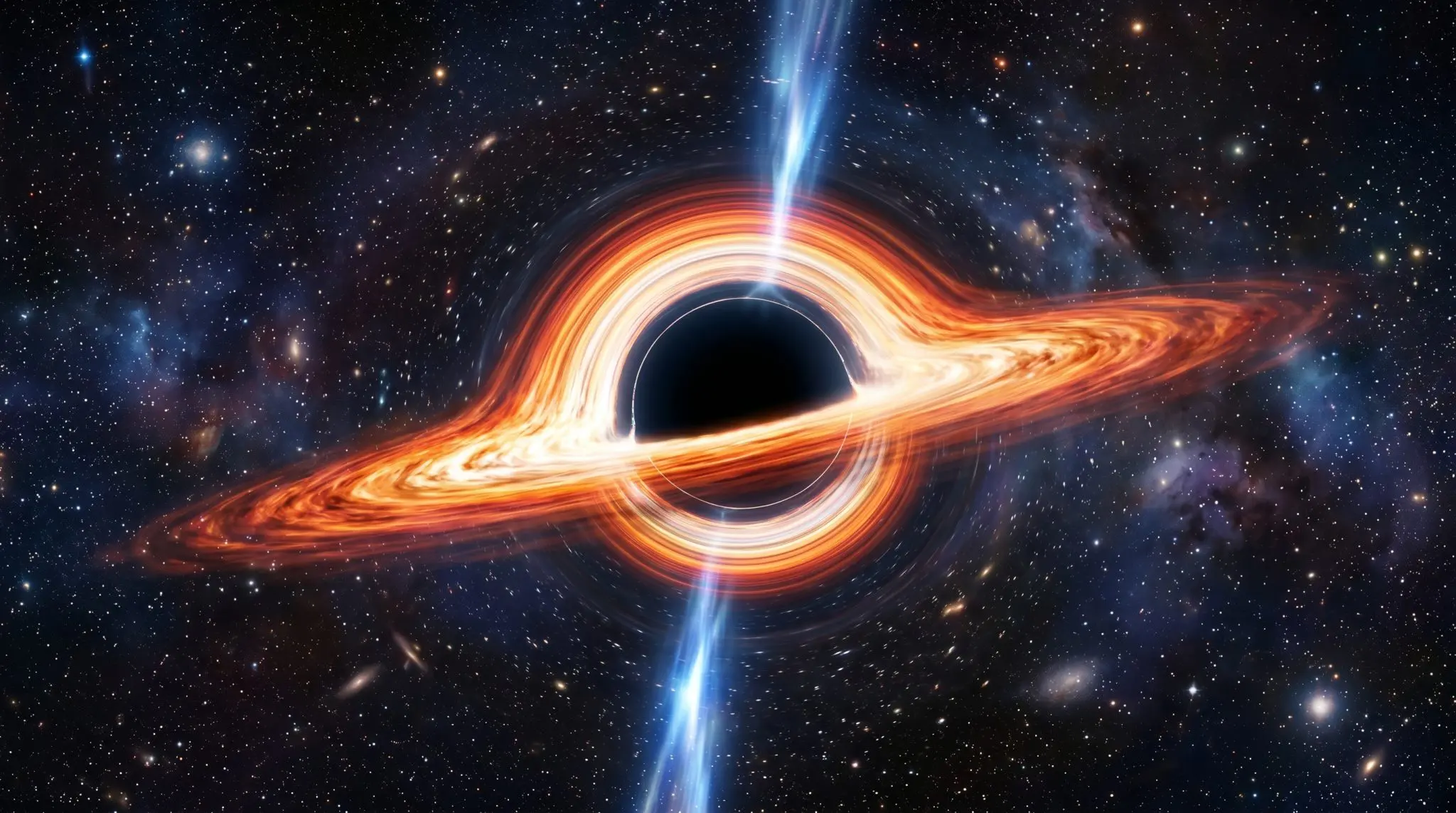
Evidence is mounting for the existence of dark matter, and Virginia Tech physicists have now offered compelling support for a long-held theory: that this invisible substance clusters around supermassive black holes. Researchers used an astrophysical technique called echo mapping to analyze 14 distant galaxies, revealing five cases where mass increased with distance faster than visible matter alone could explain. Dark matter gathers like a “thickening cloud of black smoke” around these cosmic behemoths, a behavior previously unconfirmed by particle physics. “We are reaching a point where the observational evidence for dark matter is simply undeniable,” said Mayank Sharma, a Virginia Tech graduate student in physics, emphasizing that dark matter far outweighs all visible matter in the universe.
Dark Matter’s Gravitational Influence on Galactic Speeds
Dark matter’s pervasive influence extends to the very fabric of galactic motion; stars and galaxies are rotating at velocities dramatically exceeding expectations based on visible matter alone. This suggests an unseen gravitational force is at play, driving a need to understand the distribution of this elusive substance. Researchers are now applying novel techniques to map dark matter’s presence, specifically focusing on its behavior around supermassive black holes, where its gravitational effects are amplified. The publication, led by researchers at Virginia Tech, employed an astrophysical technique known as echo mapping to analyze 14 distant galaxies, seeking evidence to support the theory that dark matter accumulates around these gravitational behemoths. This method relies on measuring the time delay between light emitted from an accretion disk around a black hole and its echo from surrounding gas, allowing scientists to calculate mass distribution.
In five of the galaxies studied, the team observed a mass increase with distance that could not be accounted for by visible matter, suggesting the presence of a surrounding halo of dark matter. Dark matter’s interaction with the universe differs significantly from that of ordinary matter; it doesn’t interact strongly with itself or visible matter, responding only to gravity. This means, unlike the turbulent accretion disks of gas and plasma surrounding black holes, dark matter doesn’t lose energy through friction and remains concentrated on the outskirts. Future observations could confirm or rule out the theory.
We are reaching a point where the observational evidence for dark matter is simply undeniable.
Echo Mapping Technique Measures Dark Matter Around Black Holes
The search for direct evidence of dark matter continues to yield intriguing, albeit indirect, results; current astrophysical techniques are increasingly capable of mapping its distribution, even in extreme environments like those surrounding supermassive black holes. This method leverages the well-established principle that light echoes, secondary pulses emitted from gas illuminated by a black hole’s accretion disk, reveal the distance to surrounding material, allowing for mass calculations. Applying this technique to observations of five distant galaxies, the team found instances where the calculated mass increased with distance at a rate exceeding what could be accounted for by visible matter alone. The significance of this finding lies in the fact that dark matter, unlike the turbulent plasma surrounding black holes, doesn’t interact with light or other matter, only exerting its influence through gravity. This lack of interaction means it should accumulate thickly on the outskirts, a description used in the study. Future observations could confirm or rule out the theory, potentially reshaping our understanding of both dark matter and the environments around supermassive black holes, as Sharma notes, “the prospects are exciting.”
There is a huge discrepancy.
Nahum Arav, Virginia Tech physicist
Five Galaxies Show Evidence of Excess Mass Beyond Black Holes
This research builds on a long-held theory, previously unconfirmed by direct particle physics observation, that dark matter interacts primarily through gravity, unlike the turbulent behavior of visible matter surrounding black holes. Sharma explained that “these galaxies are definitely showing a hint that there is extra material that cannot be explained by just the supermassive black hole,” emphasizing the study’s preliminary but promising nature. The team, employing an astrophysical technique called echo mapping, found five cases where mass increased with distance faster than visible matter alone could explain. Future observations could confirm, or rule out, the theory. Sharma also noted that “the prospects are exciting.”
These galaxies are definitely showing a hint that there is extra material that cannot be explained by just the supermassive black hole.




See today’s quantum computing news on Quantum Zeitgeist for the latest breakthroughs in qubits, hardware, algorithms, and industry deals.