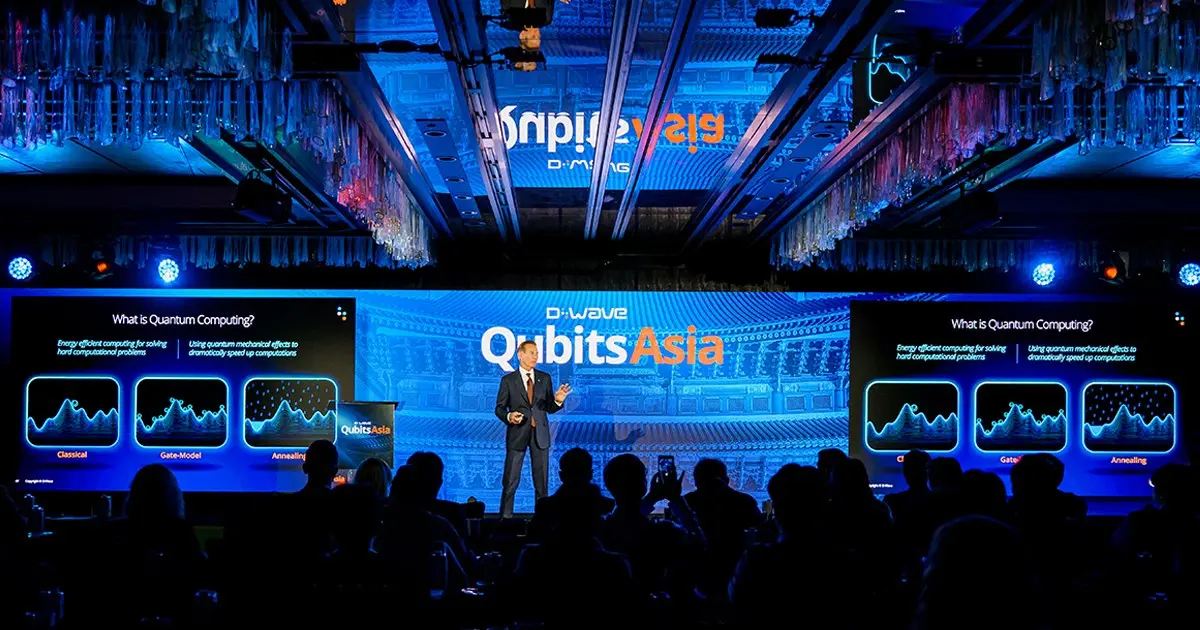
D-Wave recently hosted Qubits Asia 2026: Quantum Realized in Seoul, South Korea, bringing together researchers and industry experts to explore advances in quantum computing across the Asia Pacific region, the company says. The conference highlighted real-world applications spanning network optimization to drug discovery, demonstrating the broadening impact of quantum technology.
D-Wave CEO Dr. Alan Baratz noted, “Countries across Asia Pacific, including South Korea, Japan, Singapore and Taiwan, are moving to secure global leadership in quantum computing,” adding that D-Wave is helping to advance these ambitions with its technologies. The event also featured progress on D-Wave’s dual-platform roadmap, including a new gate-model simulator beta program.
D-Wave’s Dual-Platform Roadmap Advances Annealing and Gate-Model Technologies
D-Wave unveiled a new gate-model simulator beta program at Qubits Asia 2026, allowing select customers to prepare applications for future hardware and explore error-aware programming techniques. This simulator represents a step in the company’s strategy to expand beyond its annealing platform and develop scalable, fault-tolerant quantum computing capabilities, according to D-Wave. The program’s launch follows recent peer-reviewed research published in Nature detailing a fast, high-fidelity two-qubit entangling gate that preserves the error-detection advantages of D-Wave’s superconducting dual-rail architecture.
This gate validates an important building block for the company’s gate-model approach, demonstrating progress toward more versatile quantum computation. Alongside gate-model advancements, D-Wave continues to refine its annealing quantum computing platform with new analog-digital capabilities. These capabilities provide researchers with increased control over quantum simulations, broadening the platform’s potential in materials science and complex system modeling.
The company highlighted research exploring how quantum computing could enhance generative AI models, suggesting a convergence of these two rapidly developing fields. Dr. Trevor Lanting, chief development officer, presented these advances during the conference, outlining D-Wave’s dual approach to quantum computing development.
Presentations at the conference demonstrated applications in sectors like telecommunications, where NTT DOCOMO is using D-Wave-powered quantum computing to improve network efficiency, and manufacturing, with LG CNS exploring hybrid-quantum optimization for 3D CT image reconstruction, the firm reports. Further research presented at the event included quantum-AI hybrid engines for drug discovery at Yonsei University College of Medicine and annealing quantum computing-based frameworks for reticle optimization at National Yang Ming Chiao Tung University.


See today’s quantum computing news on Quantum Zeitgeist for the latest breakthroughs in qubits, hardware, algorithms, and industry deals.