A research team from Aalto University in Finland has developed a method for microwave photon detection at single-photon power levels, a significant advancement in nanoelectronics and quantum information science. The team, led by Kirill Petrovnin and Jiaming Wang, used a Kerr Josephson parametric amplifier, enhancing its sensitivity to low energy levels. The method achieved an efficiency of 73% and a dark-count rate of 167 kHz. This technology has potential applications in fields requiring the detection of low energy levels, such as astronomy and medical imaging. Future research will focus on improving efficiency and understanding the physics of the Kerr Josephson parametric amplifier.
What is the Significance of Microwave Photon Detection?
Microwave photon detection at single-photon power levels is a highly sought-after technology with practical applications in nanoelectronics and quantum information science. This technology is crucial for the advancement of these fields, as it allows for the detection of extremely low levels of energy. The detection of microwave fields at such levels has been a challenge for scientists and engineers, but recent research has demonstrated a new method that enhances the efficiency of this process.
The research team, led by Kirill Petrovnin and Jiaming Wang from the QTF Centre of Excellence and InstituteQ Department of Applied Physics at Aalto University in Finland, has developed a simple yet powerful method of microwave photon detection. They achieved this by operating a magnetic field-tunable Kerr Josephson parametric amplifier at the border of a first-order phase transition and close to the critical point. This method resulted in an efficiency of 73% and a dark-count rate of 167 kHz, corresponding to a responsivity of 13 10 17W1and noise-equivalent power of 328 zW Hz.
The team verified the single-photon operation by extracting the Poissonian statistics of a coherent probe signal. This is a significant achievement in the field of nanoelectronics and quantum information science, as it allows for the detection of extremely low levels of energy, which is crucial for the advancement of these fields.
How Does the New Method Work?
The new method developed by the research team involves the use of a Kerr Josephson parametric amplifier, a device that is capable of amplifying weak signals. This device is operated at the border of a first-order phase transition and close to the critical point, which enhances its sensitivity to low levels of energy.
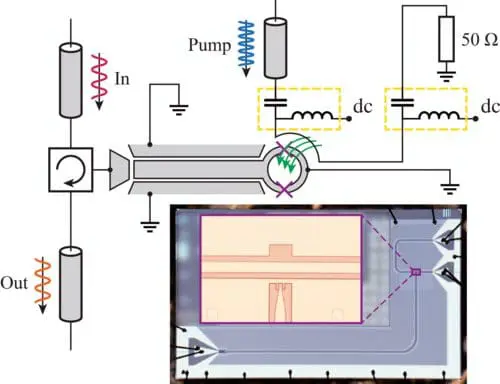
The Kerr Josephson parametric amplifier is a quarter-wavelength superconducting stripe terminated by a superconducting quantum interference device (SQUID). The effective electrical length of the device can be tuned quickly by using an external magnetic field, allowing the device to be parametrically pumped at a frequency close to double the resonant frequency. This induces three-wave mixing, a process that is crucial for the detection of low levels of energy.
The research team operated the device as a criticality-enhanced detector by exploiting the crossing of a first-order phase transition triggered by incident quanta. This method resulted in an efficiency of 73% and a dark-count rate of 167 kHz, corresponding to a responsivity of 13 10 17W1and noise-equivalent power of 328 zW Hz.
What are the Applications of this Technology?
The technology developed by the research team has practical applications in nanoelectronics and quantum information science. In nanoelectronics, the ability to detect extremely low levels of energy is crucial for the development of highly sensitive devices. In quantum information science, this technology can be used for the detection of single photons, which is crucial for the advancement of quantum computing and quantum communication.
The research team’s method of microwave photon detection can also be used in other fields that require the detection of low levels of energy. For example, it can be used in astronomy for the detection of weak signals from distant celestial bodies. It can also be used in medical imaging for the detection of weak signals from the human body.
What are the Challenges and Future Directions?
While the research team’s method of microwave photon detection is a significant advancement, there are still challenges that need to be addressed. For example, the physics near and above the threshold of the Kerr Josephson parametric amplifier is less understood and needs further investigation.
In addition, while the team’s method resulted in an efficiency of 73%, there is still room for improvement. Future research should focus on enhancing the efficiency of the method and reducing the dark-count rate. This could be achieved by optimizing the operating conditions of the Kerr Josephson parametric amplifier and by developing more sophisticated signal processing techniques.
Despite these challenges, the research team’s method of microwave photon detection is a promising technology that has the potential to revolutionize nanoelectronics and quantum information science. With further research and development, this technology could lead to the development of highly sensitive devices that can detect extremely low levels of energy.
Publication Date: 2024-05-24
Authors: Kirill Petrovnin, Jiaming Wang, Michael Perelshtein, Pertti Hakonen, et al.
Source: PRX Quantum 5, 020342
DOI: https://doi.org/10.1103/PRXQuantum.5.020342



See today’s quantum computing news on Quantum Zeitgeist for the latest breakthroughs in qubits, hardware, algorithms, and industry deals.