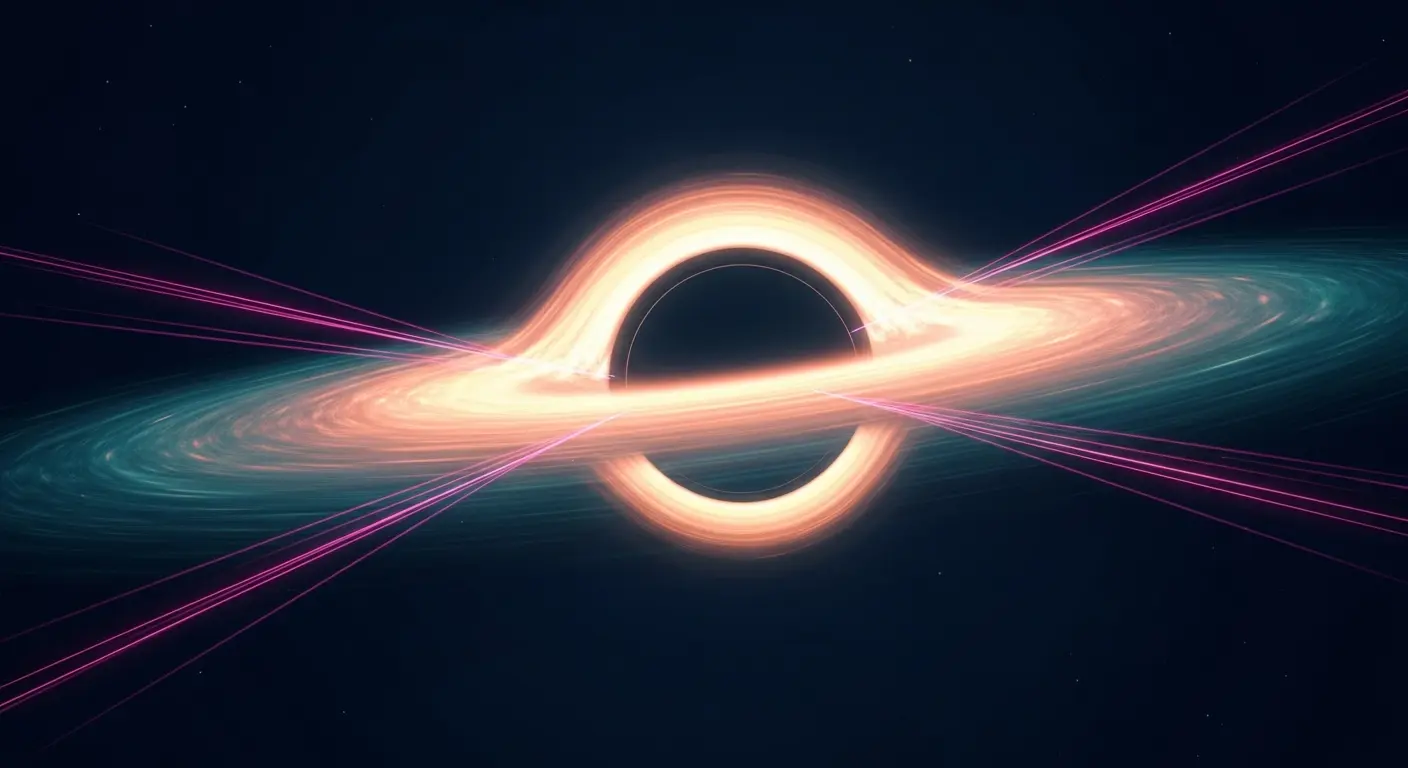
Emily Adlam, of the Philosophy Department and Institute for Quantum Studies, Chapman University, Orange, has identified a striking connection between black hole information loss and the Wigner’s Friend thought experiment. The connection favours interpretations of quantum mechanics that embrace intrinsic relationality and potentially even retrocausality. It offers new insights into the nature of observation and reality itself.
Mapping observers links black hole information paradoxes and Wigner’s Friend scenarios
Establishing operational similarity between disparate quantum scenarios proved central to this investigation. Identifying a mapping between observers in both black hole paradoxes and Wigner’s Friend scenarios, a thought experiment where two observers make measurements on the same quantum system, leading to conflicting realities depending on who is observing whom, involved a careful technique of abstracting the core logical structure of each. The Wigner’s Friend scenario, originally proposed by Eugene Wigner in 1963, highlights the subjective nature of quantum measurement. The ‘friend’ performing the initial measurement obtains a definite result, but from the perspective of an external observer, the friend and the measured system remain in a superposition until a further measurement is made. This creates a branching of realities, dependent on the observer’s frame of reference. Quantum operations then appeared to lead to contradictions in both contexts, specifically concerning the consistency of assigning probabilities to measurement outcomes.
This analysis deliberately avoids specific qubit counts or temperatures, focusing instead on the shared logical structure of the paradoxes. The method hinges on the principle that phenomena exhibiting such operational similarity should, where possible, be explained using similar underlying principles. It’s akin to a detective reconstructing events from evidence, seeking consistent explanations for seemingly unrelated clues. The black hole information paradox, stemming from the apparent loss of information as matter falls into a black hole, contradicts the unitary evolution of quantum mechanics, a cornerstone of the theory. Unlike alternatives, this approach seeks conceptual consistency across seemingly disparate areas, as both paradoxes involve measurements in incompatible bases and inaccessible outcomes for individual observers. The incompatibility arises because different observers may have access to different parts of the quantum state, leading to differing descriptions of reality. By identifying matching observers and quantum operations, a connection between black hole paradoxes and Wigner’s Friend scenarios became apparent. This uses the principle that operationally similar phenomena likely share underlying explanations, mirroring established methods in physics and Leibniz’s work on indiscernibles, which posits that if two things share all the same properties, they are, in effect, the same thing. The rigorous identification of these operational equivalences is crucial, as it allows for the transfer of insights between these seemingly unrelated domains.
Operational equivalence of black hole and Wigner’s Friend paradoxes favours intrinsic relationality
A mapping between observers in black hole paradoxes and Wigner’s Friend scenarios has been demonstrated, revealing a previously unquantified operational similarity. This analysis favours interpretations of quantum mechanics embracing intrinsic relationality, where properties exist only in relation to an observer, over those positing merely effective or emergent relationality. The distinction is significant. Effective relationality suggests an underlying objective reality exists, while intrinsic relationality asserts that reality is fundamentally observer-dependent. The work also suggests retrocausality, where effects precede causes, may be integral to resolving fundamental puzzles in quantum mechanics and our understanding of observation itself. A concept previously considered largely speculative. Retrocausality, if valid, would necessitate a re-evaluation of our understanding of time and causality, potentially offering a pathway to resolving the measurement problem in quantum mechanics.
Specifically, analyses of these linked paradoxes favour models where a quantum system’s properties only exist in relation to an observer, contrasting with theories suggesting relationality arises as a convenient description of an underlying absolute reality. Hausmann and Renner recently highlighted that several black hole paradoxes share characteristics with Extended Wigner’s Friend paradoxes, prompting this investigation into their shared implications. Prior approaches required accepting inconsistencies in quantum predictions, but this research establishes a framework where analogous paradoxes demand consistent explanations, circumventing that limitation. Accepting first-person universality, the idea that quantum mechanics accurately predicts individual measurement outcomes, can resolve paradoxes relying on third-person universality, where joint measurement predictions are considered. The challenge with third-person universality lies in reconciling the subjective experiences of multiple observers, each of whom may perceive a different outcome. This work suggests that a consistent description of reality requires prioritising the individual observer’s perspective. Furthermore, the implications extend to the foundations of information theory, as the very concept of information becomes observer-dependent in an intrinsically relational framework.
Black holes and quantum measurement share surprising operational connections
Researchers are increasingly focused on the interaction between gravity and quantum mechanics, seeking resolutions to paradoxes that plague both fields. The incompatibility between general relativity, which describes gravity as the curvature of spacetime, and quantum mechanics, which governs the behaviour of matter at the atomic and subatomic levels, is a major obstacle to a complete theory of physics. This work, however, deliberately avoids the difficult task of constructing a complete mathematical framework linking black holes to quantum measurement. Instead, it relies on identifying operational similarities, matching observers and quantum actions, between these seemingly unrelated scenarios. Acknowledging that this work presently lacks direct experimental verification does not diminish its value. The extreme conditions within black holes, and the inherent difficulties in performing quantum measurements on macroscopic systems, present significant practical challenges to direct experimental testing.
By drawing parallels between black hole physics and the Wigner’s Friend paradox, a thought experiment exploring the subjectivity of quantum measurement, scientists gain fresh perspectives on longstanding conceptual problems. In particular, this analysis suggests that certain interpretations of quantum mechanics, favouring intrinsic relationality and potentially even retrocausality, may better accommodate both black hole behaviour and the challenges posed by multiple observers in quantum systems. This conceptual work, mirroring Wigner’s Friend, a test of quantum subjectivity, could begin a new era of theoretical unification, just as early pioneers first grappled with these profound mysteries. Completed in 2026, this analysis of black hole paradoxes and the Wigner’s Friend scenario establishes a conceptual link favouring interpretations of quantum mechanics where an observer’s relationship to a system is fundamental. Intrinsic relationality posits properties aren’t inherent but arise from observation. Identifying operational similarities between these paradoxes moves the research beyond simply describing quantum phenomena to suggesting how they might be understood, offering a more coherent framework that avoids the requirement to accept inconsistencies in quantum predictions. The next steps involve exploring the mathematical formalisms that can best capture these intrinsically relational dynamics and investigating the potential for observable consequences in realistic quantum systems.
By establishing a conceptual link between black hole paradoxes and the Wigner’s Friend scenario, researchers have illuminated potential solutions to longstanding problems in quantum mechanics. This analysis favours interpretations where the relationship between an observer and a quantum system is fundamental, known as intrinsic relationality, and suggests the possibility of retrocausality. The work identifies operational similarities between these seemingly disparate areas of physics, offering a more coherent understanding of quantum predictions. Authors propose future work will focus on developing the mathematical frameworks to further explore these intrinsically relational dynamics and investigate observable consequences.
👉 More information
🗞 What Do Black Holes Teach Us About Wigner’s Friend?
🧠 ArXiv: https://arxiv.org/abs/2604.17839



See today’s quantum computing news on Quantum Zeitgeist for the latest breakthroughs in qubits, hardware, algorithms, and industry deals.