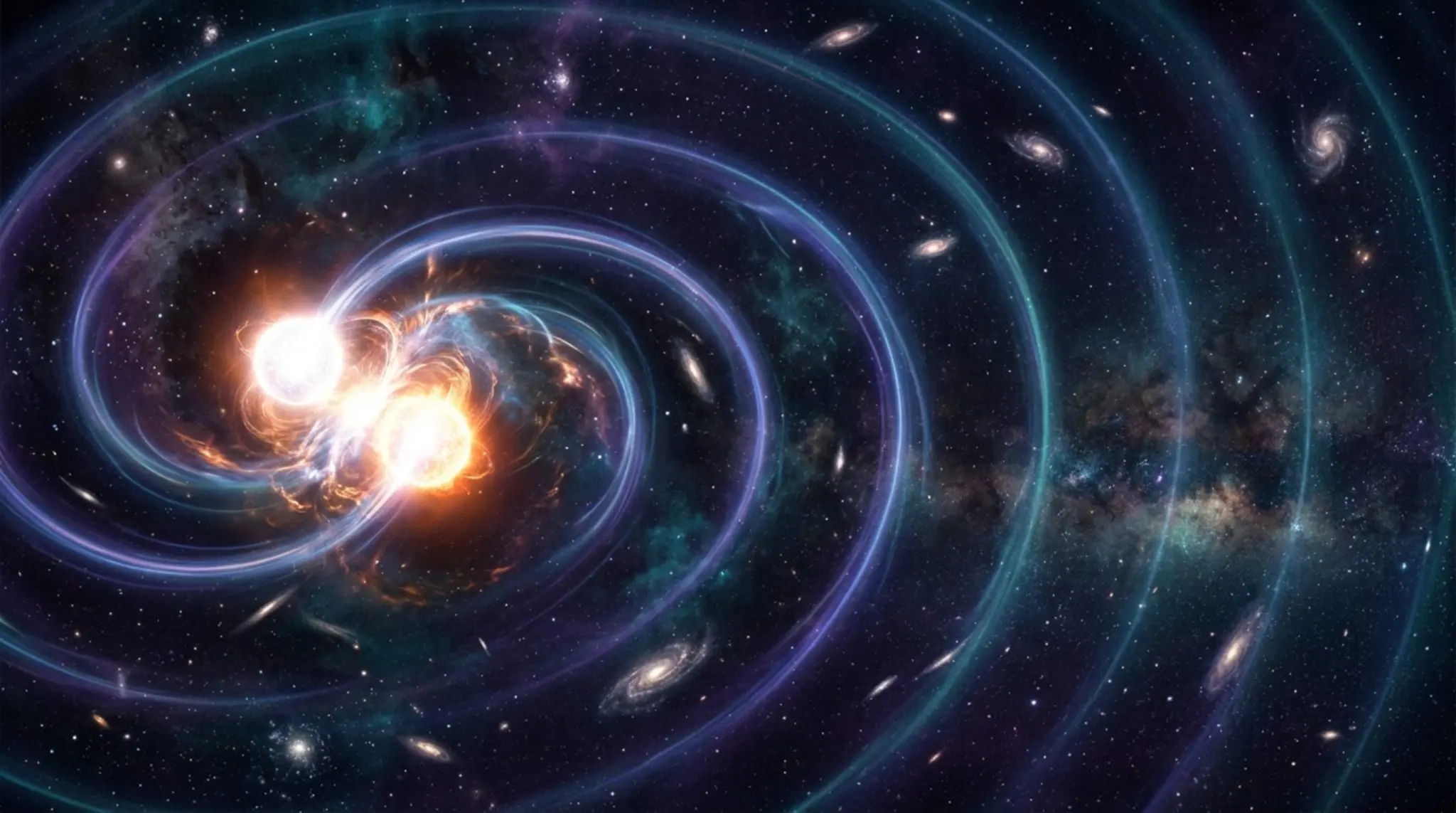
ANU researchers have delivered ultra-precise optical coatings to the Laser Interferometer Gravitational-Wave Observatory (LIGO), enhancing its ability to detect ripples in spacetime. The team spent three years developing and applying these coatings to two specialized beamsplitters, pushing precision optics to levels of uniformity.
“We’re coating this glass to within a nanometre or two across almost half a metre – a few atoms’ difference from one edge to the other,” explains Professor Robert Ward of the ANU Centre for Gravitational Astrophysics. This Australian contribution aims to improve LIGO’s sensitivity, enabling the detection of fainter gravitational waves from cosmic events.
Custom Automation Enables Ultra-Clean Optics Production
Achieving the necessary precision for LIGO’s upgraded beamsplitters demanded entirely new manufacturing techniques, according to Deon Hickey of ANFF OptoFab ACT. The team circumvented limitations in existing equipment by constructing bespoke tools to meet the stringent requirements of coating deposition and measurement. “There aren’t many machines in the world that can meet the requirements, so we had to build our own equipment and find new ways to solve the problems,” Hickey said. The extreme demands of gravitational wave detection necessitate coatings with unparalleled uniformity; Professor Steve Madden explained that “You need exquisite measurement precision, very tightly controlled processes and extreme coating thickness uniformity to build these components.” Each 45-centimetre disc, crafted from exceptionally pure glass and weighing over 20 kilograms, receives a dual coating.
One layer precisely splits a laser beam, while the other, an ultra-low-reflectivity surface, minimizes interference and amplifies the detector’s ability to register faint signals. This level of control extends to maintaining a coating thickness variation of only a few atoms across the entire half-metre surface, a feat previously unattainable. The three-year research and development effort culminated in the delivery of these specialized optics to LIGO, representing a substantial Australian contribution to the international observatory. Professor Madden emphasized the dedication of the team, stating, “We spent three years on very challenging research and development and put our heart and soul into building these optics.” The ANU team is one of only two groups globally capable of producing coatings to this exacting standard, demonstrating their expertise and the advanced facilities at the Australian National Fabrication Facility (ANFF)’s OptoFab ACT Hub. The ultimate goal, according to Professor Madden, is to maximize the scientific return from the upgraded detector, as “We really want to see this Australian contribution produce great results for international science.”
You need exquisite measurement precision, very tightly controlled processes and extreme coating thickness uniformity to build these components.
Professor Robert Ward, Director of the Centre for Gravitational Astrophysics at the ANU
Achieving the necessary uniformity in LIGO’s beamsplitters demanded the development of eight custom automated systems, each dedicated to a specific stage of cleaning, measurement, and handling. These systems were essential to prevent human contact with the delicate components, minimizing contamination and ensuring consistent results across the 45-centimetre discs. This level of control necessitated a new research facility, the ANU Research School of Physics Clean Room, built to the same cleanliness standards as advanced semiconductor manufacturing facilities. The ultra-low-reflectivity coating, more than 1,000 times more effective than a standard spectacle lens coating, further complicated the process.
We spent three years on very challenging research and development and put our heart and soul into building these optics.
Professor Steve Madden, Director of the Australian National Fabrication Facility (ANFF)’s OptoFab ACT Hub, ANU



See today’s quantum computing news on Quantum Zeitgeist for the latest breakthroughs in qubits, hardware, algorithms, and industry deals.