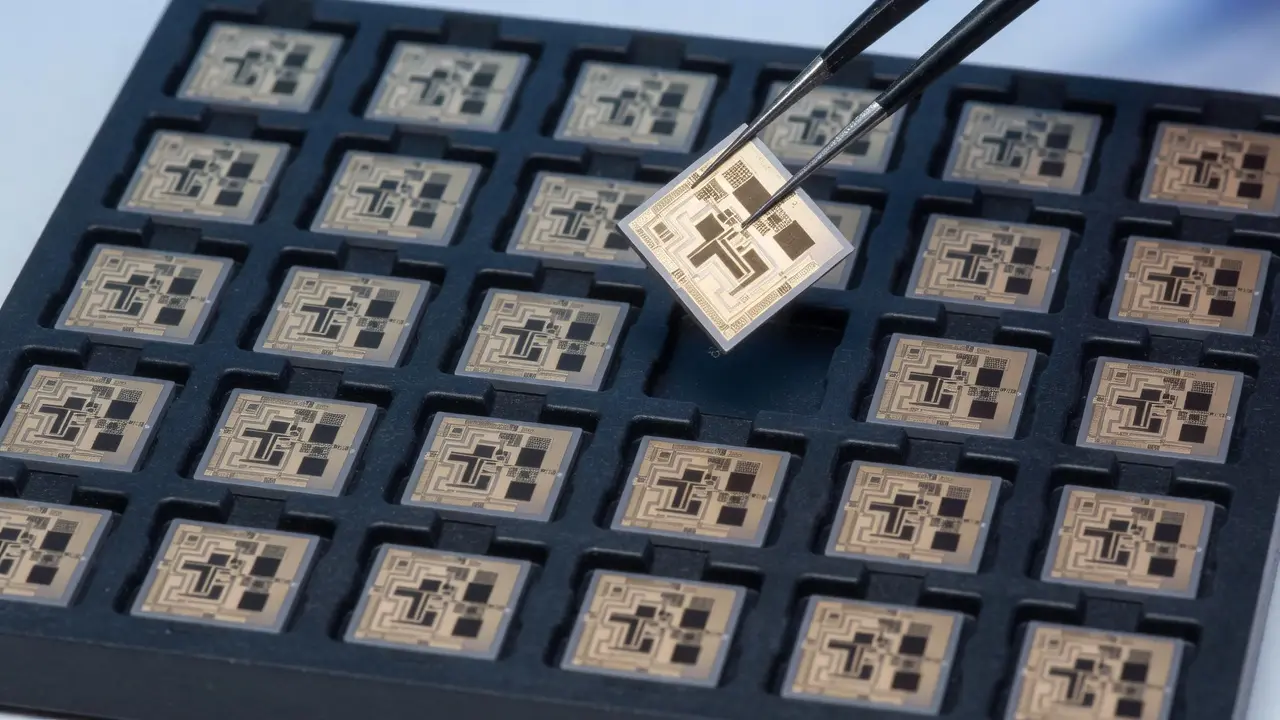
Researchers in China have achieved 99.82% maximum gate fidelity while operating hole spin qubits, a result that significantly improves prospects for scalable quantum information processing. The team demonstrated this high level of control using an in-plane method for manipulating the qubits within a planar germanium quantum dot, minimizing sensitivity to charge noise. This optimization reduces susceptibility and extends the Hahn-echo coherence time fivefold.
Hole Spin Qubit Potential for Scalable Quantum Computing
A gate fidelity of 99.82% has been achieved while operating hole spin qubits in a planar germanium quantum dot, indicating substantial progress toward stable and reliable quantum computation. Researchers demonstrated this level of control by optimizing magnetic-field orientation to minimize susceptibility to charge noise, a common impediment to qubit performance. This optimization directly addresses anisotropic properties inherent in valence band holes, which previously limited qubit coherence and fidelity.
By correlating longitudinal spin-electric susceptibility with qubit coherence and control performance, they identified an operating point where sensitivity to charge noise was minimized. This precise tuning resulted in a fivefold enhancement of the Hahn-echo coherence time, extending the duration qubits can reliably maintain quantum information. The suppression of control infidelity was nearly tenfold, a critical step toward reducing error rates in quantum calculations.
Yu-Chen Zhou, Zhenzhen Kong and colleagues, along with collaborators from Beijing Superstring Academy of Memory Technology, published their results in a recent preprint. Their work demonstrates a figure exceeding the threshold required for fault-tolerant quantum computation. The research builds on the inherent advantages of all-electrical manipulation offered by hole spin qubits, making them promising candidates for scalable quantum computers. The team’s success in reducing spin-electric susceptibility is particularly noteworthy, as it directly addresses a key challenge in maintaining qubit stability.
The authors state that their finding enhances the prospects of hole spin qubits for scalable quantum information processing, suggesting a viable pathway toward building larger and more complex quantum systems. The ability to achieve such high fidelity with a relatively simple in-plane control scheme could also accelerate the development and deployment of practical quantum technologies.
The Laboratory of Quantum Information provided the core research environment, supported by the Anhui Province Key Laboratory of Quantum Network and the Center for Excellence and Synergetic Innovation Center in Quantum Information and Quantum Physics. Additional support came from the Hefei National Laboratory, facilitating the advanced fabrication and characterization of the quantum dot devices. This collaborative effort emphasises the growing momentum behind hole spin qubits as a competitive platform for realizing the promise of quantum computing.
Anisotropic Susceptibility of Germanium Quantum Dots
Valence band holes within germanium quantum dots exhibit properties that vary depending on direction, a characteristic known as anisotropy, and this presents a challenge to building stable qubits. Researchers have now pinpointed an operating point that minimizes the impact of this anisotropy on qubit performance, potentially extending coherence and improving manipulation fidelity. This improvement stems from a detailed understanding of how the qubit’s frequency responds to electric fields, quantified as the longitudinal spin-electric susceptibility.
The team’s experiments revealed that the principal axes of the in-plane g-factors for both qubits were tilted by similar angles, approximately 14 and 12 degrees, suggesting a common origin for the anisotropy. Numerical simulations indicated this anisotropy arises from asymmetric potential and non-circular confinement within the quantum dots, influenced by the barrier and confinement gates used during enhanced latching readout.
This level of control was achieved through the application of three-stage voltage pulses and microwave signals to gates, allowing for qubit initialization, manipulation and readout. The researchers used an enhanced latching readout scheme, previously implemented in other studies, to accurately measure the qubit state. The observed differences in oscillation amplitudes of the g-factor between the two qubits were attributed to unequal squeezing induced by the barrier and confinement gates under these conditions.
The team’s ability to correlate susceptibility with coherence and control provides a roadmap for future qubit designs and operating parameters. According to the research, the origin of g-factor anisotropy comes from the asymmetric potential in the x and y direction and non-circular confinement of the quantum dots.
In-Plane Magnetic Field Optimization for Qubit Control
An optimal operating point for hole spin qubits, minimizing sensitivity to charge noise, has been identified through investigation of anisotropic susceptibility under an in-plane magnetic field. Researchers found that this point extends qubit coherence times and enables high-fidelity qubit manipulations in a planar germanium quantum dot. This approach builds on recent theoretical work and experimental results demonstrating the potential of magnetic field direction and electrostatic confinement tuning to achieve optimal operation.
The relationship between magnetic field orientation, decoherence, and control fidelity was systematically explored by varying the external magnetic field. Results indicate the longest coherence time occurs when the qubit frequency exhibits minimal susceptibility to electric fields, establishing a local sweet spot for manipulation. This correlation provides strong evidence that charge-noise-induced fluctuations of the qubit frequency limit coherence. Effective g-factors for two qubits were extracted using measurements of resonance frequencies, revealing a strong anisotropy in Zeeman splitting.
This anisotropy is not a limitation, however. Rather, it offers the possibility of finding a balance between qubit control and coherence. For qubit Q1, the I-gate infidelities exhibited a non-monotonic dependence on the magnetic field, consistent with the behavior of the longitudinal spin-electric susceptibility. Gate set tomography (GST) was used to systematically characterize the control infidelities of qubits Q1 and Q2 for in-plane magnetic field orientations ranging from -50° to +50° around the optimized angle.
The gate set employed in the GST measurements included X/2, Y/2, and I gates, where X/2 and Y/2 represent rotations by π/2 radians. This saturation suggests that further enhancement of the susceptibility yields diminishing returns for gate fidelity, and that improvements in other qubit coherence properties, such as T2* and V, are necessary. The team’s work demonstrates a path toward optimizing qubit performance through a detailed understanding of the interplay between susceptibility, coherence and control.
Correlation of Spin-Electric Susceptibility with Coherence
The research demonstrates that precise control of magnetic-field orientation is key to mitigating decoherence, a major obstacle in quantum computation. The study quantifies how qubit frequency responds to electric fields, using a metric called longitudinal spin-electric susceptibility (LSES), which directly measures sensitivity to charge noise. Researchers observed a pronounced anisotropy in LSES depending on the magnetic-field orientation, with the lowest susceptibility coinciding with the longest coherence times.
Specifically, the Hahn-echo coherence time for one qubit increased from approximately 500 nanoseconds to 2200 nanoseconds when optimizing the magnetic field, representing a fivefold enhancement. Gate set tomography at this optimized point revealed a maximum gate fidelity of 99.82%, a significant advancement in control precision.
The team’s findings show that the magnetic-field orientation directly impacts the qubit quality factor, which balances coherence and control speed. A minimum in LSES and a corresponding maximum in coherence were observed when the magnetic field was aligned to minimize the qubit’s sensitivity to electric fields. This “sweet spot” represents a local optimum for qubit manipulation, offering a pathway to more stable and reliable quantum operations.
Further analysis revealed that the anisotropy of the qubit’s g-factor, stemming from the mixing of heavy and light hole states due to electrical potential variation, directly influences the LSES. The researchers report, highlighting the importance of minimizing this sensitivity for practical quantum computation. The ability to tune magnetic-field orientation to reduce spin-electric susceptibility offers a promising strategy for improving the performance of hole spin qubits.
By carefully controlling the external magnetic field, researchers can effectively suppress charge-noise-induced decoherence and extend coherence times. The work highlights the importance of understanding the interplay between qubit properties, magnetic field direction and charge noise in the pursuit of scalable quantum information processing.
82% Maximum Gate Fidelity via Gate Set Tomography
Optimizing magnetic-field orientation diminishes spin-electric susceptibility, yielding a fivefold increase in Hahn-echo coherence time and nearly a tenfold reduction in control infidelity for hole spin qubits. The team’s use of gate set tomography, a technique that addresses state preparation and measurement errors, allowed for a more reliable extraction of gate fidelities than conventional quantum process tomography. Unlike randomized benchmarking, this method explicitly models state preparation and measurement, reconstructing the complete error structure of the gate set through maximum-likelihood estimation.
This diagnostic capability simultaneously identifies Hamiltonian miscalibrations and stochastic noise processes, providing a pathway for further qubit control optimization. The observed control infidelities of the I/2, X/2, and Y/2 gates exhibited non-monotonic angular dependence, initially increasing then decreasing with changes in magnetic-field orientation. For qubit Q2, the echo-based quality factor reached its maximum at the optimal operating point, approximately five times larger than in the least favorable configuration.
The distinct confinement potentials of the two quantum dots, coupled with the application of microwave drive to only one gate, likely influenced the markedly different dependencies of qubits Q1 and Q2 on magnetic-field orientation. While simulations align with experimental data, the team acknowledges that noise contributions from certain gates were not included, potentially contributing to residual discrepancies. The findings demonstrate that the maximum gate error for both qubits occurred at magnetic-field orientations corresponding to the shortest coherence times.
Fivefold Coherence Enhancement and Tenfold Infidelity Suppression
This improvement directly addresses a key limitation in scaling quantum computers based on these qubits, which rely on the spin of holes, the absence of electrons, within semiconductor quantum dots. Characterizing qubit quality factor, a metric balancing coherence and control speed, was essential to the study. The technique, used to comprehensively assess the performance of quantum gates, revealed the nearly tenfold suppression of control infidelity at the optimal operating point. The results highlight the strong potential of hole spin qubits in planar germanium structures, offering a viable alternative path toward practical quantum computation.
👉 More information
🗞 In-plane optimal qubit operation with control fidelities exceeding 99%
✍️ Yu-Chen Zhou et al.
🧠 DOI: http://link.aps.org/doi/10.1103/fw9y-ylsv



See today’s quantum computing news on Quantum Zeitgeist for the latest breakthroughs in qubits, hardware, algorithms, and industry deals.