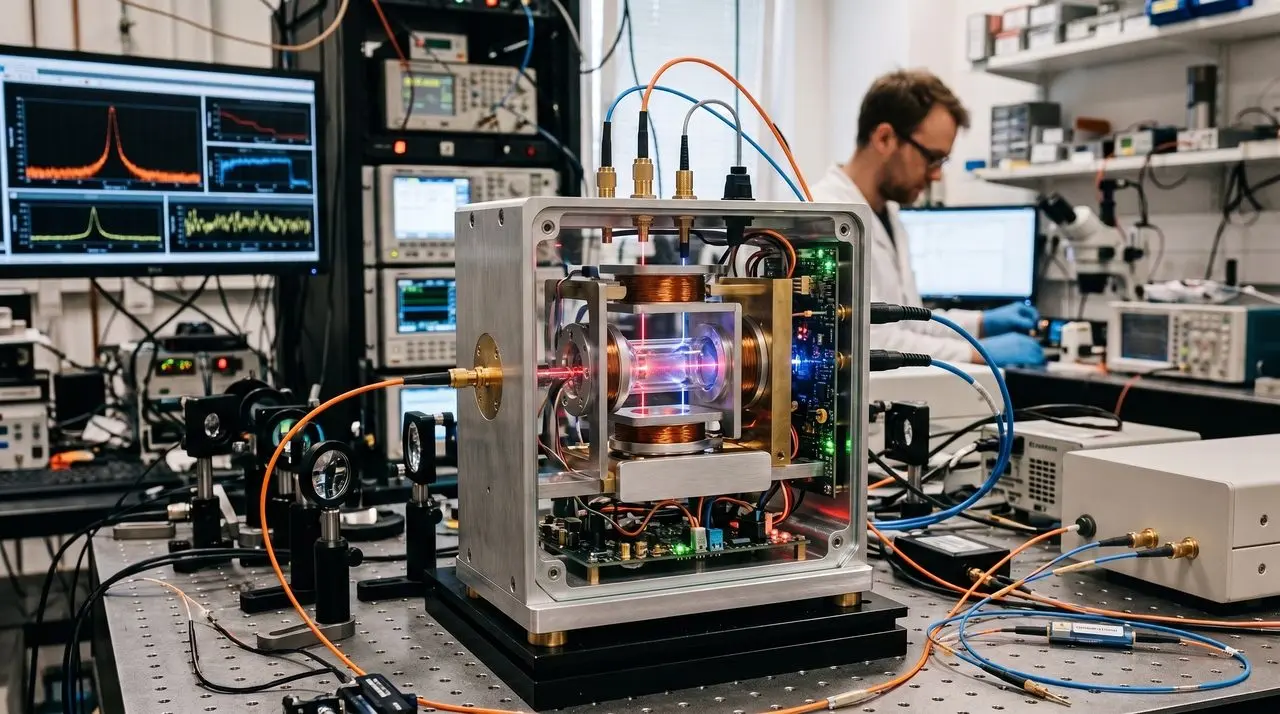
Egor Kovlakov and Rene Gerritsma of the University of Amsterdam have achieved a six to ninefold increase in precision when measuring hyperfine interaction constants in ytterbium-173 (Yb+). The researchers performed laser spectroscopy on a trapped Yb+ ion, cooling it not with lasers, but with a surrounding “bath” of ultracold atoms via spin-exchange collisions. By probing the 6²S_(1/2) → 6²P_(3/2) transition at 329 nm, the team measured magnetic and electric hyperfine interaction constants of A = -241(1) MHz and B = 1460(8) MHz, surpassing the accuracy of previous hollow-cathode discharge experiments.
Ultracold Lithium Atoms Enable Yb+ Spectroscopy
Instead of relying on traditional laser cooling techniques, Egor Kovlakov and Rene Gerritsma coupled the trapped ¹⁷³Yb⁺ ion to a surrounding cloud of ultracold lithium-6 (⁶Li) atoms, a process that continuously cools the ion’s internal degrees of freedom via spin-exchange collisions. This innovative approach allowed for highly accurate spectroscopic analysis, surpassing the precision of previous measurements conducted using hollow-cathode discharge experiments.
The team detected laser excitation of the ¹⁷³Yb⁺ ion through state-selective charge transfer, a method where the ion transfers its charge to a surrounding atom, leading to its subsequent loss from the ion trap. Observing this loss, signaled by a shift in the position of a probe ion (¹⁷⁴Yb⁺), provided a means of quantifying the excitation probability as a function of laser frequency.
The observed resonance linewidth broadened to 79 ± 16 MHz in the presence of the atomic bath, a change potentially attributable to kinetic energy released during atom-ion collisions and collisions occurring during laser interrogation. The use of an ultracold atomic bath to prepare the ground hyperfine level of the spectroscopy ion is particularly advantageous for atomic ions exhibiting dense low-energy fine or hyperfine structures.
This preparation method effectively cools the ion to its hyperfine ground state, enhancing the accuracy of spectroscopic measurements. The researchers validated their technique initially with the ¹⁷¹Yb⁺ isotope before applying it to the ¹⁷³Yb⁺ ion, performing reference spectroscopy both with and without the presence of the ultracold atom cloud.
Prior to these measurements, the ¹⁷¹Yb⁺ ion was Doppler cooled using lasers at 369 nm and 935 nm, bridging the hyperfine splittings of the ²S₁/₂ → ²P₁/₂ transition with resonant electro-optic modulators at 14. 74 GHz and 2. 11 GHz. The work demonstrates the potential for extending this technique to other ions with complex level structures, including molecular ions and anions, provided chemical reactions with the ultracold buffer gas are sufficiently suppressed.
“The technique is particularly interesting for atomic ions with a dense low energy fine- or hyperfine structure as the atoms can effectively prepare these ions in their groundstate,” the researchers note. The setup could be generalized to study the quantum dynamics of ultracold atoms interacting with ion species beyond the commonly used earth alkaline and alkali-like ions.
The team’s success builds on theoretical proposals and earlier experimental work involving trapped and cooled single ¹⁷³Yb⁺ ions, including high-precision spectroscopy of electric quadrupole and octupole transitions. The ability to resolve spin dynamics at the level of individual hyperfine and Zeeman states, achieved through reaching collision energies in the 10 μK regime, positions this method as a valuable tool for precision spectroscopy and the development of atomic clocks.
“We can conclude that the centers of both peaks coincide within the fit uncertainty,” they report, highlighting the consistency and reliability of their measurements. This innovative approach to ion cooling and spectroscopy promises to advance the field of precision measurements and quantum control.
State-Selective Detection via Charge Transfer
The experimental setup involved trapping a single Yb+ ion alongside a cloud of approximately 2 x 6Li atoms. These atoms, cooled to around 5 μK through forced evaporative cooling, were loaded into an optical dipole trap positioned near the ion trap. The researchers then applied a train of 329 nm laser pulses to the Yb+ ion, inducing transitions to the 6²P_(3/2) state.
Spontaneous decay from this excited state into metastable levels subsequently triggered charge transfer collisions with the 6Li atoms, resulting in ion loss, a signal used to detect laser excitation. “The pulse length was chosen such that ≪, where ~ denotes the Langevin collision rate between atoms and ions estimated from the measured atomic density,” the researchers detailed in their work. The use of linearly polarized light, specifically σ+ and σ- polarizations, helped minimize the first-order Zeeman shift, a phenomenon that can distort spectroscopic measurements.
By averaging transitions with opposite magnetic-field dependence, the team effectively eliminated this systematic error. An applied magnetic field of 2. 6 G, generated by low-inductance coils, defined the quantization axis for these transitions. The frequency and shape of the laser pulses were precisely controlled using an acousto-optic modulator in a double-pass configuration, ensuring accurate scanning of the excitation spectrum.
The team’s methodology also included a careful calibration of the 329 nm laser, using a frequency-quadrupled amplified diode laser and an ultra-stable optical cavity. This calibration process achieved an absolute frequency determination with a 10 MHz uncertainty, corresponding to a 20 MHz uncertainty for the quadrupled light. The researchers validated their frequency standard using a 689 nm laser locked to the narrow ^ → ^ transition in 88Sr, ensuring the reliability of their spectroscopic measurements.
The interval of 10 ms between laser pulses was deliberately chosen to allow sufficient time for the Yb+ ion to be cooled back to its ground state via spin-exchange collisions with the 6Li atoms, preventing leakage from the 329 nm excitation cycle. This technique offers a compelling alternative to traditional laser cooling methods, particularly for ions where laser cooling is inefficient or impractical.
Precise Hyperfine Constant Measurement in 173Yb+
Fitting these peaks to a sum of Lorentzian functions allowed for the extraction of the hyperfine structure constants, with the reported uncertainties reflecting fit errors. The team estimates the absolute frequency of the central line in this transition to be 911. 136272(20) THz, using the known lifetime of the 6²P_(3/2) level, reported as 7. 23 ns.
The observed agreement between the new measurements and previous experimental results from a different methodology confirms the validity of the technique, while also highlighting discrepancies with theoretical predictions derived from relativistic coupled-cluster and many-body perturbation theory calculations. Researchers note that the earlier measurements suffered from limited spectral resolution, potentially explaining differences in the measured electric quadrupole hyperfine structure constant, B. The technique’s sensitivity is such that each peak measurement requires approximately six hours, though the team accounted for reference cavity drift, estimated at 4 kHz per day, as insignificant over this timeframe. Variations in atom-ion overlap and 329 nm laser power are acknowledged as potential sources of day-to-day fluctuations in peak amplitudes.
The efficiency of the spin-exchange cooling process is linked to the ratio of the hyperfine splitting in the ground state to the ion mass, and the researchers found that the estimated spin exchange rates were comparable to those observed in combinations of 171Yb+ and 6Li. They determined that a pulse interval exceeding 2 milliseconds was sufficient to allow for adequate cooling, aligning with their calculated Langevin collision rate.
The researchers state. The energy released during spin-exchange collisions is approximately equal to Planck’s constant multiplied by the hyperfine splitting, divided by the ion mass. The team’s methodology also allows for precise determination of the absolute frequency of the transition, and the results are in agreement with prior measurements. The work demonstrates a pathway to higher-precision spectroscopy, pushing the boundaries of our ability to probe the fundamental properties of atomic ions.
Hybrid Ion-Neutral Trap and Cooling Techniques
Neutral buffer gas cooling, a long-established technique in precision spectroscopy and quantum chemistry, finds a unique application in this work through a hybrid approach involving ultracold atoms. While laser cooling typically achieves lower translational energies, this methodology uses a cloud of approximately fermionic ⁶Li atoms, cooled to around 5 μK, to continuously cool the internal degrees of freedom of a trapped 173Yb⁺ ion via spin-exchange collisions.
The experimental setup uses a hybrid ion-neutral trap, employing isotope-selective two-step photoionization to load Yb⁺ ions into a linear Paul trap. A key aspect of the process involves the formation of a two-ion crystal, consisting of a “dark” 173Yb⁺ ion and a 174Yb⁺ ion used for detection. Following evaporative cooling of the ⁶Li atoms in a 1070 nm optical dipole trap, the atomic cloud is positioned below the ion trap, facilitating the spin-exchange interactions.
The team observes the loss of the 173Yb⁺ ion after interaction with the atoms as a function of spectroscopy light frequency, providing a means of detecting successful laser excitation. The use of fermionic ⁶Li atoms, optically pumped into the lowest two magnetic sublevels, is critical for efficient spin-exchange cooling. This ensures a high probability of collisions leading to the transfer of energy from the ion to the atoms, effectively reducing the ion’s internal energy.
173Yb+ as a Candidate for Quantum Technologies
This preparation maximizes the probability of energy transfer from the Yb+ ion to the lithium atoms during collisions, effectively maintaining the ion in its ground state. The methodology employed extends beyond simple cooling; it provides a means of preparing specific quantum states within the ion. This capability is key for applications in optical clocks, qudit-based quantum computing, and probing fundamental physics.
This careful control of the atomic environment allows for the achievement of high-precision spectroscopic measurements, pushing the boundaries of what is possible with trapped ion spectroscopy. The team’s work builds on decades of research combining laser-cooled trapped ions and ultracold atoms, demonstrating buffer gas cooling capabilities rivaling those of laser cooling under carefully controlled parameters.
👉 More information
🗞 Precision spectroscopy of a trapped ion using a bath of ultracold atoms
✍️ Egor Kovlakov and Rene Gerritsma
🧠 DOI: http://link.aps.org/doi/10.1103/fq33-db1l



See today’s quantum computing news on Quantum Zeitgeist for the latest breakthroughs in qubits, hardware, algorithms, and industry deals.